From Discovery to Actionable Intelligence: Deeper Exposure Analytics in Splunk Enterprise Security 8.6
Security Milena Chen , Paul JohnsonKey takeaways
- Get richer information about users, devices, and networks to help investigate security issues faster and make more informed decisions.
- Explore network connections and track changes over time to better understand activity and spot potential security risks.
- Turn discovered data into practical insights that help security teams prioritize work, speed up investigations, and strengthen security.
For modern security operations teams, the primary challenge is rarely a shortage of data, but a lack of actionable context. While identifying an asset or user exists is a necessary first step, security analysts require deeper insights to make informed decisions. Manually figuring out this context is highly time-consuming and often delays critical response efforts.
In Splunk Enterprise Security 8.5, we introduced Exposure Analytics which brought powerful continuous entity discovery, to help organizations automatically discover and map their assets and users. With the release of Enterprise Security 8.6, we are taking this foundation to the next level, by transforming entity discovery data into active intelligence, helping to provide critical context analysts need to accelerate investigations, prioritize exposure, and make high-confidence decisions. These new capabilities are available across all Splunk Enterprise Security editions.
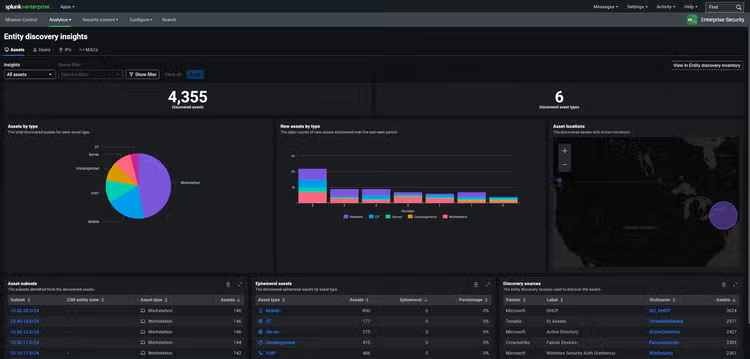
1. Entity Discovery Insights: Intelligence-driven reporting and visibility
To provide deeper, intelligence-driven visibility, we have expanded discovery reporting to unify visual insights, detailed action, and targeted investigation. Entity Discovery Insights offers visual, data-rich dashboards detailing asset trends, operating systems, cloud environments, default accounts, and NHI. To seamlessly transition from insights to action, users can drill directly from these dashboards into Entity Discovery Inventory to view details and perform powerful, targeted searches across discovered entities. From here, analysts can pivot directly to individual entity investigations using the Entity Analysis view.
2. Subnet Discovery: Translating network relationships into actionable context
Context is everything when investigating an unfamiliar IP or subnet.
Accelerate investigations by querying an IP or subnet to view all assets discovered within that same network boundary. This shared context makes it easy to infer the likely function and ownership of unfamiliar assets based on their network neighbors.
Beyond individual investigations, this feature helps organizations audit and strengthen their overall network security posture footprint by revealing active subnets that may be missing from official subnet inventories.
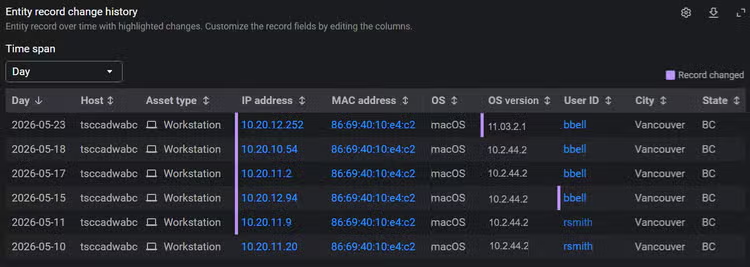
3. Historical Entity Intelligence: Tracking the evolution of entities
Security incidents are rarely isolated events; they are often preceded by subtle environmental changes. The new Entity record change history table within the Entity Analysis view provides a comprehensive timeline of how assets and users evolve over time. By tracking modifications to key fields, such as operating system upgrades or changes in user access, analysts gain the historical attribution necessary to reconstruct timelines, accelerate forensics, and distinguish routine administrative changes from potential threats.
The Bottom Line
Splunk Enterprise Security 8.6 enhances Exposure Analytics by providing deeper, more actionable intelligence on your discovered entity data. Available in all Splunk Enterprise Security editions, these new features turn continuous discovery into active insights, empowering your security team to streamline workflows, accelerate decisions, and proactively defend your environment.
Related Articles

The Insider Threat That Doesn’t Sleep
PowerShell Detections — Threat Research Release, August 2021
