Building the Foundation for Agentic-AI: Introducing Exposure Analytics in Splunk Enterprise Security
Security Milena ChenKey takeaways
- Many security teams rely on outdated data and manual processes, making it harder to spot risks, investigate alerts, and focus on the threats that matter most.
- Splunk Exposure Analytics creates a real-time, self-updating view of users, devices, and assets so teams can better understand and secure their environment.
- With faster investigations, fewer false alarms, and stronger visibility, organizations can move from reacting to problems toward preventing them.
In the rapidly evolving landscape of the "Agentic AI era," threats are moving and evolving at machine speed and many SecOps teams are still tethered to manual processes, stale data, and a persistent visibility gap.
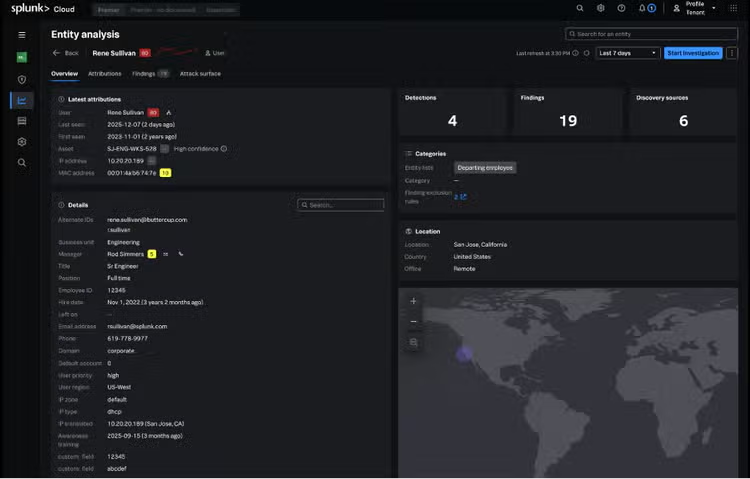
As we announced during RSAC 2026, Exposure Analytics is available as a new capability within Splunk Enterprise Security (ES Essentials and ES Premier). Exposure analytics enables Security Engineers and SOC analysts to continuously discover, enrich, and analyze entities—including assets and users—that comprise the attack surface. By delivering near real-time foundational information, it shifts the focus from searching to active investigation and resolution.
Why Are We Doing This? Stale Data and Prioritization Paralysis
Modern security teams face three critical hurdles that slow down response and increase risk:
- The Visibility Gap: Traditional CMDBs and static lookups are often outdated the moment they are created. This leaves "shadow" or unmanaged entities hidden, creating perfect entry points for attackers.
- Lengthy Investigations: According to the State of Security 2025 report, 57% of analysts waste time during investigations due to gaps in data management. Without adequate context and the ability to identify the "who, what, and when," analysts are forced into a reactive "research mode" that delays response.
- Prioritization Paralysis: Without accurate entity records, teams suffer from alert fatigue, making it nearly impossible to focus on high-impact business risks.
The Solution: A "Security Truth Layer"
Exposure Analytics solves these challenges by leveraging the data already flowing into your Splunk environment. It acts as a continuous, self-updating inventory that bridges the gap between static IT records and the dynamic reality of your attack surface.
By autonomously maintaining an entity inventory that never goes stale, Exposure Analytics provides a single source of truth for security, IT, and compliance teams—at no additional cost for the data you are already indexing.
Key Features & Signature Capabilities
- Continuous Entity Discovery: Automatically builds and maintains accurate inventories of workstations, servers, cloud assets, and IoT devices by analyzing existing security events.
- Entity Attribution: Allows analysts to accurately attribute user and assets to findings and detections, identify unusual activity and gain visibility into how an entity’s state has evolved.
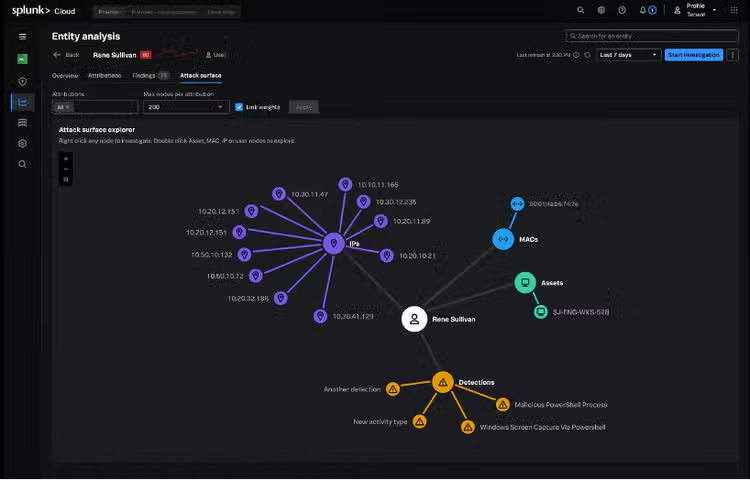
- Attack Surface Explorer: A visual tool to discover evolving entity-driven connections and relationships, helping you see how users and devices interact across your environment.
- Advanced Entity Filtering: Enables teams to isolate specific assets or identities instantly, streamlining collaboration between security engineering and SOC analysts.
Optimizing TDIR: From Detection to Response
Exposure Analytics isn't just about visibility; it’s about supercharging your Threat Detection, Investigation, and Response (TDIR) workflows:
- Faster Detection: By feeding behavioral models a continuous stream of accurate data, you reduce false positives and move from detecting "noise" to identifying "intent."
- Accelerated Investigations: Close the identification gap with instant attribution. Analysts no longer need to switch between tabs or manually map IP addresses to users; the "Who, What, and When" is embedded directly into the ES workflow.
- Proactive Response: Shift from reactive firefighting to proactive hardening. Identify security control gaps and unmanaged assets before they can be exploited.
- AI-Readiness: By establishing a high-fidelity foundation of clean entity and risk data, Exposure Analytics prepares your SOC for the next generation of AI-driven automated responses.
Strengthen Your Posture Today
Exposure Analytics transforms Splunk Enterprise Security into a proactive powerhouse. By eliminating manual data entry and providing a real-time map of your environment, we are helping security teams reduce analyst fatigue, minimize risk, and build true resilience.
Ready to see what’s hidden in your environment? Explore Exposure Analytics in Splunk Enterprise Security today and start shifting your strategy from reactive to proactive.
Related Articles

Building At-Scale User Behavior Analytics for Splunk UBA: Enhance Performance of Account & Device Exfiltration Models

CI/CD Detection Engineering: Dockerizing for Scale, Part 4