From Data Chaos to Clarity: The Complete Guide to Splunk Data Management
Platform Kimberly KungKey takeaways
- As data grows rapidly, organizations need smarter data management to decide what data to keep, protect, and use so it actually delivers value.
- Splunk helps turn scattered data into useful insights by collecting, filtering, organizing, and storing it efficiently across systems.
- With tools like Cisco Data Fabric and AI-powered automation, companies can connect all their data, reduce costs, and make faster, more informed decisions.
Machine data is growing faster than most enterprises can govern, optimize, or activate it—with data volume projected to reach 394 zettabytes by 2028. That is the real data management challenge today. It’s not just about getting data in; it’s about deciding what to collect, where to process it, how to govern it, how long to keep it, and how to make it useful for security, observability, operations, and AI.
That is why data management maturity matters.
Organizations with mature data management practices don’t just ingest more data. They create a trusted, cost-efficient, AI-ready data foundation. They reduce noise before it becomes cost. They protect sensitive information before it spreads. They route the right data to the right destinations. And they give teams faster access to the context they need to detect threats, resolve incidents, and drive better decisions.
This is where Splunk Data Management stands out: as an intelligent data pipeline that helps turn machine data chaos into clarity.
The End-to-End Journey: From Raw Data to Strategic Intelligence
An end-to-end data management strategy has to support the full machine data lifecycle across cloud, on-premise, hybrid, and edge environments. In practice, that journey looks like this:
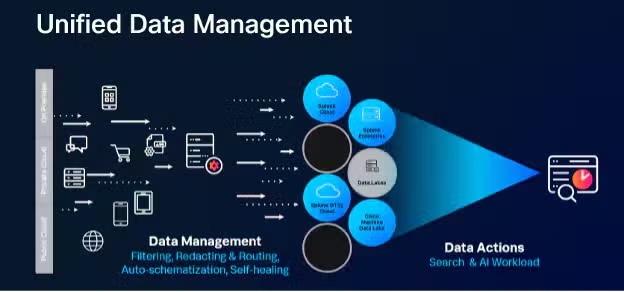
Collect: Getting Data in from Anywhere
Every data management journey starts with acquisition. You need to get the right data from the right sources into the right platform: reliably and at scale. Here are some of the most common inputs in Splunk:
Forwarders: The Universal Forwarder is the lightweight workhorse of data collection. Lightweight, reliable, and deployed on tens of thousands of endpoints across global enterprises, it collects data from files, directories, Windows Event Logs, syslog, and more, then streams it securely to your Splunk environment. For use cases that require pre-processing or routing logic at the source, the Heavy Forwarder provides full SPL-based parsing and filtering before data ever leaves your network.
Agent Management: Deploying forwarders is one thing; managing thousands of them across a global enterprise is another. Splunk’s Agent Management and Deployment Server let you group forwarders by role, region, or business unit, push configs, apps, and TAs from one place, and monitor installed configs and agent health across your fleet.
This matters because without centralized governance, configuration drift leads to inconsistent parsing, missed data sources, and downstream data quality issues. Agent Management keeps forwarders aligned and your collection layer reliable.
Data Manager: For cloud-native sources, Data Manager simplifies onboarding from AWS, Azure, and Google Cloud. It automates ingestion setup through HEC, helping teams bring in services like CloudTrail, Azure Activity Logs, and GCP audit logs much faster.
HTTP Event Collector (HEC): provides a high-performance, token-based endpoint for sending data directly over HTTP/HTTPS. It’s ideal for application developers, CI/CD pipelines, IoT devices, and any source that can make an HTTP call.
Splunk Stream and DB Connect: Splunk Stream captures and indexes live network data, while DB Connect bridges the gap between Splunk and your SQL databases, enabling bidirectional data flow for richer analytics.
Modinputs? SCDM?
Process: Intelligent Transformation Before It Hits the Index
Smart data management starts before storage. Splunk’s processing layer helps teams optimize cost, filter noise, transform verbose logs into efficient formats, mask sensitive fields like credit card numbers or PII, enrich important signals, and route data to the right destination before it is indexed.
The result is lower ingest cost, better performance, and stronger data compliance.
Edge Processor: Available for both Splunk Cloud Platform and Splunk Enterprise, EP lets customers build and manage SPL2-powered pipelines at the edge of your network to filter out noisy, low-value events before they consume bandwidth. It’s a data management console where you develop, deploy, and monitor pipelines from a central location—giving your team visibility and control over data in motion.
Why it matters: Customers using Edge Processor can routinely reduce ingest volumes by 30-50% without losing analytical value. That’s a direct hit to your infrastructure costs and a direct boost to search performance.
Ingest Processor: This cloud-based option applies the same processing model after data arrives in Splunk Cloud Platform but before it is indexed. It is a strong fit for teams that want filtering, masking, enrichment, and routing in the cloud without managing the deployment.
Store: The Right Data in the Right Place at the Right Cost
Once data is processed, it needs to land somewhere. But not all data is created equal, and not all storage is priced the same. Mature organizations tier their data strategy based on access patterns, retention goals, and cost.
Splunk Indexes: For operational data that requires fast, interactive search, Splunk indexes remain the gold standard. They deliver real-time performance for use cases like threat investigation and incident response.
Promote: Need to investigate historical data in Amazon S3 without indexing it permanently? Promote brings S3 data into Splunk Cloud Platform on demand, so you can index only what you need, when you need it.
Federated Search – Alpha: Sometimes the best approach is not moving data at all. Federated Search lets you search data in Amazon S3 directly, without the cost of centralizing it. Correlate data at massive scale, run cross-platform analytics, and keep your storage costs predictable.
Machine Data Lake – Alpha: Alongside Dynamic Data Active Archive (DDAA) and Dynamic Data Self-Storage (DDSS), Machine Data Lake (Alpha) provides a secure, low-overhead framework to ingest, enrich, and operationalize machine data, unlocking operational insights and powering the next wave of enterprise AI.
Observe & Optimize: Keeping Your Pipelines Healthy
You’ve built your collection tier, deployed intelligent processing, and tiered your storage. But how do you know it’s all working? Data pipelines are living systems—sources change, volumes spike, configurations drift.
Ingest Monitoring: Provides out-of-the-box dashboards built directly into the Splunk Cloud Monitoring Console, giving admins real-time visibility into the health and performance of their entire ingestion landscape—without custom dashboards or third-party apps.
Track event counts, volume, and latency across every data source. Slice and dice metrics by index, host, source type, or any combination for granular visibility. Compare current ingestion patterns against historical baselines to instantly spot spikes, drops, or anomalies. Notice a sudden volume change? Click “Investigate” to drill into metrics like last event time and last index time, filtering down to specific hosts in seconds.
From Monitoring to Self-Healing Observability is the first step. The next is automated response. As Splunk’s data management capabilities evolve, the vision is clear: pipelines that don’t just alert you to problems but actively remediate them. Detect a misconfigured source type that’s generating parsing errors? Flag it for auto-correction. Spot a volume spike that’s about to blow through a budget threshold? Dynamically adjust routing to a lower-cost tier. This self-healing pipeline model—where monitoring feeds directly into intelligent, automated action—is a core part of where Splunk data management is headed, and it’s already taking shape through the AI-powered capabilities we’ll cover next.
The Cisco Data Fabric: The Bigger Picture
Everything we’ve described so far, collection, processing, storage, governance, comes together under the Cisco Data Fabric architecture.
The Cisco Data Fabric is not a single product. It’s the unifying architecture that connects Splunk’s data management with Cisco’s network infrastructure, external data lakes, warehouses, and AI platforms. It’s purpose-built for a world where machine data needs to be governed, connected, and activated at enterprise scale.
What does this mean for you in practice?
- Unified analytics through next-gen federation: Correlate data across Splunk, S3, now and more data lakes in the future, without moving it all to one place.
- AI-first experiences: Built-in AI models, the Splunk MCP Server for secure agent-to-data connectivity, and AI-powered data management capabilities—Automated Field Extraction (Controlled Availability), Guided Onboarding with Auto-Schematization (Alpha)—that collapse weeks of manual work into minutes.
- Operational efficiency: Ingest monitoring, and intelligent automation that reduce admin burden, surface issues before they become incidents, and accelerate time-to-value.
- Machine data activation: The Machine Data Lake transforms raw telemetry into trusted inputs for LLM fine-tuning and autonomous agents, enriched with the deep context that makes AI models effective and accurate.
The Cisco Data Fabric is your launchpad for the agentic AI era. It turns Splunk from a search and analytics platform into an intelligent data fabric that spans your entire machine data estate.
The Bottom Line
Data management isn’t a checkbox. It’s the foundation that determines whether your security operations catch the threat, your observability platform surfaces the root cause, and your AI agents deliver accurate, trustworthy results.
Splunk has been building this foundation for nearly two decades, and the portfolio has never been more comprehensive. From universal forwarders managed at fleet scale to the Machine Data Lake powering agentic AI, from Edge Processor filtering at the source to AI-powered auto-schematization that collapses weeks into minutes—this is the end-to-end intelligent data pipeline.
And with the Cisco Data Fabric tying it all together, your machine data isn’t just managed. It’s activated.
Ready to see what your data can do? Explore the full Splunk Data Management documentation, learn about the Cisco Data Fabric, or dive into the latest innovations announced at Cisco Live.
Related Articles

Predicting Cyber Fraud Through Real-World Events: Insights from Domain Registration Trends

Securing DevSecOps - Threat Research Release October 2021