Esports Racing Analytics, Powered By Splunk
I love Data. Insights a good data-set can provide about even mundane subjects can be amazing! I also don’t have a driver’s license, in fact, if I were on the road regularly, everyone’s insurance premiums would rise. So when I heard that Logitech and McLaren had teamed up to produce the Logitech McLaren G Challenge and that Splunk was invited to provide race analytics, I realised that this was an opportunity to do something incredible, with an incredible data set, and hopefully learn something about this whole driving thing in the process…
In this post, I’ll introduce you to the Logitech McLaren G Challenge and walk you through how we instrumented racing simulators and leveraged Splunk Enterprise to provide high fidelity insights into both the drivers and the tracks they’re racing on.
LMGC
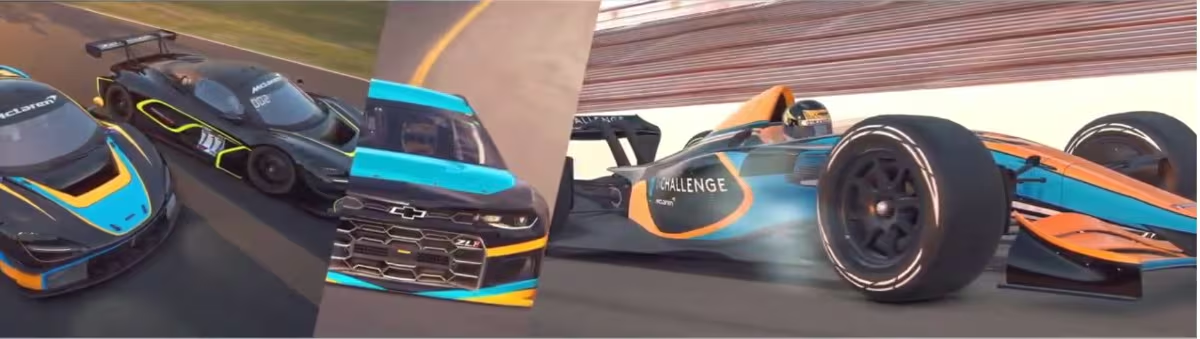
The Logitech McLaren G Challenge is a premier sim-racing esports event inviting thousands of sim-racing enthusiasts around the globe to compete for dominance in Sports Car on Assetto Corsa Competizione and Open Wheel and Stock Car on iRacing.com. The challenge spanned six-monthly regional challenges for each category, with racers competing for one of ten spots in the Grand Finals. The Grand Finals live broadcasts saw more than one million views and Splunk was pleased to partner with Logitech and McLaren to be the official partner for data-driven insights!
Getting Analytical

Getting The Data In… Fast!
Interpreting All This Data…
OK, so we now know where every car is, and what they’re doing every 100ms, but is that section a corner? A straight? What sector is the car in? Was there an accident… Or an overtake? Luckily Splunk can interpret streams of data and understand changes that show events taking place, and enrich data with contextual information… Like whether a section of track is a straight or a corner.
Drive Slowly, And Hold Up Traffic? I Can Do That!
The grand final took place on 4 circuits: The Hockenheimring, and Red Bull Ring for the open-wheel challenge, and The Indianapolis and Daytona Speedways for the NASCAR challenge. To really understand the tracks we set up our own iRacing rigs to stream data into Splunk, and carefully, responsibly, and above all else, slowly, drove around each track streaming data into Splunk stopping at the entry, apex and exit points for each corner. This gave us wherein each track the corners are and allowed us to enrich the streaming data with which corners a car is navigating using a handy lookup file!!!
Cough… Infer Events From Metrics!?
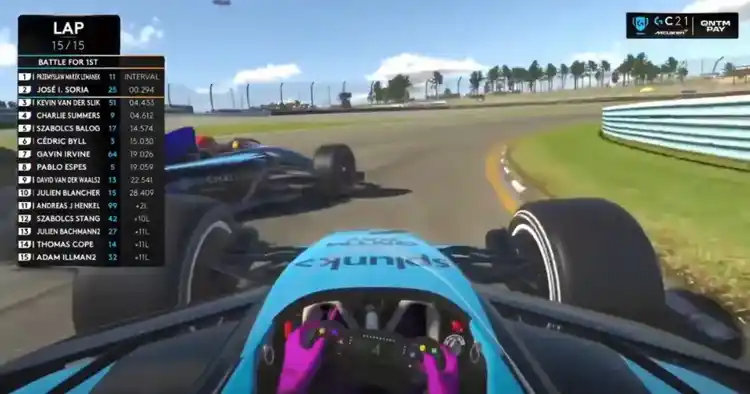
Well, we know where a car is. We know if it’s in a corner, and if so which corner it’s on. We also know its position, incident count and a plethora of other metrics. What we want to know is where and when these change. With the power of SPL, we’re able to compare metrics within sections of time series data with their neighbours. Using this we can see if a car’s position has suddenly decreased, or if its incident count has increased. Suddenly we can see where and when, and on which corners overtakes and accidents occur!
I Feel A Draft (But Don’t Smell A Wumpus…)
Rubbing Is Racing, Or So We’re Told…
Bringing It All Together
We’ve pulled data from iRacing at high speed and fidelity. We’ve enriched the data stream with critical track information, and identified important events that occurred during a race. All that was left was to bring the data together in a broadcast friendly format. The Splunk Dashboard studio is purpose-built to make data presentation easy, readable and attractive at the same time.
Open Wheel Grand Final
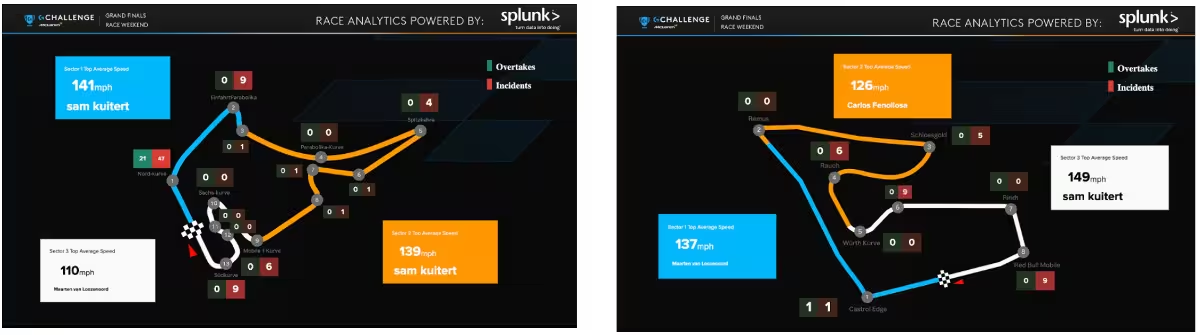
Looking at where incidents and overtakes have occurred in the track we also uncovered an interesting anomaly in the Hockenheimring. The first corner shows a high count for both incidents and overtakes. This stood out as unusual, but when we looked back on the race data, this corner was placed just after the start line, and the majority of the overtakes and incidents were caused by drivers bumping and grinding past each other around this corner as they slowly started to separate along the track.
NASCAR Grand Final
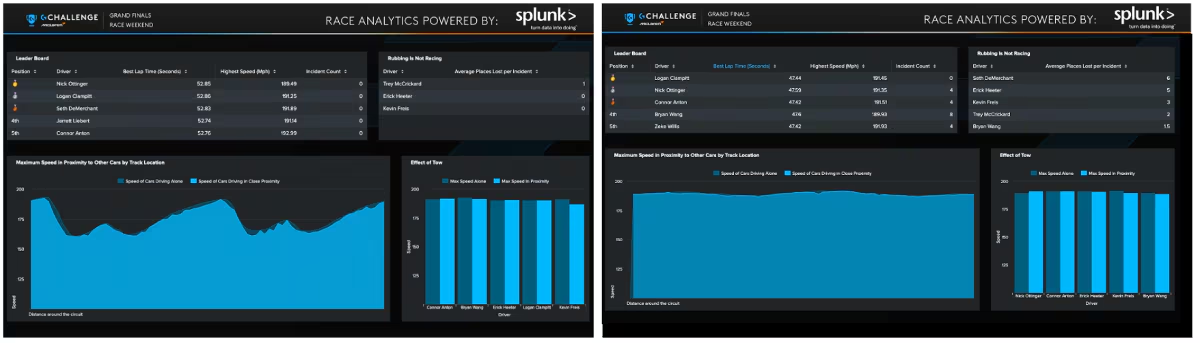
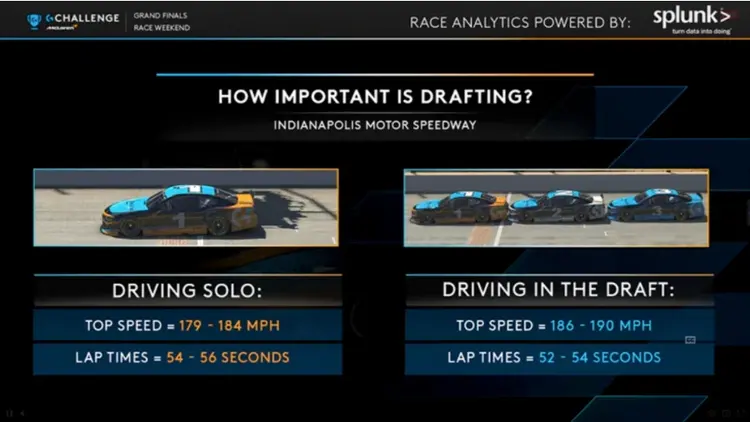
The NASCAR grand finals were held on very different tracks. As a non-driver, I would have thought the Indianapolis Speedway, a flat circuit with no banking on the corners, would have had numerous incidents, however, the opposite turned out to be true! The Indianapolis course only had three drivers that were involved in any incidents, and while some drivers were able to use the draft effect to their advantage, the final winners neither drove in close proximity nor had accidents suggesting that the crux to this track was successfully navigating its flat corners. Within the Daytona track, with fast well banked turns, we can see where rubbing carries risks with up to 6 places lost per incident, and at the same time we observe how driving in close proximity shows clear speed advantages for some of the leading drivers, particularly Nick Ottinger.
Please take some time to check out our race highlights here:
And if you’d like to watch replays of the grand final races, they’re available at https://www.youtube.com/c/LogitechG.
Where To Next!?
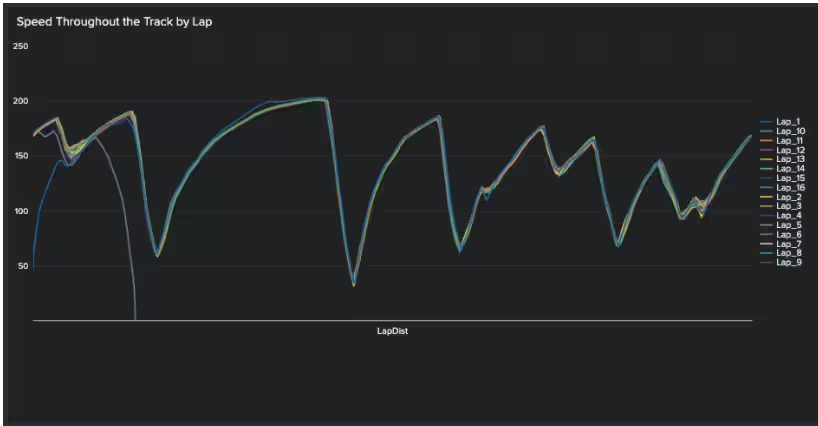
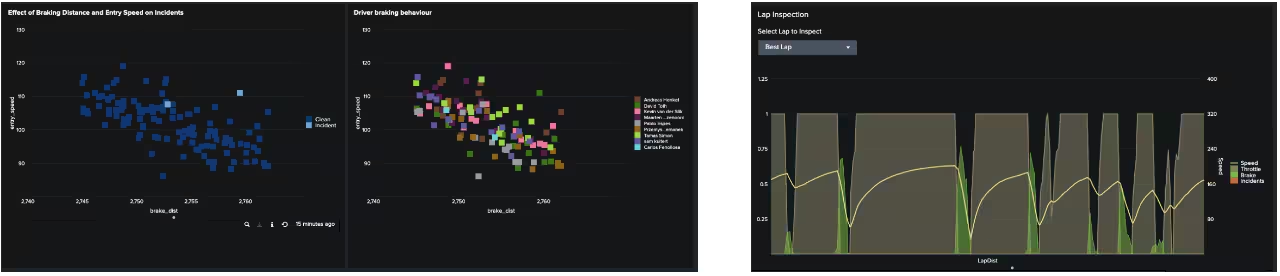
As a final note… Did I learn anything, and will I finally get my license? The short answer is yes, and maybe. I’d be the first to admit that most of what I learned during this experience is more likely to help me lose a license than gain one, but it has motivated me to get started again!
Thanks To The Logitech And McLaren Teams!
The whole journey from core concepts through to analytics and presentation during the Grand Final weekend was an epic experience. I would like to extend my sincere thanks to both the Logitech and McLaren teams for inviting us to be involved. I can’t wait for next year’s event, and to see how deep into the data we can go!
Related Articles

Unlocking New Possibilities: Splunk and AWS Better Together
Executive Q&A: Accelerating AI Success with Splunk and AWS

Accelerate Operations with AI: New Splunk and AWS Integrations

Introducing Splunk Victoria Experience on Google Cloud: Faster, Clearer, More Resilient
Splunk Cloud Platform: Accelerating Digital Resilience for the Agentic AI Era in Kingdom of Saudi Arabia with Google Cloud

How Splunk and Dataminr Work Together to Help Accelerate Resilience

Splunk Named 2025 Americas Partner of the Year Finalist by Microsoft

Managed Enterprise Platform: Delivering Mission-Critical Observability with Splunk
