Building a Resilience Ecosystem: Data Sovereignty and Compliance in the AI Era
The AI era arrived with breathtaking speed. Across Asia, enterprises are innovating at a pace the world has rarely seen. But with that growth comes a hard reality: the digital future will only be as strong as the resilience of the ecosystem we build around it.
Recent findings from the State of Observability 2025 Report reflect this tension clearly: organizations want to scale AI rapidly, but are increasingly constrained by compliance expectations, data governance requirements, and the operational burden that comes with constant change.
Resilience as the New Currency of Trust
The stakes are clear. Our finding shows that 66% of organizations suffered a data breach in the past year, with nearly half admitted to regulatory compliance violations—a stark reminder of how difficult it is to keep up with shifting mandates. Meanwhile, 69% of IT leaders cite compliance as their top data management challenge, with 67% struggling to manage relentless data growth.
This combination of rapid innovation, fragmented tools, and mounting compliance pressures is creating a resilience gap. Today, resilience is no longer just about disaster recovery or uptime. It is about sustaining customer trust, protecting brand equity, and meeting national digital infrastructure standards.
In short: resilience has become the new currency of trust in the AI economy.
Local Infrastructure, Global Confidence
Data quality is emerging as one of the biggest obstacles to AI readiness. In fact, our report highlights that inconsistent, incomplete or noisy telemetry undermines AI’s ability to support automation, root-cause analysis, and strategic decision-making. By delivering consistent, high-fidelity telemetry locally, Splunk Observability Cloud on AWS in Singapore gives teams the trusted data foundation required to scale AI confidently.
At one level, it’s a technical milestone—empowering DevOps, IT, and engineering teams with real-time, unsampled insights across applications, services, and infrastructure. On the other, it’s about meeting sovereignty and compliance obligations.
By hosting observability capabilities locally, organizations in Singapore can align with the requirements of its Digital Infrastructure Act, which sets new resilience and reporting standards for data centers, cloud providers, and critical digital services. Businesses can keep sensitive data in-country while ensuring continuity for essential sectors like banking, healthcare, and transportation.
Making this option for control available to organizations in Singapore reinforces Splunk’s long-standing partnership with AWS—a shared commitment to helping organizations accelerate innovation securely and responsibly. As sovereign tech and sovereign AI increasingly dominates boardroom and policy discussions, local hosting provides enterprises with the certainty they need. They can innovate with AI at ultra-low latency while knowing their observability, compliance, and sovereignty obligations are being met.
But resilience depends not only on where data lives, but also on how teams work with it.
From Fragmentation to Federation
A key finding from the State of Observability report is the mounting urgency to overcome tool fragmentation—one of the biggest operational stressors for teams across Asia-Pacific. In Singapore alone, 65% say tool sprawl impacts morale, a trend mirrored in Japan, alongside rising alert fatigue and AI monitoring complexity. Meanwhile, in New Zealand, 52% say they spend too much time on alerts, underscoring that fragmentation is no longer a local issue but a regional barrier to resilience.
Fragmentation not only slows detection and response, it makes compliance reporting unnecessarily complex. This is where federated access to data becomes critical. Rather than consolidating all data into a single system, federation allows organizations to securely access and analyze distributed datasets without physically moving them.
For example, with Splunk federated search on AWS, organizations get the best of both worlds: local control over sensitive workloads and global-scale visibility for faster investigation, monitoring, and response—without the need to centralise data.
This approach is particularly relevant in Asia’s fragmented regulatory environment. Federation enables businesses to meet market specific requirements in each market while still gaining global-scale insights, and turning compliance from a constraint into a catalyst for resilience.This operational strength translates directly into measurable business impact.
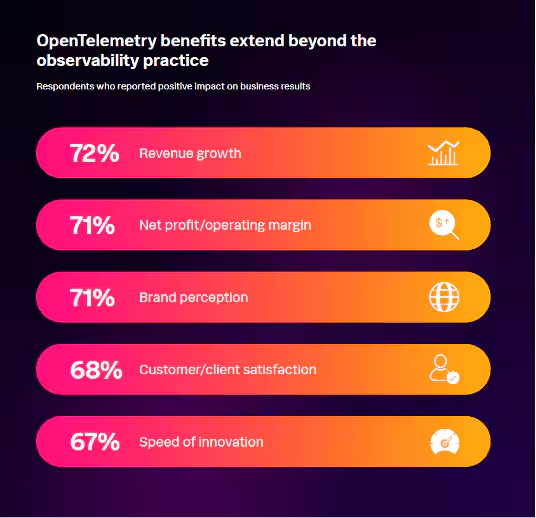
A more resilient digital foundation is already showing measurable business value—our findings show that 72% of organizations using OpenTelemetry report positive impacts on revenue growth, underscoring how modern observability foundations fuel business performance.
Towards a Resilience Ecosystem
With Splunk Observability Cloud on AWS, enterprises in Singapore can build this capability on sovereign, high-fidelity telemetry and federated access models—ensuring compliance while unlocking the performance gains needed to scale AI confidently. Together, these elements form the backbone of a resilience ecosystem.
Across the region, progressive government policies, industry appetite for AI-powered observability, and partnerships that balance innovation with compliance are beginning to align. The imperative is clear: resilience must be designed into the foundations of our digital infrastructure, not bolted on as an afterthought. Organizations that make this shift today will set the benchmark for trust, continuity, and innovation in the AI era.
Related Articles

Predicting Cyber Fraud Through Real-World Events: Insights from Domain Registration Trends

When Your Fraud Detection Tool Doubles as a Wellness Check: The Unexpected Intersection of Security and HR