Ahead of the Curve: How Recent M&A Forecasts New Observability Trends for 2026
Observability Patrick LinKey takeaways
- Recent tech acquisitions show that companies are moving away from many separate tools toward single, all-in-one platforms to make monitoring systems easier.
- AI-powered platforms help teams spot problems faster, understand what matters most to the business, and fix issues with less manual effort.
- By bringing data together in one place, solutions like Splunk and Cisco help organizations reduce complexity and make smarter decisions.
If you’ve followed tech headlines lately, you’ve seen the observability market consolidating at breakneck speed. In late 2025 and early 2026, Palo Alto Networks acquired Chronosphere, LogicMonitor bought Catchpoint, and Snowflake announced plans to acquire Observe Inc.
To some, these look like convenient grabs for point products that never made it big. But for those of us who’ve achieved broad market adoption, it proves something we’ve known for years: platforms win.
From Tools to Unified Platforms
This shift to platforms isn’t new, but it’s accelerating. We’re witnessing a second wave of consolidation after a few quiet years.
Splunk and Cisco have been committed to the platform approach for some time. Acquisitions like AppDynamics, ThousandEyes, SignalFx, and Omnition all aimed to end the days of engineers toggling between endless dashboards just to pinpoint one root cause. These investments made Splunk a leading observability platform.
Recent M&A moves from vendors echo a strategy we’ve been refining for years. While others are just now piecing together integrated platforms, we’re perfecting a unified, scalable experience that filters noise and lets teams focus on what matters.
Consolidation and Agentic Observability
AI is transforming how we work—not just summarizing logs but automating workflows and reducing manual toil. In the process, it’s dramatically accelerating mean time to identify (MTTI) and mean time to resolve (MTTR). But an AI agent is only as good as the data it can access. If your data is limited to a single domain, the quality of your AI insights will be limited, too.
Splunk has AI embedded across the incident response workflow that benefits from a breadth of data sources and KPIs. Our Splunk AI Assistant helps engineers quickly find, troubleshoot, and fix issues by analyzing metrics, logs and traces, generating code, and providing step-by-step guidance.
We recently launched an AI Troubleshooting Agent that detects, diagnoses, and remediates problems, like having an expert engineer by your side. From generative AI assistants for natural language queries to AI agents for detection and remediation, Splunk is helping to lead the way.
As part of Cisco, we’re investing in large-scale AI initiatives like AI Canvas and observability for AI Pods. Cisco AI Canvas is a collaborative AI workspace that unifies real-time data, insights, and team collaboration, built for Cisco's “AgenticOps” approach. When AI Canvas is released, it will correlate data from Splunk, ThousandEyes, and more, rapidly finding root causes and solutions in a shared, visual environment.
Cisco AI PODs are pre-validated, full-stack solutions for enterprise AI. They combine Cisco compute, high-speed networking, powerful GPUs, and integrated software, making AI deployments fast and simple so teams can focus on innovation.
Splunk Observability Cloud monitors the performance, quality and cost of AI Agents, LLMs and the specialized infrastructure they run on, including—but not limited to—Cisco AI PODs. Observability for AI is crucial to ensure the reliability, safety, and performance of new, mission-critical AI applications.
No surprise others want in on this growth.
The Demand for Integrated Security and Observability
Customers don’t want a patchwork of siloed tools. They want a platform that correlates signals—including business KPIs—across the organization.
Integrated platforms:
- Save money on implementation and maintenance
- Reduce the learning curve with a unified interface
- Deliver deeper business context for sharper focus
- Enable more accurate root cause analysis for complex problems
Many vendors are snapping up smaller ones to build multi-domain telemetry, but Splunk stands out as the only unified security and observability platform. By bridging these domains, companies break down silos and improve detection and response.
Pure play security vendors can buy their way into the observability market, but that leaves them with two wholly separate platforms—something that gets in the way of real-time threat detection and cross-domain insights.
Data Consolidation Fuels AI Growth
AI is changing observability, but for trustworthy and accurate AI, you need access to lots of data. AI demands large-scale, cost-controlled infrastructure and new types of telemetry to monitor model drift, bias, and risk.
Enterprises need a unified platform for multi-domain telemetry—security, observability, and business data—federating repositories into a cohesive structure. This enables better telemetry pipeline management, enhanced observability, and richer insights by linking technical performance, security events, and business outcomes.
Cisco Data Fabric, powered by Splunk Platform and unveiled in September 2025, turns distributed machine data into actionable intelligence across hybrid environments. It unifies, analyzes, and secures data without moving it to a central repository, cutting cost and complexity.
Other acquisitions in our space validate the value of a centralized data analytics platform with observability as a central use case, and with the promise of connecting technical and business signals.
Splunk has excelled at connecting business context to machine data, turning logs, metrics, and traces into actionable intelligence tied directly to business outcomes. For example, mapping a web server error to a drop in checkouts instantly reveals the business impact.
Why Integrated Observability Platforms Win
CTOs, CIOs, and their teams overwhelmingly prefer integrated observability platforms that unify application, infrastructure, digital experience, network, security, and AI in one place.
That’s why we brought the best of AppDynamics into Splunk Observability Cloud—so customers get a single platform supporting both cloud-native and traditional environments.
Splunk Observability Cloud links application, infrastructure, and network health directly to business impact, helping teams focus on what matters. Our AI-native capabilities enable autonomous troubleshooting and root cause isolation for complex problems.
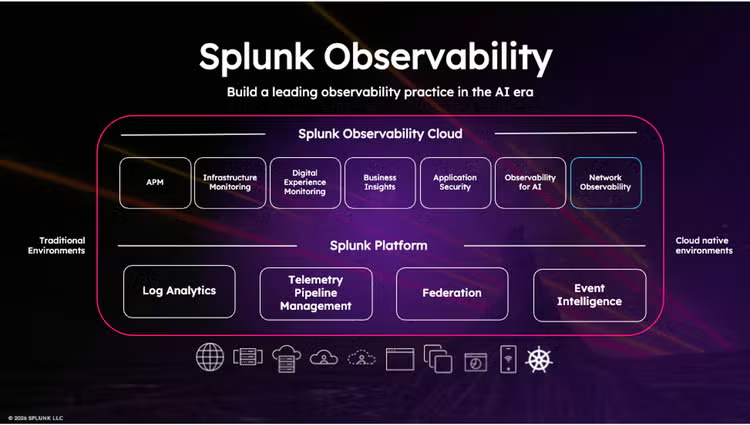
With Splunk, multi-domain analysis, business context and AI guidance are woven throughout the incident response workflow:
- Detect with AI-powered alerts that show real business impact—customers affected, revenue streams, SLOs.
- Troubleshoot by correlating traces, logs, infrastructure, code, databases, and network—all in one view, with AI surfacing probable root causes.
- Remediate with AI-guided automation or human-in-the-loop actions to reduce mean time to resolution (MTTR).
Splunk’s Leadership Is Clear
Splunk is trusted by thousands of customers and recognized by Gartner, IDC, and more. We’re already a leader in observability. Recent competitor acquisitions validate our strategy.
Ready to See the Future of Observability?
Watch our recorded webinars as TSYS and TIAA discuss key insights for observability, and as Dun & Bradstreet shares how they replaced legacy monitoring with Splunk Observability. Discover how they achieved unified visibility, faster issue resolution, and aligned observability with business outcomes.
Register now and see how Splunk Observability can transform your operations.
______________
Disclaimer
This blog post may contain forward-looking statements regarding future events, plans or the expected financial performance of our company, including our expectations regarding our products, technology, strategy, customers, markets, acquisitions and investments. These statements reflect management’s current expectations, estimates and assumptions based on the information currently available to us. These forward-looking statements are not guarantees of future performance and involve significant risks, uncertainties and other factors that may cause our actual results, performance or achievements to be materially different from results, performance or achievements expressed or implied by the forward-looking statements contained in this blog post.
For additional information about factors that could cause actual results to differ materially from those described in the forward-looking statements made in this presentation, please refer to our periodic reports and other filings with the SEC, including the risk factors identified in our most recent quarterly reports on Form 10-Q and annual reports on Form 10-K, copies of which may be obtained by visiting the Cisco Investor Relations website at investor.cisco.com or the SEC's website at www.sec.gov. The forward-looking statements made in this blog post are made as of the time and date of this blog post. If reviewed after the initial presentation, even if made available by us, on our website or otherwise, it may not contain current or accurate information. We disclaim any obligation to update or revise any forward-looking statement based on new information, future events or otherwise, except as required by applicable law.
In addition, any information about our roadmap outlines or our general product direction is subject to change at any time without notice. It is for informational purposes only and shall not be incorporated into any contract or other commitment. We undertake no obligation either to develop the features or functionalities described, in alpha or beta or in preview (used interchangeably), or to include any such feature or functionality in a future release.
Related Articles

Sequenced Event Templates via Risk-based Alerting
Detecting CVE-2020-0601 Exploitation Attempts With Wire & Log Data