What Is Zero Touch In IT?
With a goal of zero human intervention, Zero Touch is the term for the automation of:
- Resource provisioning
- Device management
- A range of ITOps processes
Zero Touch merges intelligent automation driven by AI, applied to IT service desk and IT operations (ITOps), and conforming to industry standard IT service management frameworks such as ITIL®.
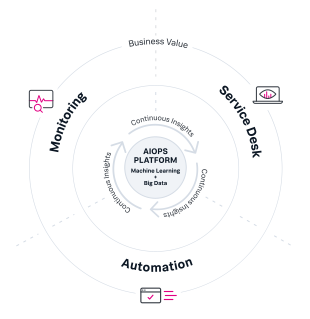
Using machine learning and big data, an Al platform helps IT operations deliver greater business value.
Zero touch in service management
In the context of ITSM, Zero Touch encompasses the entire IT service management lifecycle. Here’s how:
- Automated tools empower BYOD users to enroll into the organization’s Mobile Device Management program.
- User requests for resource provisioning — aka getting new apps and resources — are automatically handled in compliance with the organization’s governance policies.
- A single, mobile-first interface provides users with a shopping-cart experience.
- Pre-vetted tools are available at a library that is extensive and continuously updated with user requests in compliance with the organization’s governance protocols.
In this model where much is automated, IT admins and ITOps teams are directly responsible for managing the following for technology resources:
- Security
- Policy compliance
- Monitoring
- Audits
- Controls of technology resources
In a large, complex enterprise IT environment, a misconfigured device can expose the entire network to costly security attacks; failure to downsize cloud resource provisioning after a temporal peak traffic demand can add significant cost burden to a limited IT budget.
Zero Touch IT provides an automated mechanism to handle ITOps and IT management tasks. It includes automation tools and a process workflow as part of a (hyper)automation strategy.
Zero-touch versus RPA
Automation workflows reduce the level-one ticket burden, but it functions very differently than RPA does:
- Robotic Process Automation****(RPA) automates workflow processes that are fixed with a standard operating template. “If this, do that…”
- Zero Touch IT embeds AI into your service management and ITOps workflows and eliminates manual intervention for request implementation.
(Related reading: multimodal AI, federated learning & Splunk AI.)
Zero touch features & functions
So, how does Zero Touch IT support intelligent automation of end-to-end ITOps and Service Management?
Resource provisioning
Perhaps the most important capability of a Zero Touch IT system — and one that takes significant manual effort — relates to resource provisioning. The key idea of zero touch IT is to eliminate human intervention.
Ideally, Zero Touch environments are perfect and amenable to all kinds of AI-driven automation use cases. Traditional automation tools automate repeatable and routine ITOps tasks that do not depend on dynamic context — but that approach soon falls short.
In complex enterprise IT environments, context changes frequently. Plus, that context change is often hidden and unpredictable. (That’s why you need full observability. More on this below.)
For example, a containerized application may be temporarily provisioned along with the necessary dependent infrastructure resources delivered as a cloud service. These dependencies may be hidden — and these require two treatments:
- Data-driven analysis to discover relevant IT assets.
- Reconfiguration to ensure that cloud resources are decommissioned once the container application is switched off.
Reducing issues & incidents
Zero Touch IT is not focused solely on automating requests: it can help reduce IT incidents and issues that add to the ticketing volume. This functionality is core to AIOps: data-driven anomaly detection and issue resolution at the root cause.
ITSM teams that would otherwise focus on managing ticket requests and responding to alerts, can take advantage of AI-driven anomaly detection and root cause analysis. With proactive root cause issue resolution, manual intervention of ITSM on several ticket requests is eliminated.
Unified observability is one of the key AIOps capabilities used to enable Zero Touch IT. In a true AIOps environment, AI helps ITOps to:
- Filter through the log data deluge.
- Identify trends and patterns that can lead to meaningful insights.
- Act on the most impactful alerts.
Complex root cause analysis is displayed in intuitive reports and natural language text summaries. AI models can correlate multimodal information from a variety of domains, ranging from network logs to ticket request text.
Continuous & holistic
Zero Touch is more than just a chatbot system or an automated control integrated to your alert and notification system. Here’s how:
Zero touch services are continuously monitored for vulnerabilities. Deviations are discovered and remediated automatically as a self-healing mechanism. It is a holistic mechanism that uses AI-driven orchestration tools to eliminate human intervention before issues are identified and raised by an end-user.
(Know the difference: automation vs. orchestration.)
Single, universal interface
Zero Touch IT also removes the information and functional silos of ITSM to a single, universal interface. The sole Zero-Touch interface to the end-user encompasses the end-to-end service management lifecycle. Powerful and feature-rich integrations — with platforms such as JIRA, Office suite, AWS and Azure tools — help IT manage platform-specific resource provisioning and orchestration.
These ITSM decisions are based on:
- Real-time performance alerts
- User input and context
- Previous ticketing request archives
- Monitoring data collected across the network
The result is a context-aware support system that would otherwise require manual analysis of large data assets spread across multiple storage locations and domains.
The omni-channel conversational experience is also critical to accurate self-service delivery of ITSM support. The support interface compiles a single source of truth from federated storage locations.
Security and compliance is embedded into the process: organizational policies are automatically and proactively enforced. This requires a unified data platform — like the one from Splunk — that can integrate distributed storage services including third-party cloud platforms.
The future of zero touch
Generative AI and conversational AI models can serve as a replacement to human support, truly eliminating manual intervention from Zero Touch ITSM systems.
Related Articles

How to Use LLMs for Log File Analysis: Examples, Workflows, and Best Practices

Beyond Deepfakes: Why Digital Provenance is Critical Now

The Best IT/Tech Conferences & Events of 2026
The Best Artificial Intelligence Conferences & Events of 2026

The Best Blockchain & Crypto Conferences in 2026

Log Analytics: How To Turn Log Data into Actionable Insights

The Best Security Conferences & Events 2026

Top Ransomware Attack Types in 2026 and How to Defend