Threat Detection, Explained
Threat detection is the term for detecting threats, typically within an organizational setting.
Let's take a closer look into the threat detection process and understand how you can prevent cyberattacks through a proactive threat detection strategy.
What is threat detection?
Threat detection identifies threats actively trying to attack the endpoints, networks, devices, and systems within an organization. Compared to other cyber practices (like threat hunting), threat detection is significantly more reactive, as you’ve likely already been alerted to anomalies.
Threat detection is a critical cybersecurity process that focuses on identifying behaviors that pose a risk to your digital assets, processes, and business. It involves:
- Monitoring the health of your IT network.
- Analyzing changes in your technology operations.
These changes may result from attempted or successful cyber intrusions. Here are some examples of how an attack or intrusion can trickle through the network:
- Cybercriminals who successfully intrude on your network can use compromised user accounts for unauthorized data access.
- A targeted DDoS attack can cause compromised servers to slow down application performance in certain geographic regions.
- Employees may receive a high number of unsolicited communications with links to malicious Web pages.
These threats emerge as a series of network events and computing operations.
This systematic process is described by the Cyber Kill Chain framework. The CKC and related frameworks help cybersecurity professionals to identify threats at various stages of the cyber-attack lifecycle.
Watch this video to understand how certain activities and patterns can indicate something bad happened:
Threat detection distinctions
Detecting threats is fundamental to any cybersecurity approach, but there are differences in how you can detect threats and the overall goal of doing so.
Threat detection vs. TDIR
Threat Detection, Investigation and Response (TDIR) is a risk-based approach to more efficiently detecting and mitigating cyber threats.
TDIR is a direct response to the “sole use of historical indicators of compromise of even TTP-based detection models”, which is no longer sufficient for staying in front of the sophisticated threats we see today, according to Gartner.
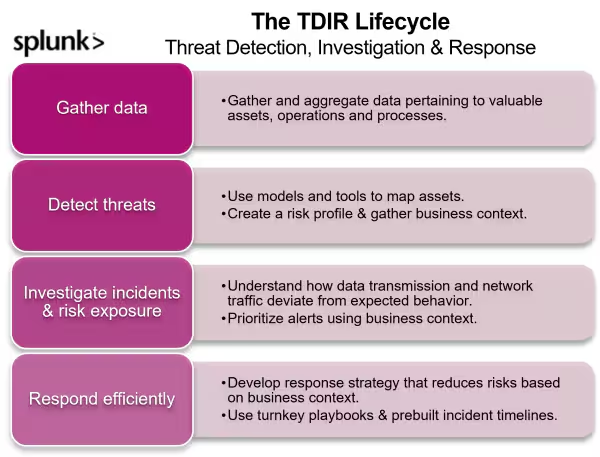
The TDIR lifecycle process involves four key steps:
- Aggregate data pertaining to valuable assets, operations and processes.
- Use threat detection models and tools to discover and map assets, create a risk profile, and acquire business context.
- Investigate the incidents and risk exposure using new data; understand how data transmission and network traffic deviate from the expected behavior.
- Develop and execute an efficient response strategy. Use turnkey playbooks for custom incident types and prebuilt incident timelines for all enterprise IT assets.
(Sound familiar? Explore modern SIEM and SOAR solutions that are capable of TDIR.)
Threat detection vs. threat hunting
Threat detection is not threat hunting. Indeed, threat hunting is a proactive practice that involves both threat intelligence and skills from human experts. Often, the documented output of threat hunting can — and should — inform your overall threat detection capabilities. The key differences in hunting vs. detecting includes:
- Approaches to threat identification approaches
- Differences in tools
- The required experience and the level of creativity both approaches require
How threats become risk
Let’s look at some common ways that threats can quickly turn into real damage and serious risk for your organization. This is why detecting threats early, easily is so important.
Social engineering and insider threats
Malicious actors exploit the human element – your workforce can act as the first line of defense against cyber threats. With a social engineering program, attackers can trick a target user, often via spear phishing, into unwitting activities like:
- Exposing login credentials or sensitive business information.
- Downloading a malicious payload to their servers.
More recently, AI has offered an alarming use case for spear-phishing: generative AI can easily impersonate a company CFO (or any other important role) to trick an employee into transferring $25 million to the attackers in a real-time deep-fake video call. (This sort of activity has really happened, and not just once!)
While this may be attributed to negligence, company insiders may also present security threats with fraudulent intent — the intentional insider threat. A disgruntled employee may leak IP protected company secrets or expose the network to security attacks by failing to adopt security best practices.
Ransomware
Ransomware is any attack that takes its target — systems, applications, servers, and/or information — as hostage against financial payment, usually in Bitcoin. Users are locked out of accessing these systems and the cost of the resulting downtime may far outweigh ransom demands. The attack may result from a network intrusion through vulnerable systems or a social engineering campaign.
Once executed, the ransomware encrypts target digital assets and applications. Decryption keys are offered in exchange for ransom settlements in Bitcoin. Ransomware is one of the fastest growing threats as ransom payments have grown by 100x since 2014 — around $1.1 billion was paid in ransom across 1,500 attacks in 2023.
DDoS
A Distributed Denial of Service attack involves a large traffic simultaneously accessing a server and populating all of the available network bandwidth. This renders the services running on target servers inaccessible for legitimate users.
A botnet consists of geographically distributed — usually compromised — connected devices that continuously send TCP/IP packets from unique IP addresses. The process is automated and highly effective. Billions of IoT devices are connected to the Internet and a significant proportion operates on outdated and vulnerable firmware.
DDoS attacks are increasing by 55% YoY and reaching traffic data rates of up to 4.2Tb per second.
Supply chain attacks and vulnerabilities
A common reason for all cyber-threats is the underlying vulnerability — whether in systems and technologies, hardware and software, people and processes.
An attack may exploit known vulnerabilities in third-party tools; even though a security patch may be available, organizations tend to run outdated systems due to a slow IT governance process and a large scale of operations that makes organization-wide updates a security challenge.
Yet, the greatest challenge is to strengthen the first line of defense in the form of a security-aware and responsible workforce. Employees can identify, monitor, report and help mitigate threats, especially for edge cases that go under the radar of even the most advanced security monitoring and detection technologies.
Detecting threats with AI
Considering these threats, what can you do about it? Can you simply monitor your network traffic and deploy a rules-based security policy to deter attacks?
Let’s first look at what makes threat detection a challenge, in context of the traffic attributes and network environment variables:
- Your network traffic is dynamic and unpredictable. You can predict a spike or an outage, but the traffic behavior follows seemingly random probabilities. So how can you accurately model such a stochastic process?
- Assigning security responsibility for threat detection is a business challenge. How can you ensure that third-party technology vendors push security updates on time? How can you align cybersecurity and business goals in your IT governance and risk management strategy? Is a negligent employee truly responsible for any lack of security defense measures, such as Principle of Least Access privileges?
An effective solution against these threats can be AI-based threat detection tools that can be fine-tuned on your company-specific information. This information can include:
- Your traffic trends and network usage patterns
- Security policies and rules
- Information access
- Modification privileges
This can serve as contextual knowledge to AI based threat detection models that have already learned to model security threat patterns from a variety of risk incidents in the real-world.
Related Articles

How to Use LLMs for Log File Analysis: Examples, Workflows, and Best Practices

Beyond Deepfakes: Why Digital Provenance is Critical Now

The Best IT/Tech Conferences & Events of 2026

The Best Artificial Intelligence Conferences & Events of 2026

The Best Blockchain & Crypto Conferences in 2026

Log Analytics: How To Turn Log Data into Actionable Insights

The Best Security Conferences & Events 2026

Top Ransomware Attack Types in 2026 and How to Defend