Introduction to Shadow AI
Learn Muhammad RazaThe rise of generative AI tools has unlocked immense productivity potential but has also given birth to a new challenge: Shadow AI. As employees increasingly turn to unsanctioned AI applications for convenience, businesses face significant risks in maintaining data security and adhering to IT governance protocols.
Let’s take a look.
What is shadow AI?
Shadow AI refers to the unauthorized use of Artificial Intelligence tools at the workplace and outside the scope of internal IT governance protocols. Shadow AI typically involves generative AI tools that are easily accessible online and make for a simple productivity hack. According to a recent research, around half of the workforce surveyed globally uses Gen AI frequently, and one-third using it on a daily basis.
A common example of shadow AI is the unauthorized use of OpenAI’s ChatGPT. This tool helps with tasks like editing your writing, generating content, research, and data analysis. This tool helps to boost efficiency, but since this tool may be unauthorized by IT teams, employees may accidentally pose serious risks to data security for their company and compromise the organizations reputation.
Shadow AI vs. shadow IT
A similar practice of Shadow IT is already prevalent in enterprise IT. The term "shadow IT" refers to the use of IT devices, software, and services outside the ownership or control of an organization’s official IT department. Gartner estimates that up to 40% of the IT budget in large enterprises is spent on Shadow IT tools and predicts that 75% of the workforce will employ Shadow IT practices by the year 2027.
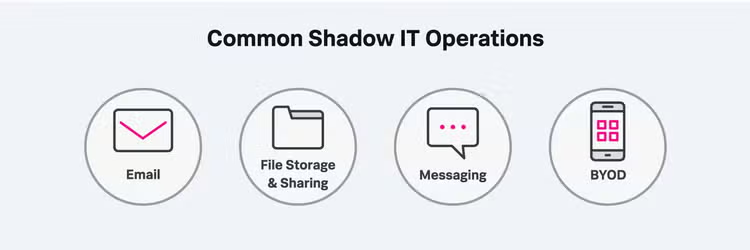
But what makes Shadow AI different from Shadow IT?
Artificial Intelligence is embedded into most technologies deployed through authorized channels of IT governance frameworks at the workplace. Most business functions are data-driven and inherently use AI to drive key business insights and decision-making processes.
Shadow AI is a subset of Shadow IT that specifically applies to generative AI tools.
Scope of shadow AI
Let’s discuss how generative artificial intelligence makes Shadow AI is different from Shadow IT in terms of its scope and impact:
- Access: Generative AI operates as standalone AI tools accessible online for free or with low subscription fees.
- Usage: These technologies can serve as productivity tools and support decision-making processes for individual users.
- Risk: Most popular generative AI tools are consumer-grade and may not enforce the necessary data security and data privacy standards. The impact is unintentional leak of company secrets, sensitive business IP, and user conversations.
- Scope: Generative AI tools can support a variety of business functions and tasks. Coding support in a variety of programming languages and deep knowledge of common enterprise IT technologies makes Shadow AI tools a useful intelligent support agent.
Impact of shadow AI
The motivation for using a general purpose LLM at the workplace is simple: an intelligent agent that draws comprehensive knowledge from the internet and supports your daily job task.
Even before the ChatGPT and other generative AI tools were released to the public, employees frequently used Internet resources to complete their jobs. For instance, engineers use Stack Overflow and GitHub and marketers use online databases.
This knowledge has now been distilled into generative AI tools that reduce the task of searching and reading online resources, into a prompt query response.
The important difference in consuming knowledge — and the main challenge — is the process of prompting an external tool with sensitive business information. For example:
- Engineers may copy IP protected code into the prompt to enhance functionality.
- Marketers may automate data analysis by using sensitive customer information into their prompts.
From a business perspective, the key challenge is the lack of control over the use of intelligent agents. Organizations can advise on security best practices, but a Shadow AI tool may not be able to process a user request without prompts containing privacy sensitive data. Since these tools are proprietary, organizations cannot identify and control how prompt data is used and protected against malicious intent.
As a result, organizations cannot enforce their own IT governance protocols to mitigate IT security and data privacy risks.
How to defend against Shadow AI
So how do you protect your organization from Shadow AI practices? The following best practices can help improve your security posture against Shadow AI while also allowing your employees to leverage generative AI as highly effective productivity tools:
Security awareness
This is perhaps the most practical approach to minimize the risk of exposing sensitive business information to generative AI tools. Employees should be aware of the risks involved and be motivated to take precautionary measures. These include obfuscating the code and anonymizing customer data before it is entered into an LLM prompt. These extra measures do not impact the output that users can generate from an LLM but eliminate the risk of business impact in the event of a data leak incident.
Go open source and build your own LLMs
Mistral AI, Meta Llama and Google Gemini models are open sourced in some capacity. These can be a starting point to build your own models: start from these pretrained open-source models and fine tune them on your own proprietary datasets. Host these models locally or on a private cloud network. Your workforce can enjoy the same freedom of integrating generative AI to their daily workflows without the security risks associated with proprietary third-party generative AI tools.
Develop a clear AI policy and guidelines
Identify opportunities and challenges associated with generative AI adoption for various business functions. Security awareness can create intrinsic motivation among your workforce to take the necessary security measures. Internal open-source AI tools can serve as valuable productivity tools.
However, third-party tooling functionality may be necessary in many ways and can inadvertently expose users to unforeseen security and privacy risks. Banning these tools will naturally lead to Shadow AI, but providing well-informed guidelines on their use can help your employees adhere to your IT governance standards carefully.
Related Articles

What Are Cron Jobs?

What is Real User Monitoring?