What is Performance Engineering?
Key Takeaways
- Performance engineering is a proactive discipline that embeds performance considerations — such as reliability, scalability, and efficiency — throughout system design, development, and testing, rather than treating performance as a final checklist item.
- Integrating performance testing and monitoring early and continuously enables earlier detection of bottlenecks, faster feedback loops, and reduces the cost and risk of late-stage performance fixes.
- Defining and monitoring Service Level Indicators (SLIs), Service Level Objectives (SLOs), and Service Level Agreements (SLAs) aligns teams around clear expectations and maintains system reliability in production.
Nowadays, the performance of your systems is a critical aspect of any business environment. A reliable and efficient system is crucial to your business, no matter what you’re offering. It is essential for successful and smooth business operations, ensuring customer satisfaction.
Performance engineering plays a key role in achieving these expected business goals.
This article explains the discipline of performance engineering and its components. We’ll also look at how it differs from performance testing. Additionally, the article describes modern tools used for performance engineering, best practices, and the main benefits.
What is performance engineering?
Performance engineering is the practice that ensures the software you’re designing meets its expected speed and efficiency goals. We can consider it one aspect of application performance monitoring (APM), one type of IT monitoring.
Focused on software architecture and software engineering practices, performance engineering digs deeper into the choices of engineers, including:
- The tech and tools to use
- The ways you design and code software and apps
Performance engineering enables organizations to build more performance-tuned applications that are scalable and reliable. It ensures those systems can provide the best user experience. There are several activities involved in performance engineering — of which performance testing is one component. It takes a shift-left approach where performance issues are identified in the early phases of the software development cycle.
(Related reading: service performance monitoring & what is SRE: site reliability engineering.)
Performance engineering vs. performance testing
Performance testing and engineering go hand in hand. However, both disciplines serve different purposes and encompass different activities.
Performance engineering is an end-to-end approach. It focuses on the entire application architecture and underlying infrastructure. In contrast, performance testing has a limited perspective since it focuses only on specific parts of the workflows of the overall system.
- The primary goal of performance testing is to ensure that the software meets its performance requirements, such as response times, throughput, and error rates.
- Performance engineering is far more than this validation. It takes an overarching view in order to optimize various aspects, from the code level to the infrastructure.
Performance engineers and performance testers both deal with the results of performance testing results. However, the responsibilities vary:
A performance tester analyzes certain key performance indicators (KPIs) during performance tests like load testing, endurance testing, and stress testing. Some examples of such indicators include response time and throughput.
A performance engineer’s responsibility extends beyond that. Here, you’re directing the engineering team to improve or optimize on those KPIs. Performance engineering includes several processes, such as performance modeling and execution, analysis, and optimization.
(Read our complete intro to performance testing.)
Phases of performance engineering
Performance engineering comprises several critical phases, from understanding the architecture to refining the system through iterative feedback.
Phase 1. Architecture overview & requirements gathering
In this phase, performance engineers get an idea of the overall architecture and identify the non-functional requirements (NFRs) of the system. For example:
- The number of users
- The number of transactions
- The amount of load the system would expect
- What performance you expect from critical workflows of the system
Additionally, here, you’ll identify potential bottlenecks in order to detect issues earlier. This solid initial understanding greatly benefits developers in making informed design choices, eliminating later rework.
Phase 2. Performance modeling
Based on the understanding of Phase 1, you’ll develop the performance model that accurately represents the complete end-to-end system.
This phase is crucial in performance engineering, especially in software systems. It should behave according to the real user loads and respond as in the real system. Performance engineers use tools or mathematical models to simulate system behavior and anticipate bottlenecks.
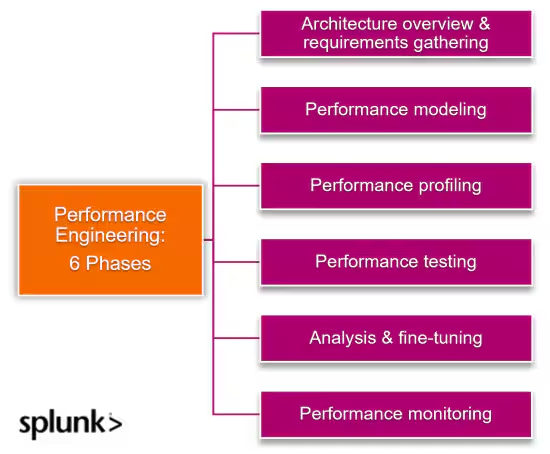
Phase 3. Performance profiling
Performance profiling is another part of many performance engineering practices. It analyzes software code to check for any resource-intensive sections. Language-specific profiler software is employed in this process. Those tools are able to:
- Report on the times taken for function executions.
- Pinpoint performance bottlenecks that could hamper performance.
Phase 4. Performance testing
In this part of performance engineering, performance tests are carried out to validate system performance against expected Service Level Agreements (SLAs):
- Load testing tests system performance under various loads.
- Endurance testing and stress testing each provide information on the stability and ability of the system to withstand a specific period of time.
Various performance testing software is employed to automate the testing process. A few examples are LoadRunner and Apache JMeter.
Phase 5. Analysis and fine-tuning
In this phase, performance engineers provide feedback and suggestions to improve the code or the system based on the performance tests. Those suggestions can include tips for:
- Architectural changes
- Code refactoring
- Adjusting configurations
Do Performance testing after you’ve fine-tuned the application — to see improvements or further improvements.
Phase 6. Performance monitoring
Finally, you’ll continuously monitor products and software to understand their usage and potential issues. A part of the goal of this performance engineering process is to quickly resolve performance issues before they adversely impact the user experience.
This phase also allows the performance engineering team to identify new trends, such as the increase or decrease in actual system users. They can adjust their tests based on the monitoring feedback.
Observability and monitoring tools are crucial in performance engineering as they provide insights into trends over time.
(Learn about the relationship between monitoring and observability.)
Performance engineering tools
Several tools are available on the market for various performance engineering tasks. Here’s a list of the top tools used in each phase of performance engineering.
Profiling tools
- JetBrains dotTrace is a profiling tool for .NET applications profiling tool.
- Telerik JustTrace is a profiling tool for .NET memory and performance.
- Py-Spy is a sampling profiler written in Rust to visualize Python program execution times.
- VisualVM is a free tool for profiling Java programs.
- JProfiler is a Java profiler with an intuitive UI.
APM and observability tools
- AppDynamics real-time monitoring tool for cloud-native applications.
- Prometheus is an open-source monitoring platform that provides a flexible query language and time series database, though its limited for complex environments.
- AWS Cloudwatch is a monitoring tool that integrates with some AWS services.
Of course, we’ll also call out Splunk Observability Cloud, the only full-stack observability solution with robust APM and infrastructure monitoring capabilities. Try it for free.
Performance testing tools
- Apache JMeter is a Java-based, open-source system for load testing web and other applications.
- LoadRunner is a load testing tool that supports more than 50 technologies.
- NeoLoad load tests web and mobile apps.
- WebLOAD offers performance and stress testing with multi-protocol support.
- Gatling is a Scala-based open-source load testing tool with features like no-code and dynamic load generators.
Best practices
No article explaining a tech topic is complete without some expert best practices. Here are best practices for a pristine performance engineering effort.
Integrate performance engineering in the early phases
Traditionally, the development cycle didn’t focus on performance engineering. Sometimes, it started only a few weeks before the planned production date. If there is any issue revealed from performance tests, only issues that could be fixed before the production date were committed to fixing or the production date was postponed.
Assume instead that performance engineering is incorporated into the development process — before the code is integrated into the pre-production environment. In that case, you’ll have plenty of time to fix issues. Early performance feedback can lead to better architectural and design decisions. This ensures the system is scalable, resilient, and performs optimally.
Consider the future directions of the system
In fast-paced environments, organizations must deal with changing market conditions and user requirements. If you anticipate the performance requirements of future features, you can easily adapt the overall system without sacrificing performance.
Invest in the right tools
To automate processes, performance engineering teams must evaluate and invest in the right tools that meet their needs. For example, automated load testing tools and APM tools. The right tools can:
- Analyze large amounts of data quickly.
- Collect precise metrics.
- Reduce the time required to identify and rectify issues, enhancing the performance engineering process.
(OKRs, metrics & KPIs: know the differences.)
Continuous performance monitoring
Continuously monitoring your performance means you can detect performance bottlenecks as quickly as possible. Early detection provides enough time for development teams to fix the issue and deploy before end-users escalate it.
Use realistic test setups
It is vital to ensure that the test setup resembles what you are using in the actual production environment. Factors to consider include the specific hardware, software versions, network configurations, user volume, data patterns, and any third-party integrations.
(Read about third-party risk management.)
Key benefits of performance engineering
Performance engineering brings many benefits to organizations. Following are some of its key benefits.
- Enhanced user experience. An application optimized with performance engineering processes can respond to user requests efficiently and have fewer performance issues and errors. Thereby delivering a seamless user experience.
- Cost reduction. Performance engineering helps organizations efficiently use their computational resources and reduce the cost of additional infrastructure.
- Proactive problem identification. Continuous monitoring helps proactively identify and address potential problems before they are noticed and escalated by end users.
- Improved user trust. Users typically avoid or stop using slow and unreliable systems. Well-performance engineered systems help gain the trust of end users and retain them long-term. It also enhances the reputation of the organization.
- Optimized scalability. Software without any major performance issues can easily scale to increase user growth without sacrificing its performance.
Engineer top performance today—with help from Splunk
Performance engineering is an essential practice today. As mentioned in this article, it takes a holistic view of the architecture of the entire system to improve its performance and reliability. Although used interchangeably, performance engineering significantly differs from performance testing.
As a leader in APM and observability, Splunk is primed and ready to help your organization truly optimize performance of all your apps and systems. We love delivering excellent customer experiences.
Related Articles
Browser-Based IDEs: The Complete Guide

Federated Data Explained: Empowering Privacy, Innovation & Efficiency

Security Breach Types: Top 10 (with Real-World Examples)

The Purple Team: Combining Red & Blue Teaming for Cybersecurity

Authentication vs. Authorization

How Digital Fingerprinting Tracks, Identifies & Affects Us

What is a Data Scientist?

What is Patch Management?