Observability That Works: Understand System Failures and Drive Better Business Outcomes
Learn Laiba Siddiqui , Caitlin HallaKey Takeaways
- Observability gives teams a unified view of system behavior by connecting metrics, logs, and traces, enabling faster troubleshooting and accurate root-cause analysis.
- By providing insights into user experience, security, and system performance, observability helps organizations proactively prevent incidents and optimize operations.
- Modern observability, especially when combined with AI, strengthens collaboration, increases developer productivity, and turns telemetry data into actionable business intelligence.
Modern systems don't fail because engineers lack skills; they fail because teams can't see why systems are failing at all or can’t see why they’re failing fast enough. Often, the problem isn't a lack of tools — it's a lack of clear, connected visibility across data, teams, and systems.
This is where observability transforms how organizations operate. It's no longer just about keeping systems running. It's about understanding why they behave the way they do and using that knowledge to drive better customer experience and business outcomes.
What is observability?
When a system slows down or fails, the real challenge isn't knowing something went wrong, it's figuring out why it happened in the first place. That's where observability comes in.
Observability is the ability to measure the internal states of a system by examining its outputs. It enables you to understand what's happening inside your systems by analyzing the data they produce — like metrics, logs, and traces. Instead of guessing or troubleshooting in the dark, you get a complete picture of system behavior to diagnose issues with confidence.
Suppose your app suddenly takes forever to load. With observability, you can scan metrics to confirm a spike in response times, dig into logs to surface errors tied to relevant endpoints, and follow traces to pinpoint the exact service causing the slowdown.
Observability vs. monitoring: what's the difference?
Monitoring and observability are often mentioned together, but they serve different purposes:
- Monitoring is about watching for known problems. It tells you when something is wrong — like a server going down or your app returning errors. Based on metrics, you can set up dashboards and alerts around what you expect might break.
- Observability helps you understand why something is going wrong, even if the problem isn't expected. It gives you a deeper look into how your system works by collecting and connecting data from different sources.
(Related reading: observability vs. monitoring vs. telemetry.)
Metrics, logs, and traces
We can’t talk about observability without discussing three key types of data:
- Metrics are numbers that show how your system is performing — response times, active users, error rates, CPU usage. They help you spot changes or patterns over time. They are structured and easy to query and store long-term.
- Logs are records of what's happened inside your system. They show events in order, like when someone logs in or when an error occurs. This helps you understand the specific actions that led to a problem.
- Traces show the path a request takes through your system, from start to finish. As a request moves through the host system, every operation performed is captured as a "span." This helps you see how different parts of your system connect and where things may be slowing down or failing.
Working with these telemetry data types independently or using different tools for each does provide visibility into your system, but it won't deliver true observability. By integrating logs, metrics, and traces within a single, unified solution, you gain complete insight into not only when problems occur, but why those problems are happening in the first place.
Why observability matters
Observability is critical in software development because it gives you greater control over complex systems. Simple systems with fewer moving parts are easier to manage.
But distributed systems built on microservices, containers, serverless functions, and cloud-native architectures have a far higher number of interconnected parts. So, the number and types of failures that can occur is exponentially higher.
Additionally, distributed systems are constantly updated, and every change can create a new type of failure. Because monitoring focuses on "known unknowns," it often fails to address problems in these complex environments. Observability is better suited for the unpredictability of distributed systems because it allows you to ask questions about your system's behavior proactively and as issues arise.
Benefits of observability
Now that you know what observability is and why it matters, let's look at how it can help an organization. A complete observability practice benefits organizations through:
Faster troubleshooting and clearer root cause analysis
Observability gives developers real-time insight into how systems behave so they can clearly see issues, often before they impact customers. Contextualized, centralized data streamlines the troubleshooting processes. Recent research indicates that organizations who adopt observability see up to 54% reduction in mean time to resolution (MTTR).
Teams also benefit because observability offers a shared view of the environment, providing a comprehensive understanding of architecture, health, and performance. This end-to-end visibility makes root cause analysis both faster and more accurate, ensuring fixes address the actual source of the issue rather than surface-level noise.
Better user experiences based on real behavior
User experience improves when you can see how people interact with your product in real time. When teams understand where pages slow down or where users hesitate, they can pinpoint exactly which parts of the experience create friction. This clarity makes optimization proactive instead of reactive. With a complete observability practice in place, organizations see 64% fewer incidents that could potentially affect customers.
Stronger security and easier compliance
Observability strengthens security by providing the same level of visibility into potential threats as it does into performance issues. When logs, metrics, and traces flow together, security teams can spot unusual patterns early and respond before those patterns escalate into incidents. This unified visibility also simplifies compliance, since teams can trace activity across systems and verify that sensitive operations follow required policies.
Higher developer productivity
Developer productivity increases when engineers no longer need to manually hunt for what went wrong across different systems. With observability, they can jump directly to the service, function, or dependency causing the issue, which shortens the entire troubleshooting and resolution cycle. That efficiency frees developers from repetitive investigations and allows them to focus on innovation and building out new features.
Critical business insight
Modern observability goes beyond performance and troubleshooting by helping you understand your business.
Telemetry data explains business behavior just as clearly as it explains technical behavior. For example:
- A dip in conversions can be traced to a slow checkout API.
- A spike in revenue might tie back to a feature rollout, not a specific marketing campaign.
Confident releases of new features combined with less downtime translates to happier customers, a better end-user experience, and a more robust bottom line.
There are numerous benefits to an observability practice, all of which positively impact business operations.
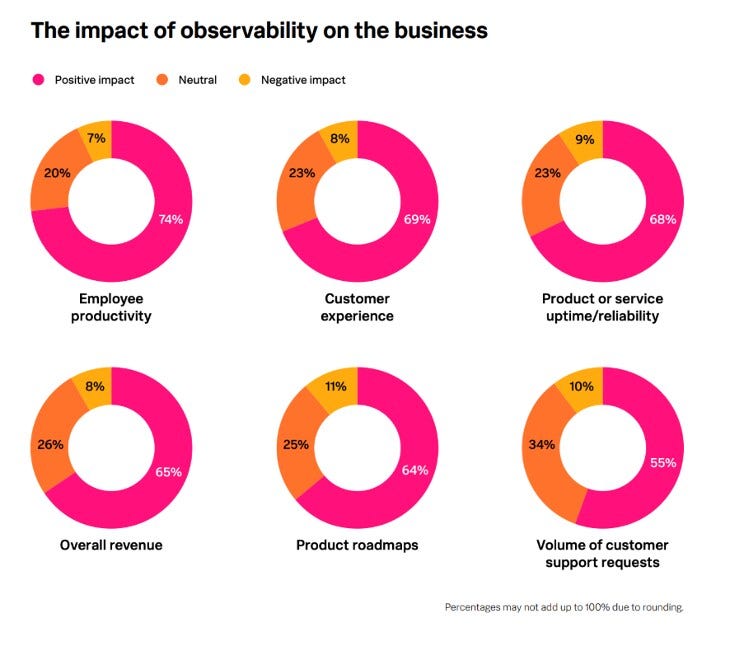
How AI Is changing observability
With more AI-driven systems entering production, insight into LLMs, MCP servers, and AI agents is critical: models drift and evolve, GPU workloads spike, and results are non-deterministic, meaning behavior changes from response to response. Observability connects model performance, response behavior, infrastructure usage, and user impact in one place.
Observability is changing in relation to the systems being observed, that’s correct. We can also say that AI is fundamentally reshaping how teams use observability:
- 78% of teams say AI helps them spend less time on maintenance and more time building new features.
- 60% report that AI accelerates root-cause analysis.
However, AI readiness depends on data quality, not just tools. Poor data quality often prevents teams from adopting AI in their observability practice effectively. AI, in relation to observability, needs clean, structured telemetry to provide accurate insights. If logs are inconsistent, traces are missing, or metrics aren't standardized, AI-driven recommendations become unreliable.
(Related reading: Observability for LLMs and the new rules of data management for AI.)
Observability challenges
Observability delivers significant value but implementing it correctly requires thoughtful planning. Here are some common implementation challenges to avoid:
- Tool sprawl: Adopting multiple observability tools fragments visibility, increases complexity and costs, causes siloes between teams, and slows down issue detection and resolution.
- Data overload: Collecting too much data creates noise instead of helpful troubleshooting insights.
- Data volume: As data volume grows, so does cost. Being intentional about the specific data you collect from the start can help you avoid unnecessary expenses without the risk of missing important signals.
- Security and privacy: Teams must ensure their telemetry collection and storage comply with regulations like GDPR and the Digital Operational Resilience Act (DORA), and they must continuously audit pipelines to avoid capturing more sensitive data than necessary.
How to start implementing observability
With awareness around the common potential challenges, you can move forward with implementing a successful observability practice. Here are several steps you can follow:
- Start with clear goals: effective observability begins with understanding what you want to improve — whether that’s reducing downtime, improving user experience, or detecting security issues faster.
- Select tools that unify your data: once your goals are defined, you need tools that bring your telemetry data together in a consistent, scalable way so your teams can quickly connect signals and see issues clearly.
- Instrument your systems with standardized data collection: after deciding on the tools, add the code or agents required to capture the right data from your applications and infrastructure. No need to instrument everything here. Start with the most critical data.
- Build dashboards and alerts that surface what matters: with instrumentation in place, create dashboards and alerts that highlight critical user impact so you can get real-time insights and notifications.
- Train your teams to use observability effectively: even the best observability tools can fail when people don’t know how to use them. Training and knowledge-sharing sessions help teams understand how to read telemetry data, interpret signals, and troubleshoot.
- Review and refine your setup regularly: no system is static. Regular reviews of your observability practice help to remove unnecessary alerting, update visualizations, and confirm your setup still aligns with your goals.
Check out this complete guide to Creating an Observability Center of Excellence in your oganization >
Best practices shaping modern observability
The organizations with the highest returns invest in forward-looking observability practices like the following:
-
OpenTelemetry: Starting with OpenTelemetry standardizes data across services, reduces complexity, and eliminates vendor lock-in. It's one of the strongest predictors of higher observability maturity.
-
Code Profiling: with code profiling enabled, teams can see exactly where performance issues originate, right down to the function or line of code. It significantly accelerates root-cause analysis and provides deep performance insight.
-
Observability-as-Code (OaC): instead of manually creating or updating dashboards or alerts, teams define their observability configurations the same way they define infrastructure or deployments — through code. This makes telemetry consistent, version-controlled, and repeatable across environments. It also reduces the risk of misconfigured resources and missing signals.
center 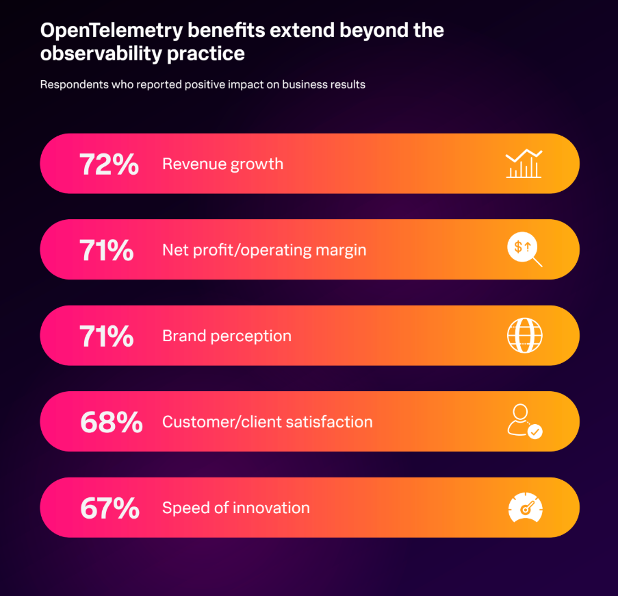
This image shows how OpenTelemetry benefits the organization in ways beyond observability, including for revenue growth, brand perception, and customer satisfaction.
Observability tools: what to look for
There are many observability tools out there; some are open-source, others are paid platforms. No matter which option you choose, a good observability tool should:
- Work well with your current tech stack, including the languages, platforms, and frameworks your team already uses.
- Be easy to learn and use so that teams can add it to their daily work without extra effort.
- Show real-time data through dashboards and reports to understand and respond to issues quickly.
- Collect data from across your systems and separate useful signals from the noise.
- Provide enough context to understand what changed, what else was affected, and the scope of the problem.
- Use AI to detect problems faster and reduce the time teams spend searching through data.
- Help you reach real goals, like smoother deployments, better system reliability, or improved customer experience.
What’s next
Observability is essential to understanding the state of your entire system. The cloud, containerization, microservices, and other technologies have made systems more complex than ever. While the net result of these tools is positive, troubleshooting and managing these systems presents significant challenges.
Fortunately, distributed systems produce a wealth of telemetry data that provides a clearer understanding of their performance — if you can harness it. Effective observability tools provide all the instrumentation and analytic horsepower you need to capture and contextualize your system's output.
If there's one takeaway, it's this: the next wave of competitive advantage will come from organizations that unify their telemetry data, strengthen cross-team collaboration, and prepare their systems and people for the realities of AI-driven observability operations. The teams building that foundation today will shape the businesses that move fastest tomorrow.
FAQs about Observability
Related Articles
What Cybersecurity Means in 2026: A Complete Overview of Cybersecurity

What Is SecOps? Security Operations Defined