NoOps Explained: How Does NoOps Compare with DevOps?
Learn Stephen WattsSince the evolution of the IT industry, different concepts have been introduced to enhance and speed application production. Automating processes is gradually becoming the way forward and, so far, the best way to speed the deployment process of projects.
Today, though, NoOps has come along. The prevalence of NoOps means manual intervention may not be needed in IT operations, but is this going to mean the extinction of DevOps? Turns out, NoOps might just be a next step in the progression of DevOps. In this article, we’ll find out why.
DevOps summary
Simply put, DevOps is a practice or methodology of making developers and operations experts work hand in hand. This set of practices combines the collaborative effort of software development and IT operations with the dual aims of:
- Shortening the system development lifecycles
- Providing continuous delivery with high software quality
(Read our comprehensive DevOps introduction.)
So, what’s NoOps?
NoOps is a newer concept that aims to completely automate an IT environment when deploying, monitoring, and improving software operations.
This makes it independent enough that the underlying infrastructure has no need for a dedicated team on the premises to manage the software. Ultimately, NoOps enables the developers to focus solely on developing the software, and the operations part of the life cycle becomes completely automated, relieving the operations team of these tasks.
What brought about NoOps?
DevOps integrates development and operations skill sets, which is a really smart concept — but one that’s proven hard to achieve, especially in large organizations. When implemented, it becomes hard to maintain, as there is no guarantee that the thoughts and actions of developers and operations experts will align.
DevOps requires infrastructure experts and software experts to work hand in hand. This means that, in unfortunate circumstances, the failure of one can cause the failure of the other. This might result in the entire software development process falling apart. All of this led to the unending question about the proficiency of DevOps and resulted in the introduction of the NoOps approach.
Why NoOps?
The NoOps approach aims to decrease the Ops expertise required and enable developers to focus solely on writing and improving the product's code by putting in more processes and resources to improve the product, infrastructure, management, security, and everything operations — making it completely automated by the platform provided. This is possible in particular thanks to:
- Platform as a Service (PaaS)
- Function as a Service (FaaS)
Anything operations become controlled by the particular automated system. With NoOps, the developer team does not need to communicate with the system administrators regarding any infrastructural concerns. Arguably, NoOps is an easy-to-adapt methodology, especially for startups, small-scale applications, and Product as a Service companies.
Ultimately, NoOps represents a step forward in innovation. With the right tools, NoOps can achieve a faster deployment process, even more than DevOps.
Brief note on PaaS
PaaS provides a platform that allows you develop, run, and manage applications functionalities without the complexities of building or maintaining infrastructure, which are typically associated with developing and launching the applications. There are many PaaS providers out there, but the major ones are:
- AWS Lambda
- Azure Functions
- Google Cloud Functions
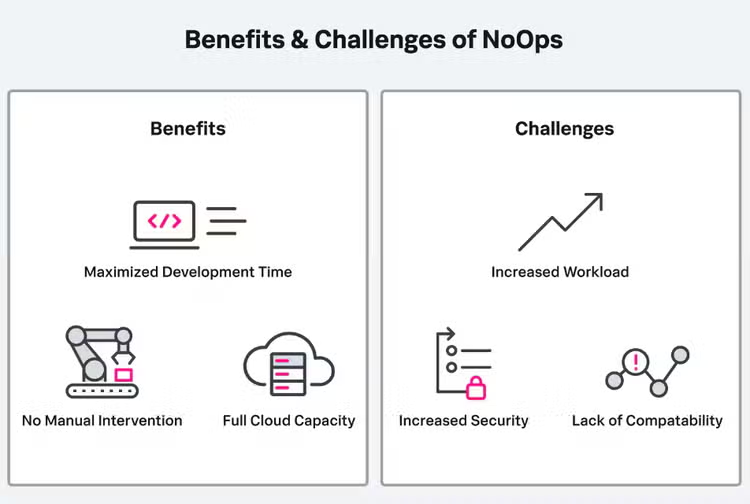
Benefits of NoOps
Here are the benefits and business value of a NoOps approach:
- Maximum development time. NoOps requires a handful of developers to manage the project life cycle. To reduce the friction between developers and infrastructure, NoOps completely automates the IT environment. The aim is to give developers more time to focus on developing the application.
- Full cloud capacity. NoOps implementation is associated with PaaS, serverless computing, and cloud computing — automating ops monitoring and maintenance. It is mostly applicable to the infrastructure existing in the cloud, so the developer team need not worry about resources and distributions.
- No manual intervention. Wherever there is manual intervention, there is human error — but not in the case of NoOps. With the level of automation in NoOps, there will be little or no need for human intervention in the operations perspective associated with the pipeline. This means there will be no room for human error.
- Milestone achievements. With more time resources focused on development, the software may well be completed before the scheduled time. This leaves more time for companies to create more opportunities that would generate revenue.
- Budget friendly. Since NoOps is a serverless computing model, consumers only pay for the duration of execution of functions and the number of executed functions. If a function is not executed, no charges are billed. Ultimately, this eliminates any idle time.
- Increased productivity. NoOps allows both developers and operations teams to stick to what they’re good at. This means that both departments can invest more time in their respective tasks and become more productive thanks to the extra focus and time saved by the continuous development mode.
Challenges with NoOps
No technology approach is without challenges. Here are some NoOps obstacles.
Increased developer workload
There is no guarantee that NoOps will entirely eliminate the need for the operations team. There will always be a need to manage:
- The infrastructure
- The information about who uses services
- The related costs
These types of responsibilities will ultimately fall on the shoulders of the developers.
Security risks and compliance issues
For an organization to have better control over a software’s security and prevent cyber threats penetrating program data, there is a need for a skilled and experienced operations team. Because compliance cannot be outsourced, regulations will only apply if the application runs on-prem or in the cloud. Someone will have to communicate to the PaaS to:
- Close vulnerabilities
- Provide administrator access to sensitive information
- Keep an eye on the activities of privileged users
The security team often relies on the IT operations team to manage network policy, administer identity governance, and enforce control. That way, the security team can focus on threats, incident response and policy writing. Eliminating the operations team would be offset by the need to grow the security team.
(See how security automation can help.)
No compatibility
NoOps is not a universal solution, as not every application can be compatible with the latest PaaS solutions. Today, there are several technologies that are not compatible with NoOps. Implementing NoOps is also not an effective option in cases where enterprises own their dedicated data centers.
Finally, the related transition to complete automation will most likely cause difficulties for many companies.
Learning gaps
With most of the responsibilities taken off the hands of the admins, they will be left with just minor security patches and server management. They can easily learn to code and upskill themselves. The developers, on the other hand, will spend most of their time writing code, testing it, and deploying it on any Function as a Service—the platform does the rest. It’s unlikely they’d even be able to learn some administration tasks to add something new to their skill sets.
Comparing DevOps vs. NoOps
- DevOps practices require the collaborative efforts of both infrastructure experts and software experts.
- Both approaches aim to enhance the system lifecycle, from development to deployment, through automation and improved methodologies.
- This, in turn, increases the speed of delivery and deployment processes.
- NoOps cannot work independently of DevOps; they both need to be present to function seamlessly.
- NoOps and DevOps aim to improve the developer experience.
The future of NoOps
NoOps has a future and will most likely play a crucial role for many startups and Product as a Service companies. It will help them reach out to the market quicker and earn revenue as quickly as possible. It even emulates the Agile methodology, where you are able to complete fast releases. NoOps can easily provide this type of agility by quickly deploying the product for testing.
However, the future of NoOps will most likely lead to intelligent Ops, where artificial intelligence will manage your software with more accuracy. NoOps is an excellent choice for software companies with interest in scaling, optimizing development, and automating everyday procedures.
Is NoOps the end of DevOps?
We can't possibly say that NoOps is the end of DevOps, since DevOps has already embedded itself in most large-scale applications. Although DevOps has its pros and cons, it has proven to be a quite reliable methodology, which makes it hard to eliminate. It is safe to say that NoOps is a progressive step from DevOps, but this evolution cannot happen overnight.
Related Articles

What is a Data Architect? Responsibilities, Skills & Salary Explored

The Quantum Threat: Options for Migrating to Quantum Safe Cryptography