HIMSS25: Digital Resilience in Healthcare - What It Really Means
HIMSS, the annual healthcare technology conference, never disappoints. Every year, you feel the pulse of healthcare shifting, and this year the buzz around AI, security, and digital resilience was everywhere. One theme stood out to me between presenting, catching up with customers, and seeing the latest innovations: we’re moving fast, but trust still needs to catch up. Many customers I spoke to reiterated that while AI and automation transform workflows, trust in AI-driven decision-making is still a major barrier.
The Digital Healthcare Revolution: Key Trends from the Industry Floor
- AI Is Reshaping Clinician Workflows: Every clinician I spoke with wants to spend less time on admin and more time with patients. AI-driven automation is helping—EPIC reports 82% of clinicians feel less burned out with AI-assisted charting. But here’s the catch: not everyone trusts the process yet. Transparency and education will be key to adoption.
- Interoperability Remains a Priority: Patient data is often trapped in silos, making care transitions fragmented and frustrating. Real-time record sharing and national health data networks are gaining traction, promising a future where clinicians have a full, real-time picture of a patient’s health. But we’re not there yet—data governance and security are still major hurdles.
- Security and Resilience at the Forefront: Cyber threats remain one of healthcare’s biggest vulnerabilities. With ransomware attacks and data breaches on the rise, organizations are shifting toward Zero Trust security, proactive risk assessments, and real-time threat detection to safeguard data and operational continuity.
- Data-Driven Decision-Making Is the New Normal: From predicting disease outbreaks to optimizing staffing levels, AI-powered analytics are helping organizations move from reactive to proactive. Leaders I spoke with agree: data isn’t just driving operational efficiency—it’s shaping the future of patient care.
- Care Beyond Hospital Walls: The shift toward hospital-at-home models, remote monitoring, and virtual nursing is picking up pace. Digital tools are extending care beyond traditional settings. The challenge remains: how do we ensure the same level of security, accuracy, and trust in virtual care as in-person care?
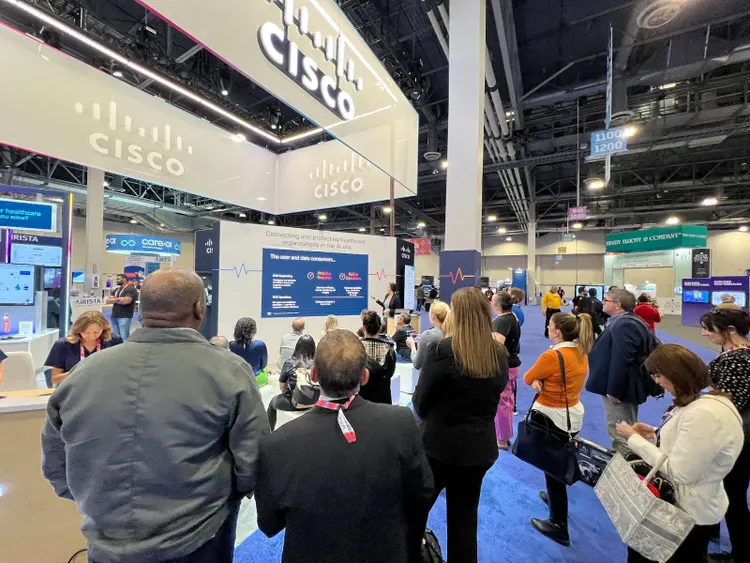
Where Cisco and Splunk Fit In
Splunk’s unified security and observability platform delivers digital resilience across IT, security, and business operations. In healthcare, this means real-time insights that improve system performance, cyber resilience, and patient care. No two healthcare organizations are alike. Some are large multinational systems, others are small community hospitals, and each has its approach to security, data management, and digital transformation. That’s why the integration of Cisco XDR and Splunk Enterprise Security is so significant—it provides flexible, scalable security operations platform to meet healthcare organizations where they are on their journey.
- Threat Detection, Investigation, and Response (TDIR): This holistic approach goes beyond traditional SIEM by combining behavioral analytics, threat intelligence, extended detection and response (XDR), and security orchestration (SOAR) to provide comprehensive cyber resilience.
- Real-Time Visibility for Interoperability and Compliance: Healthcare systems rely on vast, interconnected networks—from EHR to medical IoT devices. Cisco and Splunk enable secure, real-time data integration while ensuring compliance with HIPAA, NIST2, NIS2, and more.
- Adapting to AI’s Impact on Security: As AI becomes embedded in workflows, security concerns grow. We can help healthcare organizations detect and mitigate AI-specific threats, like data poisoning and adversarial attacks while ensuring that AI models are explainable and ethical.
What Leaders Are Saying
At HIMSS25, retired General Paul Nakasone, former Director of the NSA, urged healthcare leaders to think differently about AI adoption, stating:
He highlighted the urgent need for cybersecurity in healthcare, emphasizing that AI will be a game-changer for risk management and clinical decision-making.
Culture, Trust, and the Need for Change
One of the biggest challenges in AI adoption isn’t the technology—it’s trust. Many clinicians remain hesitant about AI-driven decision support, and the key to overcoming this is education, transparency, and culture change. AI should be a visible, explainable, and integrated part of healthcare workflows, not a black box that creates doubt.
The Future of Healthcare Is Here
HIMSS25 reinforced that healthcare’s digital transformation continues at a rapid pace. But here’s the real challenge: technology is moving faster than trust, adoption, and policy. To fully harness new advancements in AI, automation, and interoperability, organizations need to make investments in secure, adaptable, and patient-focused solutions.
Cisco and Splunk are at the heart of this transformation, ensuring that healthcare organizations can move forward with confidence, security, and resilience.
What’s your biggest takeaway from HIMSS25? Let’s keep the conversation going.
Related Articles

How Splunk is Helping Shape the Future of Higher Education IT by Tackling EDUCAUSE 2026 Top Issues

Enhancing Government Resilience: How AI and Automation Empower Public Sector Missions

Solving Manual Mayhem in Telecom with Agentic AI

Upgrading to Splunk Enterprise 10.0 and Splunk Cloud Platform 10.0: Key Resources for Public Sector Customers
Building the Next Generation of Defenders: From the Classroom to the SOC of the Future

Analytics That Work: 3 Approaches for the Future of Contact Centers

Observability + Security: Real-Time Digital Resilience for SLED

Digital Resilience for State and Local Governments (Part Two)