Site Reliability Engineer: Responsibilities, Roles and Salaries
Learn Laiba SiddiquiKey Takeaways
- Site Reliability Engineering (SRE) applies software engineering principles to IT operations, automating manual tasks to build and maintain highly reliable and scalable systems.
- SREs bridge the gap between development and operations by using automation, monitoring, and best practices — focusing on incident response, capacity planning, change management, and platform automation to minimize outages and speed recovery.
- SRE practices rely on service-level indicators (SLIs), objectives (SLOs), agreements (SLAs), and error budgets to balance reliability with innovation, improve collaboration, and support modern, complex infrastructure.
A site reliability engineer maintains the reliability of infrastructure environments. They ensure software applications run smoothly without causing errors after deployment and new changes.
In this article, we will explore the responsibilities of site reliability engineers and how much salary they should expect.
What is the site reliability engineer's role?
A Site Reliability Engineer (SRE) is an advanced DevOps role that combines software engineering and systems administration to ensure the scalability, performance, and reliability of large-scale, cloud-based applications and infrastructure.
Traditional operations roles focus on maintaining systems and reacting to issues, often with a "firefighting" mentality. However, as applications and infrastructure became complex and cloud-based—a more proactive and software-centric approach was needed to ensure reliability at scale.
By combining software engineering and systems administration, SREs brought a different mindset to operations. They approached operations challenges with a software engineering perspective, leveraging:
- Coding
- Automation
- Engineering principles
By doing so, they build resilient, self-healing systems that could scale seamlessly.
So how do they actually do this? Here’s what an SRE actually does:
- Detect issues.
- Automatically handle failures.
- Prepare disaster recovery plans.
- Keep the system up and reliable.
- Mitigate broken systems and prevent them from causing future disruptions.
Site reliability engineer vs DevOps
Site reliability engineering is often confused with DevOps because it focuses on monitoring and improving the system’s reliability. However, SREs are generally involved in the development cycle (SDLC), from coding to scaling applications. Their duties include maintaining production stability and responding to on-call incidents.
While DevOps deals with both development and operational tasks. They aim for fast software releases while maintaining cost-effectiveness.
(Learn about common DevOps roles.)
Site reliability engineer salary range
Platforms like Glassdoor, ZipRecruiter, and Indeed conduct salary surveys to track the average salary for different roles. And the SRE role is in high demand for its importances to businesses — and the income and benefits attached to it.
As of March 2024, this is what site reliability engineers are paid in the U.S on average.
- Glassdoor: $127K to $191K per year
- ZipRecruiter: $63.74 per hour
- Indeed: $153,503 per year
These numbers might go up or down depending on the following factors:
- Size of the company you're applying for
- Experience and skills level
- Job complexity
- Your location
Responsibilities of a site reliability engineer
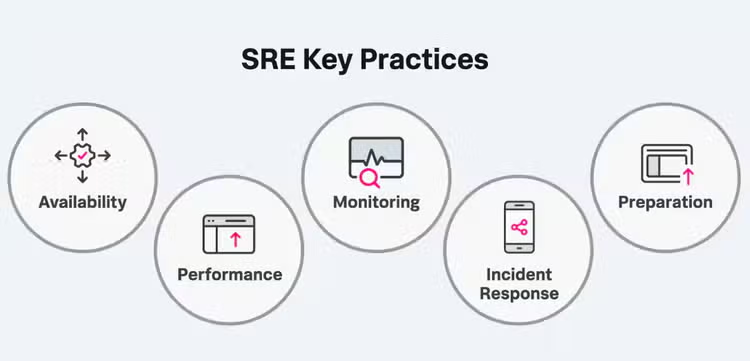
An SRE bridges the gap between traditional software engineering and operations to create highly scalable and fault-tolerant systems. As a result, they ensure the reliable and efficient operation of an organization's systems and services.
Here’s an in-depth look into the core responsibilities of site reliability engineers:
Ensure system reliability and availability
Efficient systems are the backbone of every secure and breach-free organization. Organizations continuously update their application systems to provide advanced features to users.
But sometimes, their systems become unreliable, which results in unavailability. This is where site reliability engineers help.
Here's how they ensure systems are reliable:
- Monitor system issues.
- Create strategies to detect issues.
- Address those issues.
- Design systems to troubleshoot automatically.
- Write and review post-mortems.
Mitigate operational risks
SREs identify, assess, and implement measures to eliminate potential risks that could impact the performance of systems and services.
Here’s how they do it:
- Collaborate with development teams and other stakeholders to identify potential risks.
- Once risks are identified, they analyze and evaluate potential impact and likelihood of occurrence.
- Based on the risk assessment, they implement various risk mitigation strategies to mitigate operational risks.
- Once done, they continuously monitor and review the effectiveness of their risk strategies.
By doing so, SREs maintain system reliability and ensure a positive user experience.
(Learn more about cybersecurity risk management.)
Monitor system health
Monitoring means measuring your system’s health. An SRE uses alerts, tickets, logging mechanisms, and request times to monitor a system’s health. This ensures the system is stable and minimizes user disruption. In case a bug occurs, they respond immediately to resolve it.
However, doing all of this manually is expensive and time-consuming. So, SREs automate this process for systems that handle large amounts of data. Here's how they do it:
- Study historical trends in terms of performance by using metrics like charts and graphs.
- Next, they trace the problems with system monitoring tools.
- Monitor the log files to manage infrastructures at scale.
Doing so eliminates manual collection, storage, and visualization of the data.
Minimize emergency response
Emergency response is the time site reliability engineers take to respond to problems. This period is known as the Mean Time to Respond (MTTR). It measures the time an SRE takes to fix the incident after it happens.
Minimizing the MTTR for reliable systems is necessary to reduce downtime. As an SRE, you can improve this metric by resolving the incidents quickly.
(Related reading: IT failure metrics.)
Maintain internal tooling
Site reliability engineers maintain internal tools to run complex operations smoothly. These tools help them track severe bugs, maintain CI/CD pipelines, and communicate with other teams.
Some of the most widely used internal tools are:
- Communication platforms like Gmail and Slack
- Bug tracking platforms such as JIRA
- Deployment strategies such as GitOps and Flux
- Monitoring solutions like Splunk
- Error logging services such as Sentry and FullStory
- Documentation tools such as wikis or Notion.
Continuous Improvement
Site reliability engineers aim to make systems better every day. For this purpose, they collaborate with teams like QA, software engineers, and security engineers to ensure all teams are on the same page.
They receive feedback, learn from it, and suggest new solutions.
Site reliability engineer skills to kick-start your role
If you want to become a site reliability engineer, you must possess the following skills:
Ability to grow and collab with different teams
To become an SRE, you must be ready to implement what you have learned to become better at your role with every passing day. In this role, you have to collaborate with different teams and devise a strategy for dealing with a system plagued with incidents. You must also identify what new features to deploy and how to make them reliable.
Here are three simple ways to learn and grow as an SRE:
- Observe past behaviors to understand the current state of the system.
- Learn from incidents.
- Collaborate with product teams.
Good grasp of scripting languages
To become a good site reliability engineer, you must have hands-on experience with scripting languages like Python and Bash. These scripting languages help with:
- Automation of processes.
- Troubleshooting issues.
- Enhancing efficiency and reliability across infrastructure.
(Related reading: programming languages & query languages.)
Expertise in Kubernetes
SREs' core roles include troubleshooting and managing failing systems. Kubernetes and containerization technologies automate this process by managing data on various systems.
Whenever you want to roll out new programs, Kubernetes streamlines deployments by handling complicated stuff. This makes it easier to set up and manage software smoothly. That’s why you must have good experience with Kubernetes as an SRE.
Understanding of CI/CD
Since the main job of a site reliability engineer is to ensure that the system runs smoothly, you must have an in-depth understanding of CI/CD.
- CI (continuous integration) checks and combines code from different developers.
- CD (continuous delivery) makes deliveries and deployments safe.
CI ensures that every part of a complex infrastructure fits seamlessly, while CD ensures changes are deployed without any disruption in the network. With these skills, you can minimize the chances of disaster and fix bugs immediately.
(Learn more about CI/CD monitoring.)
Ready to start your SRE job?
Site reliability engineers ensure the smooth operation of systems in organizations. They make systems more reliable and efficient by performing different tasks, from monitoring and minimizing MTTR to detecting and resolving disasters before any disruption.
Related Articles

What is Digital Experience Monitoring?

The Compliance-as-a-Service (CaaS) Ultimate Guide