Hemant Seth's Blog Posts
Hemant is a Principal Product Manager at Splunk, leading the Kubernetes Monitoring offering within Splunk Observability Cloud. Prior to this role, he focused on Splunk Observability Platform administration, including identity management and license usage. Hemant brings over a decade of experience in the observability domain and holds a Master’s degree in Electrical Engineering with a specialization in Telecommunications.
Display Mode
Paginated
Filter
Author
Author URL
Limit
6

Celebrating the Resiliency of the AAPI Community
To commemorate Asian American and Pacific Islander (AAPI) Heritage Month in the United States, we’re proudly celebrating the broader Asian and Pacific Islander (API) community both globally and here at Splunk.

Splunker Stories: Brenden Reeves
In our latest edition of our 'Splunker Stories' series, we meet our CNOC Manager, Brenden Reeves to learn more about the path which led him to Splunk, his global travel adventures, and how he embraces our core value of 'open' to encourage inclusiveness.
What's New: Splunk Enterprise 8.2
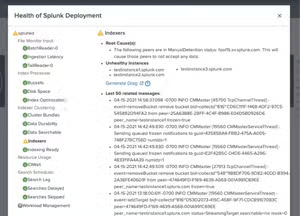
Learn about the new capabilities in Splunk Enterprise 8.2! We have focused our development offers across a number of themes: insights, admin productivity, data infrastructure, and performance.

The Hidden Cost of Sampling in Observability
If your observability platform makes you sample, you may be drawing incorrect conclusions from it – resulting in large hidden costs and consequences. Learn more about how you can avoid missing out on critical insights at the most relevant time.

Splunk and Public Safety
With the Splunk platform, public safety agencies can easily make sense of large volumes of data, from any source regardless of format, type, rate or volume, to gain real-time, enterprise-wide visibility, to make fast and confident decisions, and securely share intelligence across agencies enhancing collaboration, trust and program success.

Monitoring Model Drift in ITSI
In this blog we will talk about some strategies for monitoring your models in ITSI for model drift. This is the idea that the predictive models will become less accurate over time as the rules that were generated originally no longer match the data they are applied to.