Hemant Seth's Blog Posts
Hemant is a Principal Product Manager at Splunk, leading the Kubernetes Monitoring offering within Splunk Observability Cloud. Prior to this role, he focused on Splunk Observability Platform administration, including identity management and license usage. Hemant brings over a decade of experience in the observability domain and holds a Master’s degree in Electrical Engineering with a specialization in Telecommunications.
Display Mode
Paginated
Filter
Author
Author URL
Limit
6

API Security Threats & How To Protect Against Them
Explore the evolving landscape of API threats and their impact on compliance and risk management. Learn critical best practices to secure your APIs.

Data Classification: The Beginner's Guide
Extract meaningful insights from data with data classification. Organize, protect, and manage data while adhering to best practices and achieving compliance.

Using the Lookup Command for Threat Hunting (Lookup Before You Go-Go)
Lookup commands are basically the #1 place to start any threat hunt in Splunk. Get the expert directions here.

Measuring Hunting Success with PEAK
Splunker David Bianco explains how an effective threat hunting program is one of the best ways to drive positive change across an organization’s entire security posture.
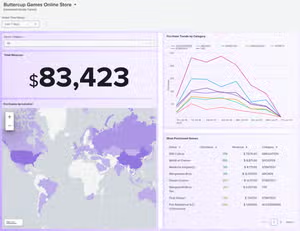
Dashboard Studio: Drilldown to New Features in Splunk Cloud Platform 9.0.2305
Learn about the latest Dashboard Studio features such as Link to reports and search, workflow actions for events viewer, expandable code editor, trellis for single values, and a new conversion report.

Infrastructure Engineering Explained: Roles, Responsibilities and Hierarchy
Learn about infrastructure engineering, its role in data center expansion, DevOps, AIOps, hierarchy levels, and strategic tasks for efficient operations.