State of Observability 2025 Reveals Why Business Growth Runs on Telemetry Data
Observability Patrick LinObservability practices in 2025 are uncovering insights that drive revenue, elevate customer experiences, and create innovative products. It’s a far cry from observability’s origins, when teams worked quietly behind the scenes to keep the lights on by maintaining the business’s applications and infrastructure, and finding and fixing issues. Now, observability practitioners aren’t only supporting the business; they’re acting as catalysts to drive the business forward.
To explore how observability is evolving in this high-stakes environment, Splunk surveyed 1,855 ITOps and engineering professionals across nine countries and 15 industries for our latest report, State of Observability 2025: The Rise of a New Business Catalyst.
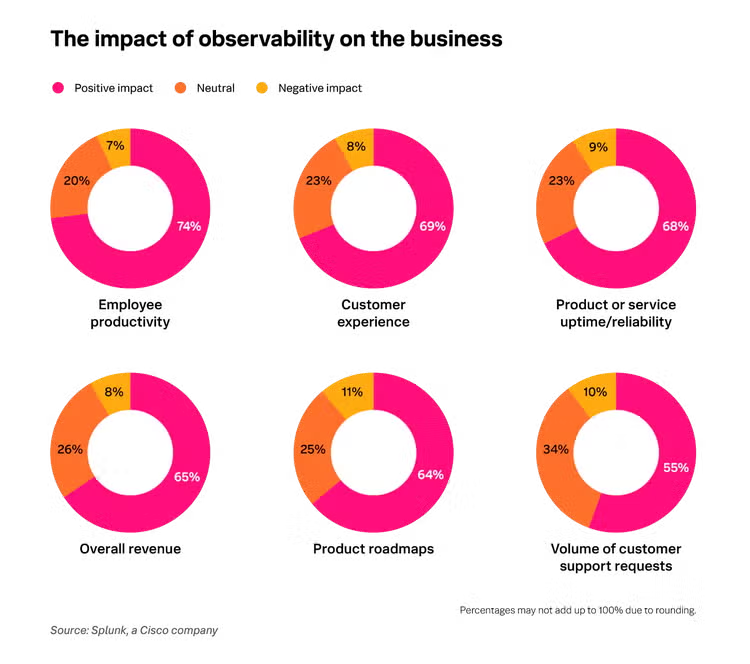
The research reveals how the highest-performing teams are driving outcomes that impact the broader business. They’re nearly twice as likely as their peers to say that their observability practice significantly improves overall revenue, employee productivity, and product roadmaps.
Observability Becomes a Growth Driver
More than ever, organizations recognize that software decisions ripple across customer experience and brand reputation. Observability data is shifting from a troubleshooting tool to a strategic asset, answering questions like “What can we do better?” rather than “What’s broken?” As such, organizations are prioritizing the ability to monitor critical business processes through their observability software; 74% rate it as moderately to very important.
These shifting priorities have paid off; 65% of respondents say their observability practice positively impacts revenue, and 64% say their observability practice positively impacts product roadmaps.
Our research found that a distinct group of leaders influenced these business outcomes more heavily than the rest, and they also generated an ROI that was 53% higher than their peers. What they had in common was a top-tier tech foundation; they often or always used OpenTelemetry, code profiling, and observability-as-code.
They also collaborated more closely with their security counterparts—44% strongly agreed that ITOps and engineering teams troubleshoot and solve issues with security, compared to 29% of others—and used emerging AI technologies like agentic AI at higher rates than their peers.
Reactivity and Poor Alerting Drains ROI
Yet many teams still struggle to shake off their reactive roots. A full 43% of respondents admit they spend too much time responding to alerts. And 20% say they often or always start a war room with members of many teams until an issue is resolved, underscoring how common (and costly) firefighting remains.
Prioritizing alert hygiene and incident response is crucial because alerts are so tightly woven to business success; 54% say the quality of their alert detections has the greatest effect on observability ROI.
One route to smoother incident resolution is collaborating with security teams; 54% say that it wastes less time chasing down issues. And the benefits extend to the broader business, too; 64% say it leads to fewer incidents that affect customers.
AI Changes the Observability Playbook
AI is a proverbial double-edged sword for observability teams. On one hand, 48% say that monitoring AI-powered systems has made their jobs harder—not surprising given how unpredictable, opaque, and dynamic these workloads can be. But that very complexity is also raising the stakes and elevating the role of observability practitioners, as they become key enablers of AI adoption to ensure its performance and reliability at scale.
On the other hand, AI is a force multiplier. Seventy-eight percent of respondents say AI enables them to spend more time on innovation than maintenance. That’s a powerful shift, and one that shows how AI can ease the burden of routine tasks so teams can focus on activities that drive the business—like building new software, which nearly half (45%) say they spend less time than they should doing.
Get the full State of Observability 2025 report for more survey insights and recommendations on how to ensure your observability practice is a business catalyst, from leveraging AI, OpenTelemetry, code profiling, and more.
Related Articles
How To Monitor Kubernetes with Splunk Infrastructure Monitoring

The Hidden Cost of Agentic AI: Why Most Projects Still Die Before Production