SOC Metrics: Security Metrics & KPIs for Measuring SOC Success
Learn Shanika WickramasingheKey Takeaways
- SOC metrics and KPIs, such as Mean Time to Detect (MTTD) and Mean Time to Resolve (MTTR), are critical for measuring the effectiveness of a Security Operations Center's (SOC) performance, incident response, and overall cybersecurity posture.
- Tracking metrics like false positive rates (FPR), false negative rates (FNR), and the cost of an incident helps SOC teams identify areas for improvement, prioritize resources, and enhance operational efficiency to reduce risks and minimize impacts.
- Improving SOC metrics involves proactive monitoring, employee training, leveraging advanced tools like AI/ML for threat detection, and fostering collaboration, enabling organizations to enhance their security capabilities and resilience.
The Security Operations Center (SOC) is the central unit that manages the overall security posture of any organization. Knowing how your SOC is performing is crucial, so security teams can measure the strength of their operations.
This article describes SOC metrics, including their importance, common SOC metrics, and the steps SOC teams can take to improve them.
SOC metrics & KPIs
The Security Operations Center (SOC, pronounced “sock”) is a vital component of an organization. It is responsible for:
- Monitoring systems, networks and data for any threats.
- Responding to security incidents.
The main goal of SOC is to maintain the overall cybersecurity posture of an organization by implementing effective security controls and policies.
SOC metrics and KPIs are the measurable indicators that assist SOC in measuring the performance, effectiveness and efficiency of its security operations. There is a set of commonly used metrics across many organizations. Organizations can choose these metrics based on factors such as:
- Organizational goals
- Industry
- The maturity of their security programs
(Power your SOC with full visibility and security monitoring from Splunk.)
The importance of security metrics
SOC metrics are critical for SOC teams and the overall organization in many ways. In addition to providing insights into areas that need improvement, SOC metrics serve as valuable indicators for assessing the security position of an organization relative to its competitors. (Don’t worry: the terms mentioned here will be explained in the rest of this article!)
- Measuring incident management effectiveness. SOC metrics enable evaluating the effectiveness of incident response and remediation efforts by the SOC teams. For example, metrics like the Mean Time to Resolve (MTTR) enable organizations to assess how fast they can identify a security incident and provide a complete resolution. This reduces the impact of the incident on your clients.
- Prioritizing improvements. Metrics enable organizations to identify areas for improvement. For instance, metrics like the number of incidents resolved, MTTR and the Mean Time to Detect (MTTD) allow organizations to measure the performance and effectiveness of their security operations.
- Comparing to competitors. SOC metrics enable organizations to compare their security practices with those of their competitors. It helps identify areas where they lag and make improvements.
- Ensuring compliance. Many organizations need to comply with various cybersecurity-related regulations. They may also need to provide proof of how their security controls comply with these regulations. SOC metrics help generate reports and showcase the effectiveness of security controls to auditors, regulators and business stakeholders.
- Optimizing teams and talent. SOC metrics help optimize the staffing needs of SOC teams. For example, they can analyze the number of incidents that one person can handle versus the number of incidents that occur. It allows organizations to allocate staff according to their needs.
- Enhancing security training. Metrics also help to evaluate the effectiveness of the training and development programs for SOC team members. Team members can identify where they require additional training by monitoring incident resolution metrics and measuring threat analysis accuracy.
Common SOC metrics
Currently, many SOC teams worldwide utilize several commonly used incident response metrics. In the next section, let’s learn what these metrics are, their importance, and the ways to enhance them.
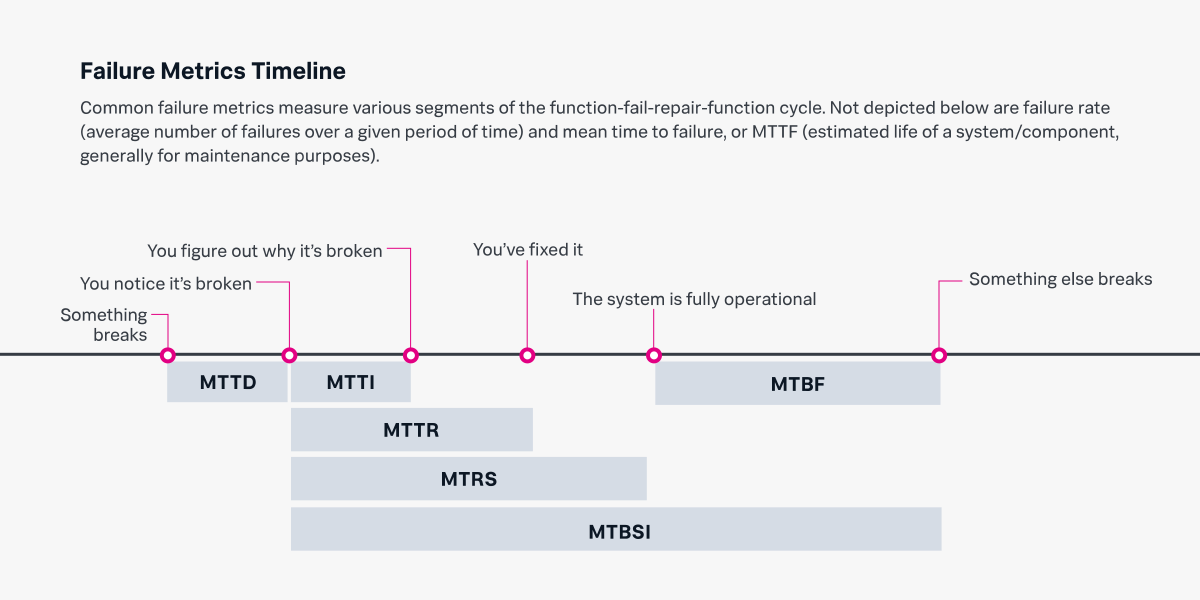
Mean Time to Detect (MTTD)
MTTD measures the average time a SOC team takes to detect an incident or a security breach. A shorter Mean Time to Detect (MTTD) value indicates better performance. It showcases the ability of the SOC team to quickly detect and respond to incidents, minimizing the impact on clients.
Additionally, MTTD it helps evaluate the effectiveness of monitoring tools and the efficiency of detection capabilities.
Mean Time to Investigate (MTTI)
MTTI denotes the average time from fault detection until the IT team initiates investigation. It bridges the gap between MTTD (Mean Time to Detect) and the start of MTTR, outlining the initial response phase.
Mean Time to Resolution (MTTR)
MTTR is the metric used to evaluate the average time a SOC team takes to completely resolve an incident once it has been detected. A lower MTTR value indicates that their incident response process is fast and highly effective. Typically, MTTR includes the time it takes to:
- Investigate the root cause.
- Apply fixes.
- Carry out recovery processes.
This metric allows organizations to identify areas where they need to focus, improving their incident response strategy.
Mean Time to Restore Service (MTRS)
MTRS quantifies the average time from fault detection until service is fully restored, emphasizing user-centric recovery time following repair. MTRS differs from MTTR in that MTTR measures repair duration, whereas MTRS encompasses the entire process until service is operational again.
Mean Time Between Failures (MTBF)
MTBF measures how frequently a failure occurs. It represents the average time between one failure and the next, indicating the expected interval before another failure might occur. This metric is versatile, applicable to individual components or entire systems, offering insights into overall system reliability and performance. MTBF, along with MTTR, plays a crucial role in determining system uptime. While MTTR assesses how quickly a system can be restored after a breakdown, a favorable scenario involves decreasing MTTR and increasing MTBF, highlighting minimal downtime and efficient recovery capabilities.
Mean Time Between System Incidents (MTBSI)
MTBSI signifies the average interval between successive incidents, calculated by adding MTBF and MTRS. It provides a comprehensive view of system stability and operational continuity over time.
Mean Time to Attend and Analyze (MTTA&A)
MTTA measures the average time taken by SOC teams to respond to and analyze an incident. It starts with detecting an incident and ends when the team acknowledges and properly analyzes its priority, impact and possible resolution.
Therefore, this metric helps you evaluate the efficiency and effectiveness of their incident response processes.
MTTA&A begins when an incident is detected or reported. It ends when the incident response team acknowledges, assesses and analyzes the incident to determine its scope, impact and potential remediation actions. This metric is crucial as it reflects the efficiency and effectiveness of the incident response process.
Number of Security Incidents
This metric measures the number of security incidents detected and reported within a specific timeframe. It helps organizations get insights into patterns or trends in security incidents.
For instance, if there is an increasing trend for several incidents, it may indicate that the organization needs improvements to its existing security controls. Additionally, tracking the number of security incidents allows organizations to easily identify which types occur more frequently and require attention to prioritize them.
(Learn all about incident management.)
False Positive Rates (FPR) and False Negative Rates (FNR)
FPR, or False positive rate, measures the percentage of incidents that are incorrectly classified as cybersecurity incidents but are not actual threats. A high false-positive rate indicates that the system is more likely to generate false alarms.
False negative rate (FNR) is the percentage of incidents that are mistakenly categorized as non-cyber threats but are actually cyber threats. A high false-negative rate indicates that the system is highly likely to miss the real security threats.
Cost of an Incident
This metric allows organizations to measure the direct and indirect costs of an incident:
- Direct costs include expenses such as the time and resources required for detection and response and legal fees.
- Indirect costs include the loss of revenue due to customer turnover, regulatory penalties, reputational damage, etc. Additionally, there may be other expenses, such as costs associated with software updates and measures to prevent future incidents.
Improving security & SOC metrics
OK, so you’ve tracked some of your SOC metrics and, well, you don’t like what they show. It’s time to improve your metrics. Really, improving metrics is shorthand for improving operations, as the metrics are merely outputs.
Let’s take a look.
How to improve MTTD
Implement robust monitoring and alerting systems to identify issues quickly. Those tools should be capable of notifying the related individuals and teams of the incidents, providing comprehensive incident information.
Furthermore, the tools should escalate the incidents to higher levels if no action is taken at lower incident response levels.
- Regularly assess your systems for vulnerabilities using techniques such as vulnerability scanning and penetration testing. These measures will assist in proactively identifying potential threats.
- Educate employees on how to proactively identify and report suspicious activities and unusual system behaviors. It will aid in early detection and response to potential security threats.
How to improve MTTR
You can improve your documentation by documenting known issues, solutions and troubleshooting steps. It enables SOC teams to resolve incidents efficiently.
- Use effective communication and collaboration through knowledge sharing using collaborative tools will help speed up the incident resolution process.
- Automate manual tasks such as data corrections, testing, and incident triage to save time, minimize human error, and accelerate the overall resolution process.
(Are you using AI in your security operations? Get this checklist to activate and optimize AI in the SOC.)
How to improve MTTA&A
- Implement dedicated communication channels to enable SOC teams to analyze incidents collaboratively and share information effectively. For example, use instant messaging platforms, dedicated incident response channels, etc.
- Use automated tools for incident triage and prioritization, applying well-agreed-upon criteria like the source and nature of the incident and customer types.
- Use analytics tools to assist in incident analysis. For example, anomaly detection systems and threat intelligence systems help identify known threat patterns. These tools can expedite the analysis process.
- Maintain up-to-date documentation on useful information, such as how to analyze data, guidelines for incident triage, and initial analysis, in an easily accessible place.
- Improve alerting in such a way that responders can be informed of newly-created issues faster.
- Implement on-call schedules to ensure that an adequate number of responders are allocated 24/7 to acknowledge and respond to incidents.
How to reduce the number of security incidents
- Regularly assess system vulnerabilities. It enables organizations to proactively detect any new security threats or weaknesses in the system and remediate them before any incident occurs.
- Educate and train employees and customers about cyber threats to avoid becoming victims of cyber crimes and to prevent risks to the organization.
- Proactively monitor and alert to detect incidents before they could impact the organization.
How to improve FPR
- Constantly refine threat detection rules and thresholds used to generate alerts using the latest threat information and intelligence.
- Use innovative technologies like Artificial Intelligence (AI) and Machine Learning (ML) to improve the accuracy of SOC metrics.
- Improve data quality, as inaccurate and inconsistent data can produce more false positives.
- Perform threat hunting to proactively detect potential threats. It helps you identify false positives and improve the overall accuracy of your threat detection systems.
(Know the difference between threat hunting & threat detecting.)
How to improve FNR
- Comprehensively monitor the organization, covering all applications, systems and networks 24/7. This will reduce the chance of any cyberattack going undetected.
- Mature your operations. Based on the capabilities of the organization, you can leverage advanced threat detection techniques such as threat intelligence, AI, and ML-based threat detection to further enhance their detection capabilities.
- Regularly invest in training and awareness programs to stay up to date with the latest cybersecurity trends and attack techniques. It will help address any security gaps.
(Check out these security events & conferences.)
How to reduce the cost of an incident
Proactive monitoring, faster incident response, and remediation are critical to reducing the overall cost of an incident. Implement robust security mechanisms such as antivirus software, strict access controls, and regular software updates to prevent cyber incidents from occurring in the first place.
Conduct continuous security vulnerability assessments to identify potential vulnerabilities and remediate them proactively.
Summing up the successful SOC
SOC metrics are the measurable indicators that enable SOC teams to assess the effectiveness, efficiency, and overall performance of their security operations, including incident response.
There are several SOC metrics that organizations can use, depending on their requirements, as we’ve covered in this article.
Related Articles

Understanding Application Lifecycle Management (ALM): Stages, Strategies, and Benefits

Log Analytics: How To Turn Log Data into Actionable Insights