What Is Risk Scoring? How To Score Risk
Learn Leanne MittonKey Takeaways
- Risk scoring quantifies the potential impact of security events, enabling organizations to prioritize threats and focus resources on the most critical risks.
- Aggregating and automating risk scores — especially within SIEM or SOAR workflows — streamlines triage, accelerates threat detection, and improves response efficiency.
- Splunk solutions allow teams to define risk rules, adjust weighting, and refine models as new data or threats emerge, supporting proactive and dynamic security operations.
With the rapidly evolving digital landscape, the ability to accurately measure and prioritize risks has never been more critical.
A key aspect of cybersecurity, risk scoring uses a numerical assessment to quantify an organization's vulnerabilities and threats. As technology becomes more integrated into our daily lives, identifying and mitigating risks is essential to:
- Safeguard our sensitive data.
- Protect confidential information.
- Eensure business continuity.
From cyber threats and data breaches to regulatory compliance issues and supply chain disruptions, these risks pose significant challenges to organizations of all sizes. That's where risk scoring comes in.
Businesses should use risk scoring to pinpoint and rank risks, making assigning resources easier and applying suitable risk management strategies.
(This article is about the general concept of risk scoring, as part of risk assessments. For more information about risk scoring in Splunk, read how risk scores are calculated for RBA in Splunk Enterprise Security.)
The evolution of risk scoring
Historically, risk scoring was a slow, manual, and somewhat subjective process, relying heavily on expert opinion, checklists, and past experiences.
However, through advances in technology using artificial intelligence (AI) and machine learning (ML), we've been able to transform this process into a more objective, data-driven endeavor. Organizations are now able to sift through vast amounts of data at unprecedented speeds, giving you the ability to:
- Improve the accuracy of risk assessments.
- Enable real-time monitoring and updating of risk scores.
Consequently, businesses can now predict potential vulnerabilities and threats with greater precision, enabling proactive — rather than reactive — strategies.
Proactive identification and evaluation of new threats is important when maintaining an effective risk management strategy and can be achieved through a combination of:
- Advanced analytics
- Threat intelligence
- Regular risk assessments
This evolution is a total change in how organizations approach risk management, emphasizing the importance of leveraging cutting-edge technologies to stay ahead in a digitally dominated world.
Understanding risk scoring
Understanding risk scoring involves grasping the metrics and methodologies used to calculate the likelihood and impact of potential threats. This calculation typically incorporates a variety of factors, including the following:
- Nature of the threat
- Vulnerability of the system to that threat
- Potential damage or loss that could result
When you assign numerical values to each of these factors, organizations are able to create a combined risk score that quantifies the level of risk in a clear and actionable way.
Step 1: Identify which assets are at risk
The process begins with identifying the assets at risk — be it data, physical assets, or personnel — and then evaluating the threats and vulnerabilities associated with these assets.
Vulnerabilities might include:
- Weaknesses in software, hardware, or systems
- Inadequate security protocols and controls
- Human error or malicious intent
Threats can range from cybercriminal activities and natural disasters to system failures and insider attacks.
Step 2: Assess each risk event
Once you’ve identified the potential threats and vulnerabilities, the next step is to assess each risk event. You can use a simple 2x2 or 3x3 matrix, for example, or more advanced software (though beware that might complicate your efforts, too). In this step you’ll want to assess both:
- The likelihood of that event
- The potential impact of the event
This is where AI and ML technologies really shine, providing a significant advantage by offering the ability to analyze trends, predict events, and model potential outcomes with a high degree of accuracy.
(Learn how to analyze risk using Splunk Enterprise Security.)
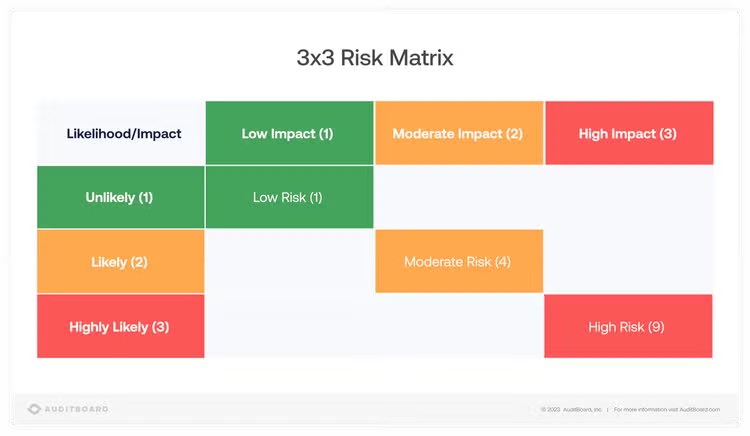
Example of a risk matrix. (Image source)
Step 3: Prioritize those risks
The final risk score helps businesses prioritize their risks, focusing their efforts and resources on mitigating those with the highest scores — ensuring that efforts are concentrated where they are most needed in the organization's overall security systems.
How to implement risk scoring in your organization
Implementing a robust risk scoring system within your organization involves careful planning, execution, and ongoing management. The following steps are crucial in establishing a framework that not only identifies and assesses risks accurately but also aligns with your organization's strategic goals:
- Establish framework and criteria. Define your risk scoring objectives and develop criteria based on impact, likelihood, and organizational risk appetite. Ensure these criteria align with your overall risk management strategy and industry standards.
- Collect data and identify risks. Gather comprehensive data from internal and external sources. Use a combination of automated tools and expert analysis to identify and catalog potential risks across the organization's operations.
- Develop and integrate your scoring system. Create customized scoring algorithms tailored to your organization's specific needs. Integrate the risk scoring system with existing IT and risk management infrastructure, ensuring seamless operation within current workflows.
- Train stakeholders and implement the system. Conduct training sessions to educate stakeholders about the risk scoring process and their roles. Roll out the system initially through a pilot project, allowing for adjustments based on feedback before wider implementation.
- Monitor, review, and update. Continuously monitor the system's effectiveness and gather feedback for improvements. Regularly review and update the risk scoring criteria, algorithms, and processes to adapt to new threats and changes in the organization's risk landscape.
By implementing these steps, your organization can leverage a risk scoring system that not only enhances its overall security posture but also supports informed decision-making and strategic planning efforts.
This proactive approach to risk management empowers organizations to mitigate potential threats effectively and drive long-term success and resilience in an increasingly uncertain world.
(Learn more about this solution, Splunk Asset and Risk Intelligence.)
Tailoring risk scoring to industry needs
Every industry faces unique risks that require specialized consideration in the development and application of risk scoring systems.
- The financial sector must contend with fraud, cybersecurity threats, and compliance risks, necessitating algorithms that can dynamically adjust to evolving regulatory landscapes. - The healthcare industry, with its emphasis on patient data privacy and safety, demands a risk scoring system that prioritizes the confidentiality and integrity of sensitive information. - Manufacturing entities faced with supply chain disruptions and operational hazards benefit from scoring models that highlight logistical and physical vulnerabilities. - The energy sector, with its critical infrastructure and high-profile attacks, requires a risk scoring approach that considers geopolitical events and the potential for cascading impacts.
Organizations must tailor their risk scoring systems to reflect industry-specific risks accurately. Doing so enables them to allocate resources effectively, comply with relevant regulations, and safeguard their operations against the unique threats they face.
Navigating the challenges of risk scoring
Despite its extensive benefits, a risk scoring system's implementation and ongoing usage can encounter several pitfalls. Recognizing and addressing these challenges early is important in maintaining the efficacy and reliability of the risk scoring process.
- Over-reliance on quantitative data. While quantitative analysis offers objectivity, over-dependence can overshadow qualitative insights that are equally critical in risk assessment. Balancing both types of data ensures a more comprehensive understanding of risks. - Static scoring models. Risk landscapes are continually evolving. A static scoring model fails to reflect current threats accurately. Regular updates and adjustments to the scoring algorithms are necessary to stay relevant and effective. - Insufficient stakeholder engagement. The success of a risk scoring system heavily relies on the active participation of stakeholders. Lack of engagement or inadequate training can result in misunderstandings and underutilization of the system. - Data quality and availability. High-quality, relevant data is the foundation of accurate risk scoring. Data collection, storage, and data management issues can significantly impair the system's ability to identify and prioritize risks effectively. - Complexity and usability. An overly complex risk scoring system may deter users, reducing its effectiveness. Balancing sophistication with user-friendly interfaces and processes is critical for widespread adoption and utilization.
Navigating these pitfalls requires a proactive, informed approach. Regularly reviewing and refining the risk scoring process, fostering a culture of risk awareness, and ensuring active involvement from all stakeholders are key strategies for overcoming these challenges.
By doing so, organizations can maximize the benefits of their risk scoring system, enhancing their resilience and strategic decision-making capacity in the face of dynamic risk landscapes.
Staying ahead of emerging risks
In an ever-evolving threat landscape, staying ahead of emerging risks is key for organizations across all sectors.
By fostering an environment of constant vigilance and adaptability, organizations can quickly adjust their risk scoring models to reflect the current risk environment. Engagement with industry peers and participation in security forums can also provide valuable insights into emerging threats and mitigation strategies.
Through these concerted efforts, organizations can not only protect themselves against immediate dangers but also anticipate and prepare for future risks, ensuring long-term resilience and success.
As the digital landscape continues to evolve, the need for sophisticated risk scoring methodologies has never been greater. Now is the time for companies to assess and enhance their risk scoring practices, ensuring they are prepared to meet the challenges of the digital age head-on.
Related Articles

IT Operations Analytics: An Introduction

Data Privacy: The Ultimate Guide