Machine Customers: A Complete Introduction
Key Takeaways
- Machine customers — autonomous systems such as bots, IoT devices, and AI agents — are increasingly making purchasing decisions and transactions on behalf of humans or organizations, creating a new class of consumers that businesses must address.
- This shift requires organizations to rethink traditional business models, customer engagement strategies, and approaches to security and data management in order to stay competitive in a digital ecosystem where machines are significant market participants.
- To effectively serve machine customers, companies must adapt their products, services, and infrastructure — establishing robust observability, service level management, and innovative marketing approaches — to support the unique traffic patterns, performance needs, and engagement channels of automated buyers.
What is a machine customer? A machine customer is a non-human entity that autonomously engages in transactions, like purchasing goods and services. Unlike traditional automated systems, machine customers do not strictly follow predefined rules. Instead, they can…
- Make decisions based on a variety of factors.
- Adapt their behavior over time.
- Make transactions on behalf of a human or even for themselves.
In this article, we'll examine the future of machine customers and the potential impact they could have. First, let’s compare humans and machines.
How machine customers are different from human customers
There are great benefits to having machine customers rather than, or in addition to, human customers. Some of the traits that make this tech different include:
- Efficient and methodical. Machine customers are poised to be more efficient and effective than human customers. Human customers are often inconsistent and forgetful, leading to suboptimal purchasing behaviors. In contrast, machines are observant, tireless researchers. They apply logic and reason, ensuring that they are better at buying what’s necessary and avoiding unnecessary or impulsive purchases.
- Removal of emotion and sensory manipulation. Machines focus on completing tasks. They won’t be influenced by the music being played in a store, odors and scents, such impact human sales. Neither the wide variety of psychological manipulation taking place in facilities like casinos and grocery stores can affect machines.
- Make use of massive amounts of data. Machine customers can access and analyze vast amounts of data far beyond human capacity. Large Language Models are a perfect example of this capability.
- Mitigate the paradox of choice, decoy effect, and decision fatigue. Humans suffer from manipulative pricing strategies, nudging them towards suboptimal choices. They suffer from the effects of making too many decisions in a day. Furthermore, when presented with a selection of options, humans can end up frustrated. Machine Customers are able to avoid all of these natural tendencies of human beings.
Machine customers: Current state and near-future growth
The presence of machine customers is already noticeable. Screen scrapers, initially used to extract data from web pages, are early example of this technology.
As technology evolves, these forms will become more sophisticated — and more bots and other frameworks capable of interacting with digital platforms will be developed. Thus, businesses must adapt to cater to these non-human customers, which might involve providing application programming interfaces (APIs) for more efficient interactions.
Some prognosticators believe machine customers will have one of the greatest impacts on economic transactions among all emerging technologies by the end of the decade.
ZDNet suggests that machine customers will account for staggering trillions of dollars in revenue by 2030. Meanwhile, Gartner reports that CEOs expect up to 20% of their companies’ revenue to come from machine customers by 2030.
(Related reading: a global look at IT spending today.)
Three developmental phases for machine customers
Gartner suggests there will be three phases of machine customers:
- Today: The bound customer. In this model, the human leads, the machine executes.
- In 2026: The adaptable customer. Human and machine co-lead, the machine executes.
- In a decade: The autonomous customer. Machine leads and executes, no human involved.
Major technology corporations are laying the groundwork for the rise of machine customers. The necessary technologies —IoT and AI pattern recognition — are already in place. These technologies will be central to creating a machine customer economy, revolutionizing digital commerce, and creating new market spaces far beyond the complexity that traditional business models can handle.
Interest growing in machine customers
Google Trends shows a clear rise in interest in the phrase “machine customers” over the past year or two, while “custobots” remains basically unused. Google Trends data is relative and represents search interest over time — there is always a “100” value, which is the peak of interest. Here, the value is 61.
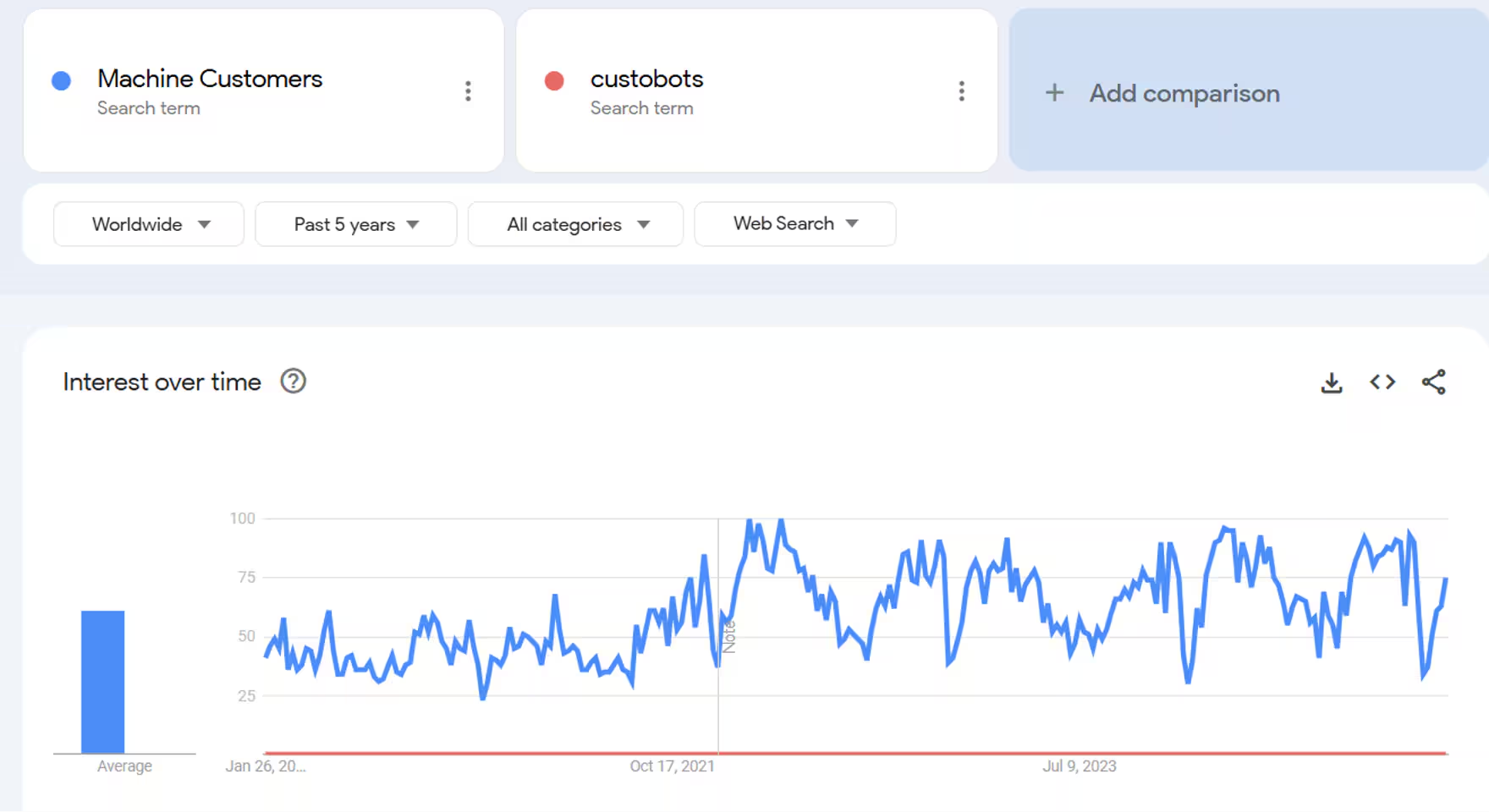
Source: Google Search Console, 1/31/2025
Machine customers in the hype cycles
Gartner publishes various hype cycles throughout each year. Machine customers appear frequently in different hype cycles since 2021. Particularly, it seems mostly to be found in the Innovation Trigger phase at this point. While very few technologies move all the way from Innovation Trigger to the Plateau of Productivity, it's quite possible that machine customers are able to achieve this distinction.
Regardless, with the recent popularity of ChatGPT and other Large Language Models, it’s almost certain that machine customers will rise to the Peak of Inflated Expectations (and further grow in search interest as a result).
The August 2023 Gartner Hype Cycle for Supply Chain Strategy has machine customers positioned in the Innovation Trigger phase, just ahead of the Digital Twin of a Customer and Generative AI.
Notably, the most recent version of the Hype Cycle for Emerging Technologies Highlights Developer Productivity, Total Experience, AI and Security — published in August 2024 — bumps machine customers into the Peak of Inflated Expectations.
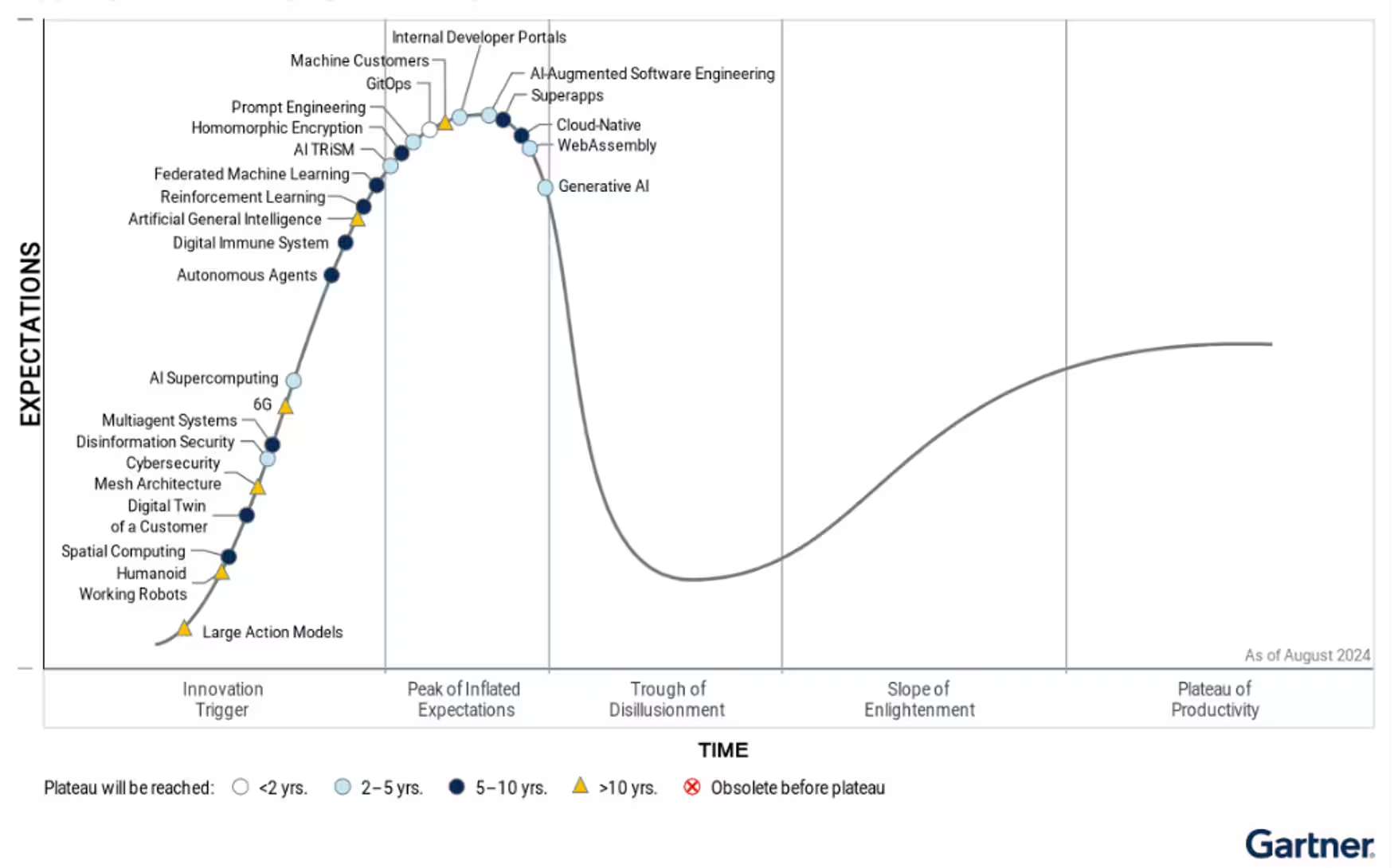
It will be interesting to continue watching machine customers move in and out of these and other hype cycles and potentially into further phases in the coming years.
Use cases and applications for machine customers
So, why is this tech concept hanging around for the last few years? How can we start using machine customers? Let’s look at the common business functions of sales, marketing, and data analysis.
How machine customers support sales and marketing functions
Machine customers collect and analyze data on the behavior, interests, and preferences of human customers. They then use:
- Behavior-based product recommendations to suggest tailored products.
- Predictive analytics to learn future purchasing behavior, helping businesses forecast customer needs and customize marketing strategies to meet consumer experiences.
This technology incorporates virtual assistants (VAs) and chatbots that provide real-time sales support. It can also notify customers of upcoming events, discounts, and promotions.
How machine customers will affect data analysis departments
Machine customers generate high volumes of data in real time. Thus, data analysis departments need to prepare to process large datasets of real-time data.
On top of that, as more unstructured data is generated from areas like AI, voice, and chatbot conversations, more advanced AI models for analysis are needed. With automation, analysts' roles will shift from data collection to interpreting and making decisions based on AI-generated insights and ensuring compliance with data protection regulations.
Machine customer's risks and concerns
There are three major concerns when it comes to machine customers.
Incomplete or biased data. Machine customers' algorithms are trained on data. If the data is incomplete or biased, it may lead to algorithms generating discriminatory or unfair outcomes — and they are not accountable for their decisions. For instance, machine customers are not accountable for poor purchasing decisions that they may make or any manipulation of consumer behavior.
Data privacy and cybersecurity. Another concern is that AI systems collect and analyze personal and transactional data. Cyberattacks could target this data, increasing the risks of identity theft and unauthorized transactions.
Lack of transparency in machine decision-making. The "black box" issue is a common concern in machine learning models. Machines make decisions without explaining the reasoning behind those choices or the data they're using. When users don't have visibility into how the machines produce results, they might not feel confident in the fairness or accuracy of the outcomes.
The decision-making process changes when AI models are updated, modified, or retrained on new datasets. Maintaining transparency consistently is challenging.
Wrapping up
The development of machine customers is reaching a tipping point, driven by the need to free humans for more valuable tasks and the capacity of technology to support this shift. This evolution demands that business strategists view the rise of machine customers as an inevitable trend and plan accordingly.
The potential for improved efficiency and smarter purchasing decisions points to a future where this technology plays a pivotal role in shaping market dynamics and consumer behavior.
Related Articles

How to Use LLMs for Log File Analysis: Examples, Workflows, and Best Practices

Beyond Deepfakes: Why Digital Provenance is Critical Now

The Best IT/Tech Conferences & Events of 2026
The Best Artificial Intelligence Conferences & Events of 2026

The Best Blockchain & Crypto Conferences in 2026

Log Analytics: How To Turn Log Data into Actionable Insights

The Best Security Conferences & Events 2026

Top Ransomware Attack Types in 2026 and How to Defend