Computer Forensics: Everything You Need To Know
Every day, thousands of people become victims of cyberterrorism, online fraud, and crimes beyond white-collar offenses. That’s why law enforcement agencies combine traditional investigations with digital evidence to combat these and secure cyberspace.
But how do we collect digital evidence?
Computer forensics has emerged as a modern technology to identify, extract, document, and preserve data stored on digital devices. This ensures the data is presented in authentic and undamaged form at the court of law.
Let's see the steps involved in computer forensics, its various types, and some key challenges.
What is computer forensics?
Computer forensics is a post-incident analysis that involves analyzing recovery, documentation, and presentation of digital evidence. As crimes like cyberstalking and harassment increase, advances in computer forensics are becoming increasingly important.
This progress will drive growth in the cybersecurity industry, which is expected to reach $185.70 billion in revenue by 2024.
To perform computer forensics the right way, you must consider the following points:
- Maintain authenticity and integrity of digital evidence.
- Acquire warrants from relevant authorities.
- Never compromise on individual and organizational privacy.
- Follow professional protocols and avoid conflict of interest.
(Related reading: digital forensics.)
How computer forensics works
Any data that is unreliable or compromised cannot be used in court or other justice systems. To avoid that, computer forensics is an excellent threat detection and recovery tool that helps ensure the data is ready to be used.
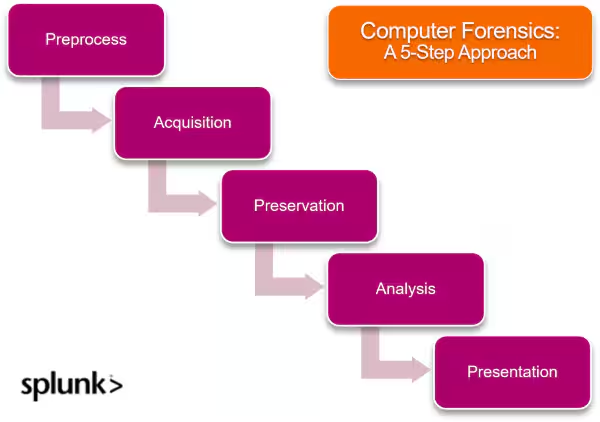
Here are five core investigation phases involved in computer forensics to make sure digital evidence meets legal standards:
Step 1. Pre-process
Before data collection and investigation, computer forensics examiners must complete the following pre-process steps:
- Computer forensics examiners must be practicing officers.
- They must obtain approval from the authorities.
- They should prepare and set up the required tools.
- They should obtain consent from relevant parties.
- Verify if the consenting party has the authority to access certain areas or devices in a shared location.
Step 2. Acquisition
In the second phase, they must acquire data from a suspect's digital devices. These devices may contain files or documents that can help resolve legal matters.
That’s why the forensic examiner thoroughly searches these devices and seizes them if they're relevant to the investigation. This helps them collect and transport relevant data securely.
Step 3. Preservation
After data acquisition, the investigation team safeguards the crime-related information and collected evidence to maintain its integrity. They ensure that the documents and ID are readable and traceable.
The team uses appropriate tools and methods to prevent data loss and modifications. In addition, they engage a third party for digital archive management to strengthen data authenticity by introducing an independent layer of verification.
Step 4. Analysis
Aside from finding the source and type of information stored on the device, this phase also includes identifying the real culprit. It can be straightforward if only one person can access the device, but that's not always true.
So, if there are multiple users, forensics teams analyze the following:
- How many people have access to the device?
- How many user accounts exist?
- Which accounts are shared by multiple individuals?
These questions help them build a solid case and catch the responsible person.
Step 5. Presentation
In the final phase, the forensic examiner prepares a final report and presents the findings to the authorities. The report includes:
- The findings from each phase of the investigation.
- The methods used to collect and analyze the evidence.
- A clear explanation of how and where you accessed each document.
- Sequence and timeline of the events if any similarity exists.
Different types of computer forensics
The type of computer forensics you need to perform depends on the nature of the crime. Maybe you are investigating a malware attack or a phishing attack. Each type of crime requires a different approach and set of tools.
Let’s look at some of the most common types of computer forensics:
Web forensics allows you to trace and attribute security attacks on web applications. You analyze log files from web browsers, servers, and applications to find evidence of cybercrime.
Email forensics. Of attacks reported in quarter one of 2024, more than one-third (37.6% ) were phishing attacks. In such attacks, users receive fake emails with malicious links to steal their identity or install malware. As a result, email forensics is used to detect such crimes.
Network forensics. Network breaches are on the rise. In 2023, a staggering 19% of all detected cyberattacks involved a network breach. That’s why companies use network forensics to analyze cookies and cache and identify attack sources. This way, you can avoid spam websites and prevent becoming a victim again.
Cloud forensics. While more businesses are adopting cloud computing models, cloud security remains the biggest concern. Cloud forensics addresses these cloud-related privacy crimes. However, since clouds are deployed in different locations, it's quite daunting to seize the physical devices.
Memory forensics allows you to analyze active processes on RAM and volatile memory to extract data where malware might be hidden. The goal is to find when the virus was installed and what its actions were on the system.
Computer forensics: Some key challenges
Computer crime is the ugly truth of the digitally connected world. Unsurprisingly, the IT sector is the most breached sector of 2024. That’s why organizations use computer forensics to find the root cause of these attacks.
However, following are some of the associated challenges with implementing computer forensics:
- Difficulty retrieving mobile data: Recovering deleted data is part of computer forensics, which is challenging for cell phones and iPhones. It's nearly impossible to retrieve data from the latest released models.
- Shared computing resources: Multiple users share the same cloud resource. That's why isolating and securing evidence without compromising other users' privacy is challenging.
- No physical accessibility: Due to cloud models' distributed nature, it's impossible to find the exact location of data. This issue will persist unless users can choose the territories of their data.
- Data hiding in storage space: Steganography is a common way for criminals to hide evidence in digital storage in the form of images, which makes it challenging for forensic experts to differentiate anomalies from modified ones. (Related reading: storage monitoring can help.)
- Data encryption: Scammers encrypt data to other formats to delay the digital investigation process. Data decryption is complex and requires a secret key to crack the code — making it time-consuming for forensics teams to break the encryption.
Computer forensics needs more attention
In 2023, computer crimes resulted in 12.5 billion USD in losses, which will grow if not appropriately handled. Only the rapid pace of technological change and ample funding can bridge the gap and keep you ahead.
Computer forensics is used to handle these crimes. It has many strengths, but some areas still have loopholes. For example, handling cloud evidence is currently the biggest challenge.
Related Articles

How to Use LLMs for Log File Analysis: Examples, Workflows, and Best Practices

Beyond Deepfakes: Why Digital Provenance is Critical Now

The Best IT/Tech Conferences & Events of 2026
The Best Artificial Intelligence Conferences & Events of 2026

The Best Blockchain & Crypto Conferences in 2026

Log Analytics: How To Turn Log Data into Actionable Insights

The Best Security Conferences & Events 2026

Top Ransomware Attack Types in 2026 and How to Defend