A Guide to Cloud-Native Security: 4Cs, 3Rs, and Essential Protection Strategies
Learn Blessing Onyegbula , Shanika WickramasingheKey Takeaways
- Integrate security at every cloud layer — from cloud infrastructure to code — by applying the 4Cs (Cloud, Cluster, Container, Code) framework for resilient cloud-native applications.
- Use proactive and reactive strategies, including the 3Rs (Rotate, Repair, Repave), and robust security tools to defend against evolving cloud threats.
- Adopt a shift-left and zero-trust approach, regularly update systems, and implement strong encryption to minimize vulnerabilities and strengthen cloud-native security.
Many organizations today develop, build, and deploy cloud-native applications that use the infrastructure and services offered by cloud computing providers like Amazon Web Services (AWS), Azure, or Google Cloud Platform (GCP). This trend highlights a critical consideration for organizations that care about securing the applications, infrastructure, and data they house in cloud-native systems.
In this article, we will explain cloud-native security, its importance, the core principles of the 4Cs and 3Rs of cloud-native security, and cloud-native security strategies.
What is cloud native security?
Cloud native security is the integration of security strategies into applications and systems designed to be deployed to and run on cloud environments. Rather than retroactively adding security measures to existing applications, cloud-native security focuses on securing the cloud infrastructure and applications from the beginning of the development lifecycle.
This involves adding necessary security measures to every phase of the cloud-native application development, deployment, and operation. These security measures are also incorporated at every cloud layer, including the infrastructure planning, coding, testing, deployment, and maintenance phases.
Cloud-native security incorporates security into your organization’s overall cloud-native application development process. This includes using a wide range of security tools and technologies and implementing practices with preventive measures to defend the systems against cyberattacks. It also involves using reactive measures that allow quick resolutions during security incidents. This provides a strong foundation for developing and deploying cloud-native applications.
Common approaches to cloud-native security include:
- Authentication and access control with identity and access management (IAM).
- Encryption of data in transit and at rest to secure data and systems.
- Network security and data security strategies.
- Processes and procedures for incident response and risk management.
- Disaster recovery policies.
- Periodic security scans.
Why is cloud-native security so important?
Any security loophole can impact your cloud operations and potentially have widespread ramifications across your organization. Take the 2022 attack on CircleCI, a popular CI/CD platform. Hackers gained access through a compromised engineer's laptop, targeting environment variables and secrets stored in the build pipelines. The incident lasted for two weeks and led to the theft of environment variables, tokens, and keys belonging to different third-party systems.
In 2023, Microsoft disclosed a breach where Chinese hackers exploited a token validation issue in their Azure Active Directory, giving unauthorized access to multiple U.S. government email accounts. This breach was not discovered until a month after it first occurred.
These incidents underscore a crucial reality: vulnerabilities in cloud-native systems can lead to catastrophic fallouts.
There are many ways by which cloud-native environments can be compromised. Some of the more common attack vectors include:
- Compromised container registries like malicious base images.
- Supply chain attacks, such as injecting malicious code into dependencies.
- Identity and Access Management (IAM) misconfigurations, for example, unfettered permissions or privilege escalation.
- Kubernetes API vulnerabilities, like exposed APIs or misconfigured role-based access controls (RBAC).
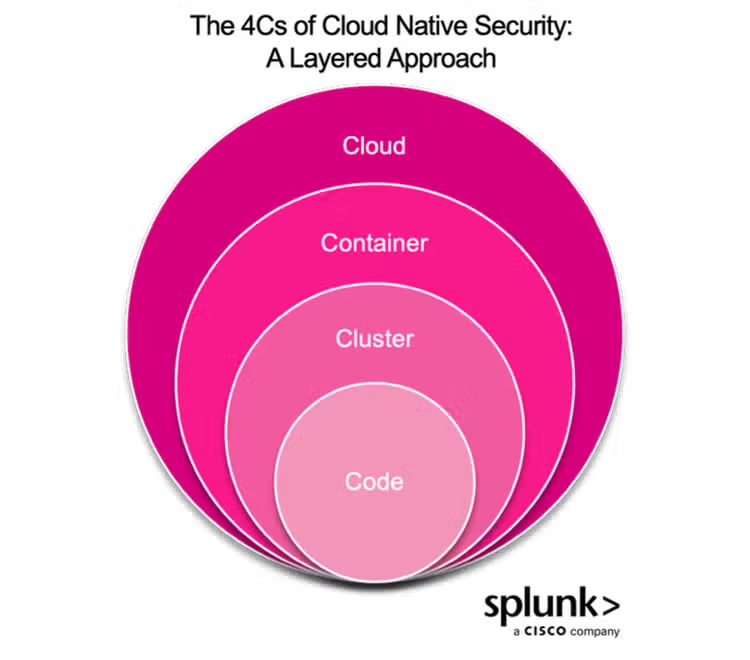
The layered approach to cloud-native security
In cloud-native applications, you can consider security in layers, typically known as the 4Cs of cloud native security:
- Cloud
- Container
- Cluster
- Code
A set of principles should govern each layer to drive the development of secure, scalable, and resilient applications and services in cloud environments. That means each layer depends upon the next outermost layer. Consequently, your Code, which is the innermost layer, benefits from having strong and secure Cloud, Cluster, and Container layers.
Let’s break down each of these layers.
Cloud
The cloud layer is the infrastructure that hosts and executes your applications in the cloud environment. Several common security issues are associated with this layer, including:
- Misconfigurations: Some teams maintain default configurations for infrastructure. For example, you might keep some critical ports in servers open to internet traffic. Attackers can exploit these vulnerable ports to enter the virtual network and execute cyberattacks. Another example is weak access controls to cloud resources. These common misconfiguration issues can result in losing sensitive data and costing organizations large sums.
- Issues in automation: Automation allows you to create, configure, and quickly deploy resources to the cloud. However, this also means security issues can quickly and automatically be deployed to the cloud environment.
To achieve cloud security, you have a shared responsibility, along with the Cloud Service Provider (CSP), to secure the cloud infrastructure. Often known as the shared responsibility model, it involves securing configurations, overseeing data security, and many other tasks.
Follow these best practices to move closer to cloud security:
- Obey the security recommendations from your CSP.
- Routinely review your configurations to ensure no misconfigurations in the application infrastructure.
- Use infrastructure as code (IaC) to automate cloud resource creation, configuration, and deployment. This minimizes human errors caused by manual resource provision.
Container
The container layer consists of resources in a containerized application, such as container images. These are common security issues associated with the container layer:
- Container images can contain security vulnerabilities.
- Weak access controls.
- Container content with untrusted sources.
To achieve container security, you should:
- Scan for known vulnerabilities using open-source tools when building the images.
- Regularly update containers to enhance security by eliminating known vulnerabilities.
- Create users with the least access privileges required to carry out the container functions.
- Build the container images using only a trusted registry, such as an image signing tool like the Docker Content Trust (DCT).
Cluster
A cloud-native application is often a containerized application with a container cluster. This layer is typically a Kubernetes cluster that contains cluster components and applications. Therefore, in this layer, organizations should focus on the security of components and applications, including in these ways:
- Using encrypted communication for Kubernetes components.
- Using TLS certificates to authenticate incoming traffic.
- Meeting or exceeding security standards and network policies.
One of the most important components of this layer is the Kubernetes API. To authorize the Kubernetes API, use role-based access control (RBAC) rules.
Code
The code layer, being the innermost layer, benefits from secure cloud, cluster, and container layers. Also known as the application layer, it focuses on secure coding strategies. Common security issues associated with coding in cloud-native applications include:
- Developers often use third-party software to develop apps, which can contain security vulnerabilities.
- Insecure coding practices like unhandled validations, hard-coding passwords, etc.
- Inadequate security risk assessments.
These robust strategies will help secure your application code:
- Use dynamic security scanning software to automatically scan your code to reveal vulnerabilities like cross-site scripting (XSS), insecure password stores, cross-site request forgery (CSRF), and SQL injection.
- Detect insecure code with a static code analysis tool. You can integrate this into your coding pipeline to trigger the analysis on every code commit.
- Suss out vulnerabilities in third-party dependencies using dependency-checking software like OWASP Dependency-Check and Snyk.
Three principles for cloud-native security
The 3 Rs of cloud-native security — rotate, repair, and repave — are the core principles for securing cloud-native infrastructure and applications. The core security strategy behind these principles is embracing changes as fast as possible to minimize the time left open for attacks and attackers.
Rotate
Cloud-native applications use different credentials, such as:
- Passwords
- Encryption keys
- Certificates
- Access tokens
To maximize security, do not keep the same credentials for long. Instead, rotate or change them frequently. You may change them every few minutes or even hourly. This rotation makes it difficult for attackers to leak them, as one credential is kept for only a short period.
Repair
Typically, software releases and updates include security patches to repair security vulnerabilities. Apply software patches as soon as they are released to keep your systems and applications up to date.
Repave
If you need to rebuild the cloud servers and applications, use a known secure state to rebuild them. Also, repair the entire software stack by revamping it from a verified secure state without patching.
Strategies for cloud-native security
Overall, organizations can adopt several security strategies to improve the safety of their cloud-native applications and services. The most common strategies are as follows:
Use identity and access management (IAM) controls
This includes implementing IAM policies and authorization mechanisms to limit access to only the required cloud resources. IAM controls help ensure that only authorized users can access the Oimos resources. AWS IAM Access Analyzer and Google Cloud IAM Recommender are great examples of IAM tools.
Leverage cloud-native security tools
Take advantage of cloud-native security tools that enable you to:
- Monitor and detect security violations.
- Automate the deployment and management of security controls.
Encrypt wherever possible
Protect sensitive information from unauthorized access by encrypting data at rest and in transit. All data stored in databases should be encrypted and stored in object storage and server volumes. Encryption should also be done on data transmitted between the cloud and other systems.
You can encrypt your systems with Key Management Services (KMS) from your Content Security Policy (CSP). Also, consider homomorphic encryption to create secure computations on encrypted data.
(Explore encryption strategies.)
Adopt a shift-left security approach
Integrate and test security controls from the beginning of the software development lifecycle rather than in a single phase and production environment. This approach enables developers to identify the effects of the security strategies and vulnerabilities beforehand, offering plenty of time to fix them.
Some of the ways organizations can incorporate the shift-left approach include:
- Integrating Checkov or tfsec for IaC security scans.
- Using GitHub Advanced Security to capture secrets or vulnerable code during pull requests.
Take the zero-trust approach
The zero-trust approach states that you should assume all network traffic is potentially malicious. Therefore, you should implement security controls to confirm identity and access rights before granting access to your resources. Istio, Linkerd, and SPIRE are great tools for implementing the zero-trust approach.
Enforce security in containers and container orchestrations
Containers and container orchestration technologies like Kubernetes are increasingly used to deploy cloud-native applications and services. Implementing security controls to protect these environments from cyber threats is crucial.
Try the “defensive depth” strategy
In this strategy, the security team must monitor every network layer to detect any threats and provide remediation as soon as possible. This includes:
- Preparing backup plans.
- Implementing various defense mechanisms.
- Preparing for data breaches.
Stay up to date with security resources
Security is an ever-changing landscape, so stay updated with additional resources. Read expert-recommended security articles and books, understand emerging threats, attend in-person and online security events, and build resilience into everything across the enterprise.
With the emergence of AI, many tools now exist that leverage machine learning in securing systems. Darktrace and Vectra AI are prime examples of software that use ML to detect anomalies in network traffic. AWS GuardDuty also uses ML to detect account compromise and unusual API calls. GitHub’s Copilot for Security helps developers write safer code with AI-assisted code suggestions.
Secure the cloud from the start
Cloud-native security incorporates security strategies, applications, and underlying infrastructure, focusing on security at all cloud layers. To achieve cloud-native security, you should implement reactive and proactive security approaches. Three basic principles lie behind this: rotate, repair, and repave. Following various security strategies, you can maximize your cloud-native security according to your organization’s requirements.
Related Articles

Data Lakehouses: Everything You Need To Know

A Guide to Bots: Good vs. Bad Bots, Common Types, and Online Safety in 2026