Error, Defects, Bugs & Incidents: What’s the Difference?
Key Takeaways
- Distinct meanings in software development: A bug is a flaw in code causing unintended behavior, a defect is a deviation from requirements, an error occurs when something goes wrong during execution, and an incident involves an event affecting system performance or availability.
- Clear definitions help teams categorize and prioritize problems, whether they originate from coding mistakes, requirement gaps, or system failures, streamlining resolution processes.
- Proactive monitoring reduces incidents and errors: By using tools to detect issues early, teams can minimize the impact of bugs and defects, ensuring smoother system performance and better user experiences.
Humans always make errors. Sometimes, errors in code produce a problem, defect, or bug that can lead to software failures. And when an organization delivers software riddled with issues, it destroys its reputation and causes financial loss.
While error, defects, bugs, and incidents are unavoidable, you can reduce them with some best practices. So, in this article, we'll explore the key differences between them and some best practices to minimize them.
What is an error?
Up to 95% of security incidents happen due to human error. An error occurs in the software when a human makes a mistake while coding the program. As a result, it causes the software to enter an unexpected state and disrupt the operations.
Here’s why errors can occur in your software:
- Incorrect syntax
- Improper calculation of values
- Misunderstanding of software requirements
These errors can occur at any stage of the software development cycle (SDLC), and you can usually discover them in this development process. However, some errors can make it to the end user, appearing (expectedly or not) when the use starts using the software or app.
What is a defect?
An actual error in code leads to a defect — resulting from an incorrect process or step in the development process. These defects can affect the quality and maintenance of the software system.
Here are some common reasons why defects occur:
- Complex code
- Evolving technologies
- Pressure to deliver
- Infrastructure complexity
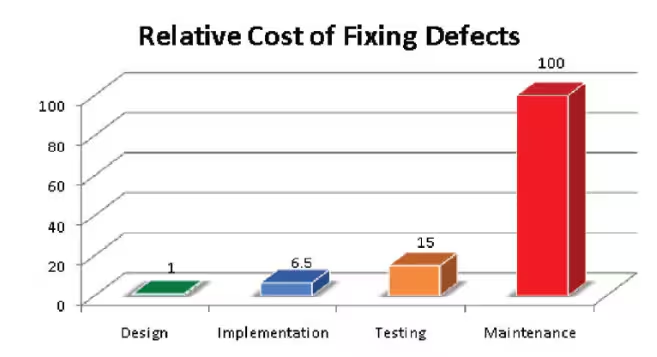
Fixing these defects costs a lot and increases at every stage. That's why systems that can predict these defects earlier or in the initial stages keep operations efficient and defect-free.
What is a bug ?
Since software systems are evolving and becoming more complex, bugs appear quite often. A bug is an error spotted during the testing phase of SDLC — it can cause your system to behave unexpectedly.
Since you can't detect and remove all the bugs during testing, they may appear later as operational failures. As a result, fixing them after the software's implementation can cost six times more than during development.
Bug types
Let’s look at some common types of bugs:
- Functional bugs occur when developers write new codes to release new features or improve existing ones.
- GUI-related bugs occur in modern software due to its dependence on graphical user interfaces (GUIs). As software systems become more complex, GUIs tend to have more bugs.
- Configuration bugs occur when more programs rely on APIs and libraries.
- Test code bugs occur during tests even when no issues are found in the production code.
- Performance bugs occur when programming errors slow down the system and harm user experience. Fixing these bugs takes more time and experienced developers.
What is an incident?
An incident is any issue that could breach your personal or financial data assets. These days, cyber incidents occur every 39 seconds, which is why the cost of a data breach has increased by 15% over the past three years.
As a result, 80% of organizations intend to increase their security budgets this year and in coming years — because data for successful organization is constantly targeted by significant cyber threats.
To better understand some incidents, let’s look at common incident types.
DDoS attacks
Denial-of-service attacks (DDoS) are attempts by attackers to disrupt a service and block its legitimate use. In this technique, attackers mainly target big organizations and the public sector for a minimum duration of one hour.
Here’s what we find out:
- There were 26% DDoS attacks on the finance sector in 2023.
- The government sector was the second most targeted, with 21% of attacks.
So, analyze network traffic to identify and mitigate these malicious incidents before your organization’s data is breached.
(Related reading: security monitoring.)
Insider threats
When an insider with access tries to misuse — or accidentally misuses — your data, it is known as an insider threat. This person can be anyone from a janitor to an IT team member. This damage to their organization’s data integrity can result in:
- Financial loss
- Reputational loss
- Disruption to organization
Detecting and preventing these threats is quite challenging as the attacker has legitimate access. That's why these breaches occur more frequently than external incidents.
Phishing attacks
Nobody wants their identity stolen — and that's what attackers do with phishing attacks. When you click a URL, for example, it can redirect you to a rogue website. Around 1.35 million of these sites worldwide are in operation, and the number is increasing daily.
Phishers use this to hack your personal information, such as your email address and password, and steal money from your bank account. In 2022, the amount U.S. residents lost to phishing attacks totaled more than $52 million!
Identifying these attacks is quite tricky, as it can take as long as 243 days. So, it’s always better to take preventative measures before the incident happens.
(Related reading: spear phishing targets particular individuals.)
Unauthorized access
In 2022, 21% of healthcare data incidents were due to unauthorized access. This shows that unauthorized access also leads to severe incidents, where someone who doesn't have permission gains access to your devices or data. This can expose sensitive data to risk or tamper with your bank account.
Best practices to reduce error, defects, bugs & incidents
Error, defects, bugs, and incidents are inevitable occurrences that lead to costly downtime, security breaches, and loss of credibility.
However, by implementing best practices, you can mitigate the risks associated with these issues and ensure the smooth operation of systems. Here are some of these best practices:
- Distributed load testing reveals potential latency issues and also provides a consistent user experience globally.
- Constant testing should be part of your software development cycle (SDLC) as it detects bugs and defects earlier.
- Have users & stakeholders work with your developers so the dev team can provide more efficient solutions.
- Design realistic test scenarios based on real-world user interactions. Consider user behaviors, data volumes, and geographical distribution to understand and minimize failures. Businesses are investing more than ever in software testing, which is why this market is expected to hit $50 billion by 2032.
- Automated software testing involves less human involvement so it leaves minimal chances of errors and reduces bugs by up to 70%.
Know the difference
Software errors, defects, bugs, and incidents are an unavoidable part of the software development life cycle. However, by adopting best practices and leveraging modern techniques, you can reduce their impact and associated risks.
When organizations embrace a proactive and comprehensive approach to software quality and security, they deliver better services while protecting their reputations and ensuring smooth operations.
Related Articles

How to Use LLMs for Log File Analysis: Examples, Workflows, and Best Practices

Beyond Deepfakes: Why Digital Provenance is Critical Now

The Best IT/Tech Conferences & Events of 2026

The Best Artificial Intelligence Conferences & Events of 2026

The Best Blockchain & Crypto Conferences in 2026

Log Analytics: How To Turn Log Data into Actionable Insights

The Best Security Conferences & Events 2026

Top Ransomware Attack Types in 2026 and How to Defend