Australia Is Investing in Resilience – Are Businesses Ready?
The 2025-26 Australian Federal Budget sets out a clear priority: building a stronger economy and a more resilient nation. That includes investment in critical infrastructure, skills and services to help Australians navigate ongoing uncertainty.
More than $3 billion has been committed to upgrade the National Broadband Network (NBN), extending high-speed fibre to 95% of homes and businesses. Funding continues for small business cybersecurity programs, which reflects a longer-term effort to lift digital capability across the economy.
But while national investment grows, many businesses remain exposed to the everyday risks that threaten their own continuity.
Cybersecurity may be a board-level priority, but the most immediate — and underestimated — consequence of disruption isn’t always data loss. It’s downtime.
Our latest research shows that cybersecurity-related downtime is costing up to AU$86 billion in Australia. These figures go far beyond IT recovery costs. They represent business-wide disruption, affecting operations, trust and the bottom line.
Downtime is a high stakes business issue. And it’s drawing the attention of regulators, boards and the public alike.
Keeping Pace in a Future Focused Economy

But that momentum isn’t being matched in every corner of the economy. Many businesses are still grappling with the demands of today.
New governance measures — from the Security of Critical Infrastructure Act to the incoming CPS 230 standard from the Australian Prudential Regulation Authority — reflect a sharper focus on downtime. It’s no longer enough to have a recovery plan. Businesses today are expected to maintain continuity when systems fail, and minimise the impact on customers, operations, and the wider economy.
And the cost of falling short is growing.
For Global 2000 companies (or some of the largest in the world), it costs an estimated USD$400 billion annually or nine percent of total profits. In Australia, businesses with over 500 employees face average losses of AU$251,000.
Beyond the financial impact, there’s also a growing capability gap.
While 93% of Australian leaders say they feel prepared, Splunk’s research shows that 90% of Australian businesses experienced a serious incident in the past year — many resulting in direct downtime.
All of this demands active involvement from leadership, embedding resilience into business-wide strategy and decision-making.
Building Capability With People, Process and AI
In today’s rapidly evolving digital landscape, businesses need to proactively enhance their resilience strategies to keep pace with increasing complexities and emerging threats. This means having the right people, the right processes and the right technology working together.
A modern approach to cybersecurity and observability can change the game. A modern Security Operations Centre (SOC) should provide the visibility, speed and intelligence required to reduce the impact of downtime. By unifying security and IT operations with real-time insights across infrastructure, applications and endpoints, Splunk enables teams to detect, investigate and respond faster — before incidents affect business performance.
Modern SOCs are not just about chasing alerts. With artificial intelligence (AI) and automation, Splunk helps streamline event management, reduce alert fatigue and prioritise what matters most. This shift from reactive response to proactive detection and resilience gives businesses the one up to control what they need to keep moving — even under pressure.
Splunk AI Assistant takes this a step further. It uses GenAI to help teams troubleshoot faster and smarter. Security teams can ask questions in plain language to surface root causes, generate custom charts or triage incidents with step-by-step guidance. By working with metrics, logs and infrastructure data, the AI Assistant helps reduce complexity and accelerate resolution, which minimises downtime and keeps systems running.
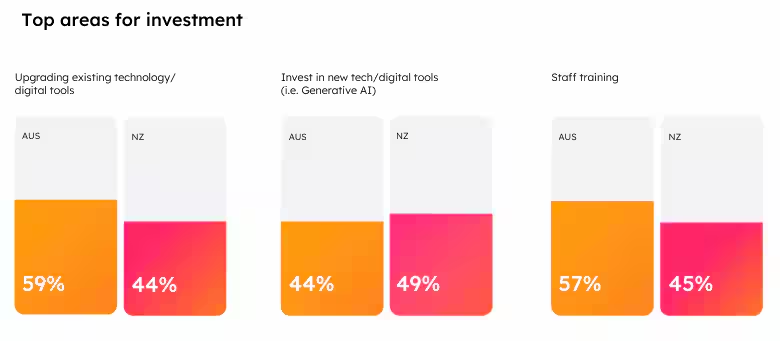
Source: Downtime: a rising challenge for organisations in Australia & New Zealand report (Splunk)
The most resilient businesses combine technology with skilled people - using AI to enhance decision making, not replace it. At Splunk, we take a human-in-the-loop approach to AI, where we put people in control while automation handles all the noise. Because when downtime happens, it’s not just about the data, it’s about context.
Our latest research found that 57% of Australian leaders plan to expand preparedness training for employees. This is a recognition that resilient businesses are built on both strong tools and capable teams.
Rethinking Resilience for What’s Next
As digital systems become more interconnected, the impact of failure spreads faster across teams, customers and entire supply chains. While the government may be laying the foundations for national resilience, the gap where businesses are and where they need to be is widening.
This readiness isn’t defined by strategy alone. It’s built through capability that combines the right technology, scalable processes and teams who can act under pressure. Clear visibility, faster response and the ability to adapt don’t happen on its own. They have to be designed into how the business operates every day.
This starts with asking:
- Do we have real-time visibility across our full digital footprint?
- Can our teams act quickly, decisively and in sync when disruption hits?
- Are we investing in the people, processes and technologies needed to adapt and respond at speed?
Download our latest report here to understand what resilience leaders in Australia and New Zealand are investing in to boost enterprise resilience.
Related Articles

Predicting Cyber Fraud Through Real-World Events: Insights from Domain Registration Trends

When Your Fraud Detection Tool Doubles as a Wellness Check: The Unexpected Intersection of Security and HR

Splunk Security Content for Threat Detection & Response: November Recap

Security Staff Picks To Read This Month, Handpicked by Splunk Experts

Behind the Walls: Techniques and Tactics in Castle RAT Client Malware

AI for Humans: A Beginner’s Field Guide

Splunk Security Content for Threat Detection & Response: November 2025 Update

Operation Defend the North: What High-Pressure Cyber Exercises Teach Us About Resilience and How OneCisco Elevates It