How REMA 1000 Stays Ahead: Innovative Retail Solutions Powered by Splunk
Platform Lizzy LiThis blog post was co-authored in partnership with André Nydegger Wermundsen and Emilie Ruud from the REMA 1000 team and with In Hye Lee from Splunk.
Key takeaways
- REMA 1000 uses Splunk to turn complex data into clear insights that help all employees, even non-technical ones, quickly find and fix issues.
- Real-time visibility across systems allows the company to resolve problems faster, streamline operations like price updates, and improve collaboration.
- This data-driven approach helps REMA 1000 stay competitive, maintain low prices, and deliver a better experience for customers.
REMA 1000, one of Norway’s top grocery chains, leverages Splunk’s dashboarding and data correlation capabilities to maintain their low-price promise to customers in a competitive market.
REMA 1000 exemplifies how to use Splunk for both traditional IT monitoring and non-traditional retail use cases to solve critical business challenges. By focusing on user-friendly dashboards and leveraging Splunk’s powerful data correlation, they’ve transformed their operations, ensuring efficiency and competitiveness:
- Democratizing data: Splunk makes complex operational data accessible and actionable for non-technical users across the organization.
- Driving efficiency and speed: significant reductions in issue resolution time and operational processes such as price changes.
- Enhanced collaboration: provides a single source of truth, fostering better communication with internal teams and external vendors.
- Competitive advantage: enables REMA 1000 to maintain their "lowest price" promise and react quickly in a dynamic market.
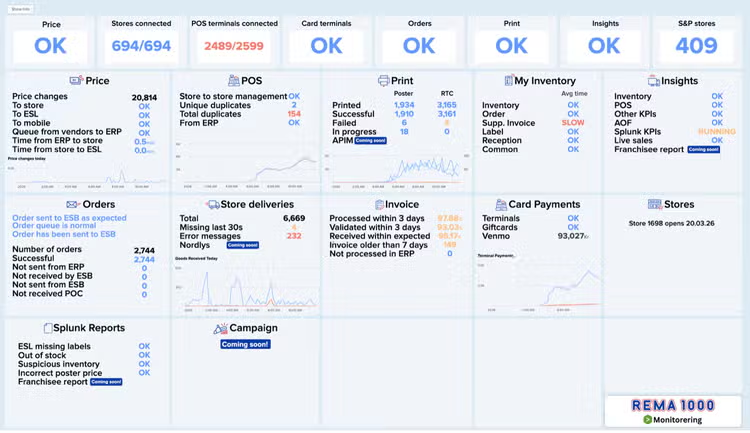
This FIKS (Norwegian for “fix”) dashboard allows REMA’s support agents to quickly and proactively identify and resolve points of failure before they lead to widespread customer impact.
Who is REMA 1000?
REMA 1000 is a top grocery chain in Norway recognized for their focus on efficiency and operational discipline, delivering high-quality products to customers at the lowest prices. The “1000” in “REMA 1000” refers to the original business model of stocking only 1000 different products to focus on keeping costs low to deliver value to customers. REMA 1000 operates nearly 700 retail locations, which are all franchisee-run.
The Challenge
REMA 1000’s monitoring team also reflects their commitment to efficiency. Their lean monitoring team relies on a wide range of SaaS vendors to support key retail processes. Because most systems are SaaS, the underlying code and infrastructure are often controlled externally. REMA 1000 needs reliable end-to-end visibility across systems that affect price communication, ordering, payment, POS operations, and in-store tools that franchisees use. Even small delays or data inconsistencies can affect price competitiveness or store operations, making real-time insight essential.
Splunk as the Solution
REMA 1000 uses Splunk to connect to data from multiple vendors and systems, providing real-time insights. Splunk turns complex data into actionable views so that non-technical users can identify issues, narrow down the root cause to the system impacted, and address problems before they impact customers. Let’s take a look at how REMA 1000 uses Splunk in 3 distinct use cases:
- End-to-end POS Transaction Flow Monitoring
- Real-time Price Change Management
- Franchise Enablement and Merchandising Tracking
Use Case: End-to-end POS Transaction Flow Monitoring
REMA 1000 uses Splunk to track every phase of a transaction, from when an item is scanned at the checkout in-store to when the transaction is finally saved in the data warehouse. When an issue occurs at any phase in the transaction flow, support teams need to be able to quickly identify the point of failure to resolve it before it leads to widespread customer impact.
When an issue occurs, the support team gets an alert via email or ServiceNow and accesses the FIKS (Norwegian for “fix”) dashboard, which provides an overview of critical services, such as payments, price distribution, ordering, and POS operations, with links to detailed dashboards for each service. Problematic metrics display on the FIKS dashboard in red, allowing the agent to identify points of failure with a glance. They click the metric to drill into the relevant dashboard, inspect logs, and contact the appropriate vendor or team to resolve the issue. To learn more about how REMA 1000 uses dashboards and their best practices, see here.
Before Splunk, issues were often only discovered after customers complained, resulting in frantic uncoordinated troubleshooting. Now the process is proactive, fast, and controlled, reducing resolution time and customer impact.
Use Case: Real-time Price Change Management
In Norway’s highly competitive grocery market, prices can drop multiple times a day. To ensure that REMA 1000 provides customers with the lowest prices, they need to be able to update prices across all stores quickly.
Using Splunk, REMA 1000 monitors the entire price change workflow across more than 5 vendors: from planning the change in central systems to propagating the price change to ERP systems, store systems, POS systems, and electronic shelf labels.
End-to-end visibility ensures price accuracy and rapid updates across all stores. Dashboards visualize pricing KPIs per store and region, using color coding to highlight performance. This provides a comprehensive overview for regional managers to quickly identify which stores need support to ensure price labels update correctly. Splunk enables daily progress tracking, whereas many other KPIs measure progress only weekly.
Dashboards show other key data, such as missing electronic shelf labels per store and region depending on sales in the store, allowing clearer control and helping ensure consistent price communication across the chain.
Before Splunk, price updates could take hours to reach all stores, creating risk in a market where competitors adjust quickly. Using Splunk to expose bottlenecks and streamline the process, REMA 1000 now completes full price updates across nearly 700 stores in under 2 minutes, remaining competitive in a constantly changing market.
Use Case: Franchise Enablement and Merchandising Tracking
REMA 1000 uses Splunk to go beyond traditional IT operations by correlating data from diverse sources to create actionable tasks for streamlining franchise operations.
When a product price is updated, a store may need to print an accompanying promotional poster. Previously, franchisees spent significant time manually checking whether posters were up to date with the latest prices. REMA 1000 found a solution by correlating printer logs with price logs to confirm whether the store printed new posters since the last price update. If not, they send a task to the franchisee’s hand terminal to print the new posters.
REMA 1000 also highlights stockouts based on sale trends. They can correlate delivery and sales data to see that an item was delivered to a store a week ago but has no sales. They can send a task to the franchisee’s hand terminal to move the stock out to the sales floor.
Franchisees report that these tasks save time and help them maintain accurate in-store communication, which is a key element of staying consistent with REMA 1000’s low-price positioning.
Learn More: REMA 1000’s Dashboarding Best Practices
REMA 1000 leverages Splunk for traditional IT monitoring and custom use cases to reduce resolution time and customer impact and to remain competitive in a fast-paced market. See REMA 1000’s Dashboarding Best Practices: Reducing Time to Resolution with Accessible Data and End-to-End Visibility to learn more about how REMA 1000 uses Splunk Dashboard Studio and their dashboarding best practices.
The screenshots and data in this post are for illustrative purposes only.
Related Articles

Threat Advisory: STRT-TA02 - Destructive Software

Paving the Way for Unified Cybersecurity: OCSF Joins the Linux Foundation with Splunk’s Support