AI SRE: Meet Your New Agentic Teammate
Observability Annette SheppardKey takeaways
- SRE teams are overwhelmed by alert noise, siloed tools, and manual troubleshooting that drives up outage costs, averaging $300 million per year in losses for companies.
- AI SRE automatically sets up detectors, surfaces root cause analysis in plain language, and delivers a step-by-step remediation plan, cutting resolution time significantly.
- The AI SRE covers the full incident lifecycle from detection to remediation, keeping humans in control while removing repetitive toil so teams can focus on innovation.
In the modern digital landscape, the role of the site reliability engineer (SRE) has evolved from a specialized function into the backbone of business continuity. However, as systems grow in complexity—spanning multi-cloud environments, microservices, and distributed architectures—the sheer volume of data generated has grown faster than a person's capacity to track it. Today’s SREs often spend much of their time firefighting issues, drowning in alert noise, context switching, and the manually connecting the dots between disparate systems to make sure everything stays up and running.
Keeping everything up and running is more important than ever. According to the The Hidden Costs of Downtime, companies lose an average $300 million a year to unplanned outages and suffer an average 3.4% stock price drop after a single incident. What if you had a teammate who could take the manual toil off your plate and help ensure you’re not part of that statistic—automatically setting up detectors, weeding through the alerts, tying it all together across observability data sources, and presenting you with actionable RCA and a plan to get everything up and running again.
Say hello to your new teammate: the AI SRE.
Before jumping in to how this teammate can help take things off your plate, let’s better understand the common issues that engineering and IT operations teams face:
- Alert Fatigue: With thousands of alerts firing daily, teams struggle to distinguish between critical business-impacting events and transient "noise." The result is alert fatigue, where critical signals are buried under false positives.
- Troubleshooting Silos: When an issue occurs, teams need to pivot across different tabs and screens, between logs, metrics, traces, CI/CD and Kubernetes change events, other tools and more. The time spent manually correlating this data is the primary driver of high mean time to resolution (MTTR).
- Resolution Toil: Even when the root cause is identified, the path to resolution is often manual and not well defined.
All of this not only creates frustration, but also takes away precious time that could be spent on innovation.
The introduction of ChatGPT in November of 2022 was the start of a tectonic shift in the way we approach everything from planning vacations to summarizing meetings. Observability is no exception.
The rise of Generative AI and large language models (LLMs) has fundamentally changed the observability game. We are moving away from passive monitoring—where you wait for a dashboard to turn red—to proactive, agentic observability. AI and agents are now active participants across observability, from detection, to troubleshooting and remediation. Agents can correlate, troubleshoot and suggest actions in real-time.
The Value of AI SRE in Splunk Observability Cloud
AI and agents embedded across the entire incident response lifecycle, can not only shorten each step in the workflow, but, in some cases, completely remove some of those steps. This means you can spend your time focusing on high-level strategy and innovation rather than constant firefighting.
Let’s talk about how this new agentic teammate can help you
Detection: From Noise to Signal
Detection is the first line of defense, and it must be precise. Splunk Observability Cloud leverages AI to move beyond static thresholds by helping you automatically detect issues, understand the impact, map dependencies, and correlate alerts.
AI SRE helps you eliminate the toil and guesswork of figuring out which metrics matter and manually setting up performance baselines by automatically deploying anomaly detection and pre-built alerts within minutes of ingesting data. With an understanding of upstream and downstream dependencies, it doesn't just tell you what is broken; it shows you the blast radius, identifying which services are affected and which are the likely culprits. Alerts are enriched with business context correlating the technical performance with transaction data, so the AI SRE can help teams prioritize incidents based on customer and business impact.
Troubleshooting: Finding Root Cause
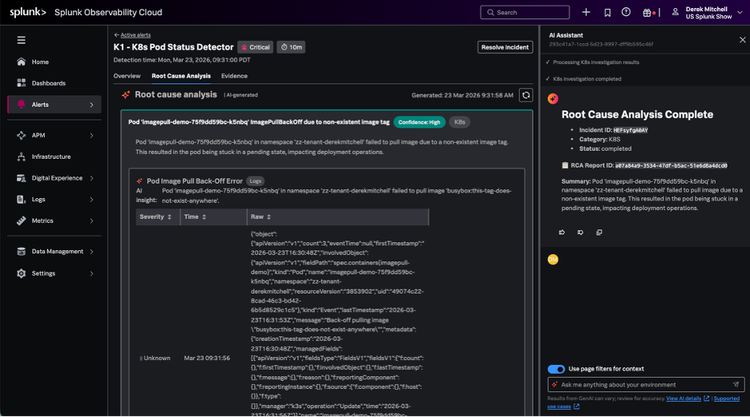
When you open an alert in Splunk Observability Cloud, the AI troubleshooting agent immediately analyzes related telemetry across data types. Instead of manually querying logs or reviewing traces, it automatically investigates the issue, surfaces relevant logs, identifies patterns in traces, and explains in natural language why a service may be behaving abnormally. For deeper analysis, you can continue the investigation in the AI Assistant in Observability Cloud, in plain English. Together, these capabilities significantly reduce manual effort and speed up troubleshooting.
AI shouldn’t be a black box, and explainability is one of our design principles. AI SRE generates and validates multiple hypotheses. By sharing what was ruled out and backing every conclusion with evidence, it shares context and builds trust in its reasoning and recommendations.
Remediation: Turning Insights into Action
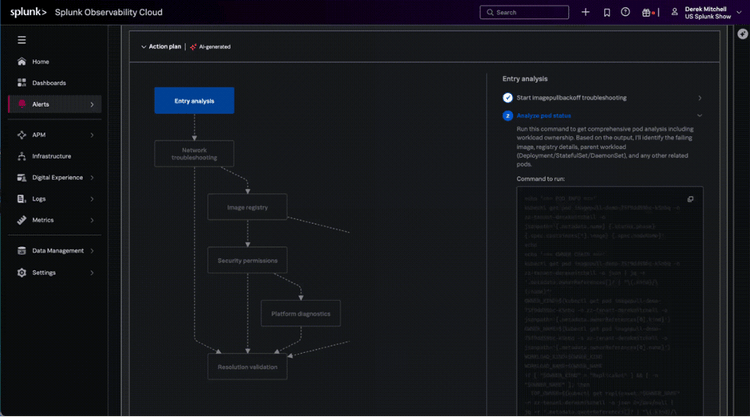
The final stage is remediation. The AI SRE doesn't stop at root cause identification; it provides a structured remediation or mitigation plan. By analyzing historical incident data and current system state, the guided plan suggests the most effective path to resolution, while keeping you in the loop for authentication and action. Whether it’s recommending a configuration change, a rollback, or a specific runbook execution, the AI SRE provides the guidance needed to rapidly and reliably restore service.
AI-Native User Experience
Whether using the AI Assistant query your data in plain English or building your own agents and leveraging the observability tools in the Splunk MCP server, we want to meet you where you are in your observability and AI journey. With an AI-native experience, we can help you get deep insights into your data whether or not you have deep expertise.
The goal of the AI SRE is to take the toil off your plate, so you can shift from "keeping the lights on" to building the next generation of digital experiences.
The future of observability is agentic. Are you ready to onboard your new teammate?
Take the next step in your observability journey. Explore the AI SRE in Splunk Observability Cloud today and see how our AI SRE can help reduce your mean time to resolution.
Related Articles

SOC Models: In-House, Out-Sourced, or Hybrid SOC?

The New & Improved Splunk Guide to Risk-Based Alerting