What Is Attack Surface Management? A Complete Guide To ASM
Key Takeaways
- Your attack surface is bigger than you think: Cloud, SaaS, mobile, hybrid work, and third-party vendors have created a sprawling, ever-changing set of digital exposures, making ASM essential for visibility and control.
- Continuous, proactive management is critical: Attack surface management means security teams can discover, prioritize, and remediate risks in real time, minimizing the window of opportunity for attackers.
- Integrated tools and automation are must-haves: Effective ASM combines automated asset discovery, risk-based prioritization, and seamless integration with existing security workflows to help teams stay ahead of evolving threats.
ASM Is no longer optional. The number of entry points into your organization is infinite. Cloud infrastructure, SaaS apps, mobile devices, hybrid work, and third-party vendors have all contributed to a sprawling and often invisible digital footprint — what’s known as the attack surface.
That expansion isn’t slowing down. On average, 100+ new vulnerabilities emerge every day, creating an overwhelming burden on already stretched security teams. And those are the vulnerabilities we know about!
This is where attack surface management (ASM) comes in.
Defining attack surface management
Attack Surface Management (ASM) is the continuous process of discovering, monitoring, evaluating, and reducing all the exposure points across your digital ecosystem. The goal is simple: make the attack surface visible and manageable, so attackers don’t find the gaps before you do.
ASM helps answer questions like:
- What assets are actually connected to the internet right now?
- Are there exposed services or APIs that shouldn't be?
- Have we inherited any risks from cloud sprawl or shadow IT?
- What changed in our environment in the last 24 hours?
ASM gives security teams the context and control needed to proactively manage risk, and not just respond after the fact. With threat actors exploiting weaknesses faster than ever, ASM helps shift organizations toward a more resilient, prevention-first security posture.
- Why ASM matters today
- Hybrid work models expose more endpoints
- Multi-cloud environments and rapid provisioning
- Shadow IT creates blind spots
- Regulatory compliance hinge on asset visibility
Overview: What is the attack surface?
An attack surface is the sum total of all possible ways an attacker could gain access to your environment, whether through exposed infrastructure, human error, unmonitored third-party tools, or forgotten test servers.
It includes every internet-facing asset, every internal system or endpoint, every third-party integration, every single human entry point. In short: your attack surface is not only about technology, it’s about anything that could be exploited to compromise your business.
see primer on what constitutes an attack surface: What Is an Attack Surface?
Attack surface vs. attack vector
An attack surface is what’s exposed. An attack vector is how it’s attacked. ASM focuses on reducing exposed assets, thereby limiting attacker options.
- Attack surface = all your assets and exposure points
- Attack vector = route the attacker takes (e.g., SQL injection, misconfigured API)
Why ASM matters now
Every year, organizations grow more connected — and more exposed. According to recent industry reports:
- Cyber asset inventories grew 133% year-over-year, increasing complexity.
- Ransomware surged 126% in early 2025.
- The average number of cyberattacks per week rose 47% globally in early 2025
With digital infrastructure evolving faster than security practices, it’s easy to lose visibility over what’s live, what’s vulnerable, and what’s connected. ASM helps close that visibility gap.
Without ASM, most organizations are flying blind across parts of their infrastructure, leaving shadow assets and outdated systems exposed to increasingly automated and opportunistic attackers.
Benefits of attack service management
- Broader visibility over your entire environment
- Faster incident response: You know what to protect
- Regulatory compliance: Audit-ready asset inventories
- Supports Zero Trust: Continuous validation of access points
- Proactive risk reduction, not reactive fixes
What ASM looks like in practice: A four-stage lifecycle
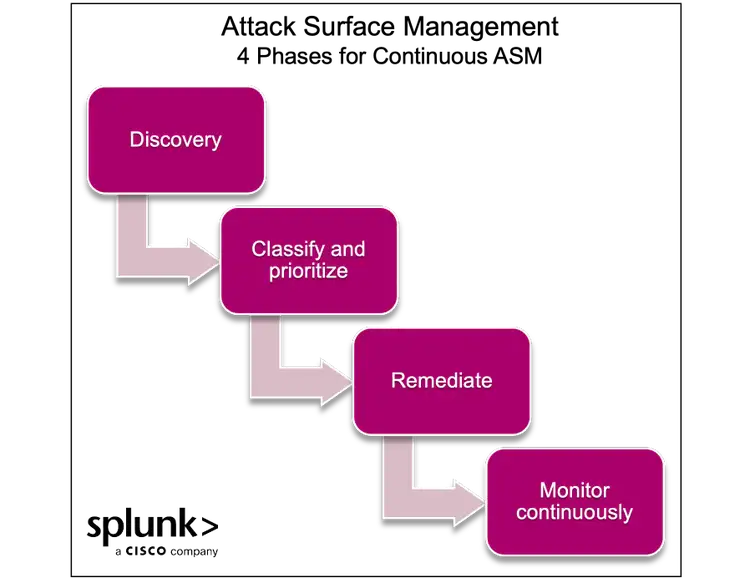
ASM isn’t a one-time scan or an annual audit. It’s a continuous lifecycle designed to help organizations stay ahead of risk. Your ASM program can be custom to your organization, and should include these four key stages:
Phase 1. Discover
Step one is to understand all your assets. Inventory all internet-facing and internal assets, including:
- Cloud: VMs, serverless, storage, IaC templates
- On-prem: Servers, network appliances, dev/test systems
- Third‑party: SaaS apps, vendor portals, supply‑chain services
- Shadow IT: Unanalyzed GitHub repos, expired test VMs, demo apps
Example: A development team spins up a temporary cloud environment that gets indexed by search engines. Discovery ensures it gets flagged, even if IT wasn’t informed. That cloud environment expands the attack surface.
Phase 2. Classify & prioritize
Not all risks are equal. Group and prioritize assets based on business context and risk. Knowing what something is, and how critical it is to operations, helps guide your response. Prioritize assets based on:
- Data sensitivity
- Exposure level
- Threat likelihood
- Business impact
Fix what poses the greatest risk first. Consider risk scoring to assist in prioritization and know your organization’s risk tolerance and risk appetite.
Example: An exposed staging environment may be low priority in terms of attack service risk. In contrast, an exposed production database with customer data is not.
Phase 3. Remediate
Now it’s time to take action. Act on exposures, as prioritized, by patching, removing, isolating, or hardening assets. Actions here will depend on the prioritized assets but common remediation can include:
- Patching
- Decommissioning assets
- Tightening firewall rules
- Integrate with SIEM and SOAR tools.
After remediating, always be sure to validate that your actions actually worked — do not assume.
Example: A SOC uses ASM data in its SOAR playbook to automatically quarantine risky assets and assign tickets to relevant teams.
Phase 4. Monitor continuously
Use automation to continuously monitor and track changes continuously and over time. The continuous monitoring is essential because your attack surface changes constantly: new assets get added, apps get misconfigured, people leave the organization. ASM keeps your inventory fresh and your alerts real.
Watch for changes and exposures, such as:
- Configuration drift
- New domain registrations
- Certificate expiry
- Open ports or unusual network routes
What types of assets are in scope for ASM?
ASM isn’t limited to firewalls and endpoints. That’s why assets in scope for ASM must include:
- Cloud infrastructure and assets: virtual machines (VMs), S3 buckets, public IPs, cloud VMs, Kubernetes clusters, serverless functions, etc.
- Web assets: Domains and subdomains, ports, certificates, login pages, APIs
- SaaS applications: data platforms, CRMs, ERPs, HR, marketing tools, etc.
- Credentials & certificates: API keys, access tokens, SSL/TLS certificates
- Mobile & IoT devices: Phones, tablets, sensors, smart devices, guest devices
- Third-party integrations: Anything connected via an API or shared login
- People: Employees, contractors, partners, anyone who can be socially engineered, phished, or otherwise targeted
Challenges to getting ASM right
Even with the right intent, managing attack surfaces can be difficult to implement without the right strategy or tooling. Common roadblocks include:
- Shadow IT and asset drift: Employees often use technology outside IT’s visibility, while cloud resources frequently change, making it difficult to track and secure all assets.
- Cloud and multi-cloud complexity: Rapid adoption of multiple cloud providers creates a constantly shifting environment, each with its own APIs and security models.
- Tool sprawl and integration: Disconnected dashboards and siloed data hinder holistic visibility, and effective ASM requires seamless integration with existing security workflows.
- Third-party and supply chain risk: Vendor-related breaches are on the rise, expanding the attack surface beyond the organization’s direct control.
- Context and prioritization: Without clear business context and accurate risk scoring, security teams struggle to prioritize real threats amid noise and false positives.
How Splunk supports attack surface management
Attack surfaces may be expanding, but so are the tools and strategies to manage them. With attacks on organizations happening every day, we can no longer rely on manual processes alone.
Platforms like Splunk help teams automate discovery, correlate data across assets, and respond faster, making attack surface management both manageable and actionable. Splunk brings structure and visibility to ASM by helping teams:
- Automatically discover assets across cloud, SaaS, and hybrid environments.
- Correlate signals from endpoints, logs, threat intel, and user activity.
- Prioritize risks based on asset criticality, exposure level, and real-world threats.
- Enable automation with SOAR workflows and custom alerting.
- Maintain continuous visibility through integrations and anomaly detection.
Frequently asked questions (FAQs)
Video: Learn more about Attack Surface Management (ASM) Explained
Related Articles

Security Books & Articles: Must-Read List From InfoSec Experts

Incident Severity Levels 1-5 Explained

Cloud Network Monitoring: An Introduction

The Democratization of Data: The Pros & Cons of All That Data

Trunk-Based Development vs. GitFlow: Which Source Code Control is Right for You?

What Is TBD? Trunk-Based Development & Its Role in CI/CD

Status Pages: The Ultimate Guide

When and Why To Adopt Feature Flags