Software-Oriented Architecture (SOA) Defined
Software Oriented Architecture (SOA) is a design paradigm for software applications. SOA involves individual components behaving as self-contained, loosely coupled, modular, autonomous and network accessible packages.
These software operate independently and are designed to perform self-contained tasks — multiple components independently exhibit their own functionality. Connected together, these self-contained local systems serve as building blocks to the global functionality of the larger software application.
Plus, each software can be seen as an independent business capability, where multiple SOA software can be combined to perform complex computing tasks.
Let’s take a deeper dive into SOA design principles and characteristics to better understand why business organizations are increasingly adopting the paradigm for their multi-cloud IT environment.
Characteristics of Software Oriented Architecture
SOA is primarily an architectural paradigm. It provides abstract principles, while the real-world implementation of an SOA system may be vastly different for every use case scenario. It also shares some key characteristics of earlier design philosophies such as object-oriented programming and component-based engineering, but there’s more to Software Oriented Architecture.
Let’s review the key characteristics of SOA:
Multiple use
Component packages are to be deployed repetitively by multiple users. A software architecture that enables repetitive instantiation of pre-vetted and approved software packages is both:
-
Productive for DevOps and engineering teams
-
Secure from a governance standpoint
Non-context-specific
Application components are designed to be reusable and interoperable across:
-
Different vendor products
-
Different functional contexts
These components do not assume the functionality and limitations of other building blocks within the SOA and are instead designed to integrate smoothly according to acceptable industry-standard and open-standard protocols.
Composable
The independent components of the SOA system are modular, interoperable and loosely coupled. They may encapsulate unique functionality, computing operation or business process.
A modular design combines multiple local functional components to establish composite applications in a cloud-based system. These components may run in different cloud environments.
Granular & encapsulated
The internal state and configurations are abstracted from the control layer of the architecture. The self-contained packages provide sufficient controlled access over the functionality of its objects. Access control mechanisms may be required, depending on the security sensitivity of the software components.
Interoperability
Software components are deployed and versioned independently. This is especially relevant for distributed cloud-based systems where self-contained components must communicate smoothly. Each component can have their own SDLC life cycle. Developers can use unique identifiers to release different builds as part of their DevOps strategy.
Loose coupling
The SOA provides standardized interfaces that abstract the underlying implementation configurations and details. The SOA mechanism establishes well-defined and standardized contracts between the software. The internal implementation details are hidden under a layer of abstraction, which includes standardized interfaces that promote interoperability and independence.
Software reusability
The software components encapsulate unique functionalities that must be reused by multiple users and integrated software.
For instance, an authentication software may be generic and reusable, but fully self-contained, modular and standardized for communication with other software components. Other users can integrate this software via API connectivity, without having knowledge of the underlying implementation details.
Scalability & statelessness
Software Oriented Architecture is designed to be scalable. Software decomposition breaks down complex application systems into modular and small functional units.
Resource allocation for these software can be managed automatically and autonomously. The application components do not maintain a session state. Each interaction is treated as an independent computing transaction.
Software discovery
The key aspect of discovery in SOA is the centralized mechanism for discovering software and IT assets. This may be achieved through:
-
External software orchestration frameworks
-
A centralized software registry
-
A dynamic software registration process
The idea is to ensure a centralized and simple mechanism to capture information from all software that may be distributed, deployed dynamically or maintain an ephemeral state in a multi-cloud environment.
Platform independence
The Software Oriented Architecture is designed for compatibility and interoperability with software, apps and technologies from a wide variety of vendors and platform versions. This is achieved by promoting the use of open standards for software development. This includes the use of:
-
Standardized communication protocols
-
Standardized software interfaces, contracts and abstraction capabilities
Limitations of SOA
Software Oriented Architecture also has its limitations. Multiple software share the same underlying resources to coordinate a global function of the application — limiting its scalability.
Increasing the number of software sharing the same resources such as registries and databases can also slow down the system and introduce unwanted interdependencies. Promoting reusability of the same software also leads to a single point of failure.
The role of microservices
One solution to these challenges is to use microservices that are independent application components specializing in one complete task. All of the dependencies and libraries are packaged within the same container and completely decoupled from other software.
Instead of sharing data with other software, the microservices duplicate data, making them entirely independent from a centralized software interface that is used for data communications.
FAQs about software-oriented architecture (SOA)
Related Articles
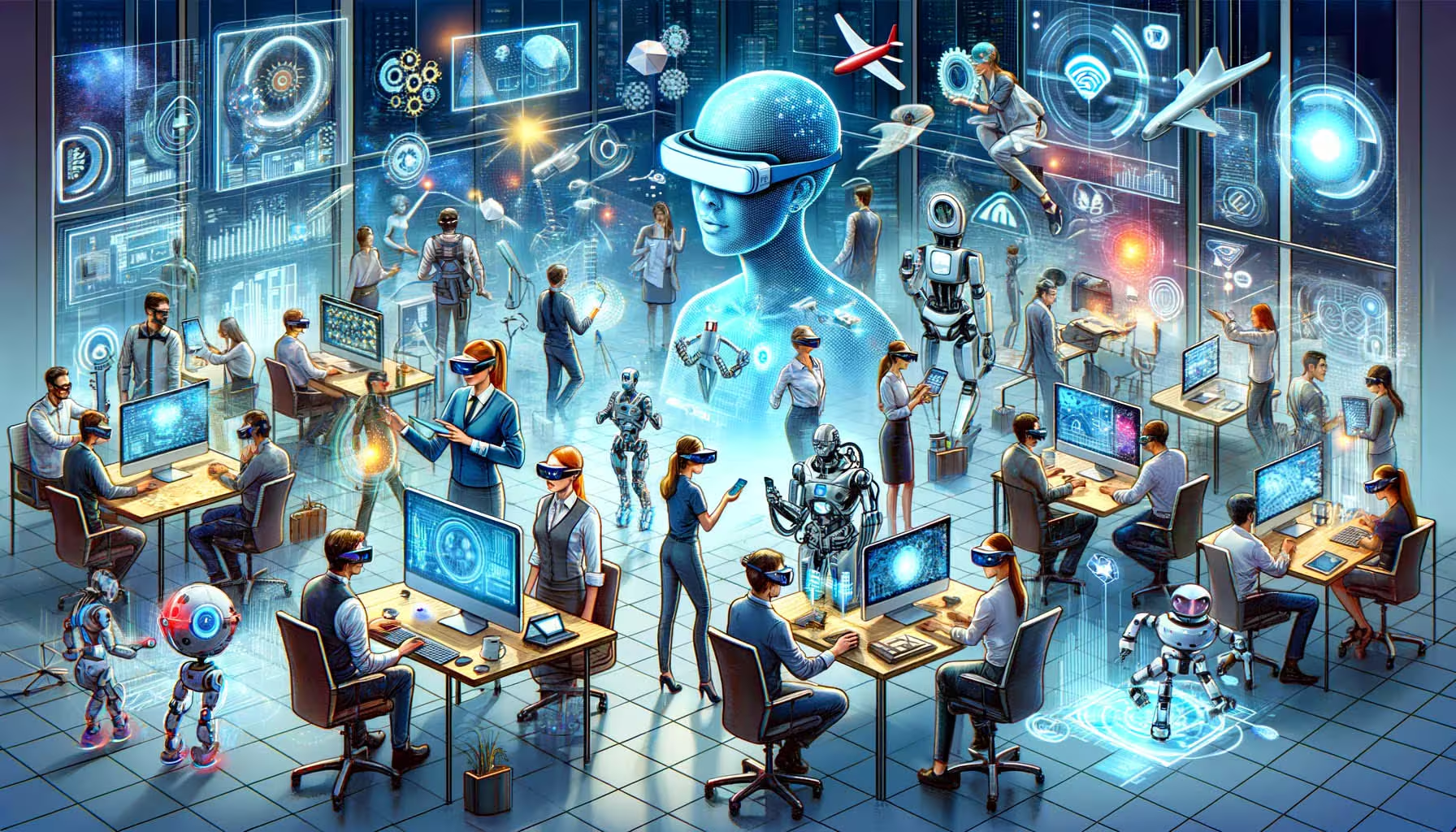
What is the Augmented Connected Workforce?

What Is Data Logging?

What is Fraud Detection and Prevention?

What’s IT Monitoring? IT Systems Monitoring Explained
Splunk Cheat Sheet: Query, SPL, RegEx, & Commands
SysAdmins: System Administrator Role, Responsibilities & Salary

The Digital Immune System (DIS) Explained

Multi-Stage Attacks & How To Detect Them