Red Teams vs. Blue Teams: What’s The Difference?
Cyberattacks are unauthorized attempts to access data and disrupt your organization's computer systems or networks. It’s reported that 49% of organizations have suffered a data breach over the past two years — it’s possibly higher than that.
These data breaches can cause financial loss, reputational damage and legal liabilities. So, organizations develop Red and Blue teams to mitigate the risk of cyberattacks. These teams follow an offensive/defensive approach to security, and we can briefly summarize the teams like this:
- The Red Team hacks the security infrastructure.
- The Blue Team defends against such attacks.
- The Purple Team combines the best attributed of both Red and Blue Teams.
In this article, we’ll explore the role of the red team vs. blue team in preventing cyberattacks. We'll also take a look at everyone's favorite new topic: what generative AI means for these teams.
What is the Red Team?
According to the National Institute of Standards and Technology (NIST), the Red Team is a “group of people authorized and organized to emulate a potential adversary’s attack or exploitation capabilities against an enterprise’s security posture.”
In simple terms, the red team identifies vulnerabilities in security systems and simulates real-world attacks by thinking and working like hackers. Doing so helps the organization improve its security posture and prevent real-world attacks.
Testing your organization's security comes with high responsibility. So, the red team uses techniques like social engineering and penetration testing to provide valuable insights into the security posture. They work closely with the blue team who defend the systems against severe security attacks and develop a comprehensive security strategy covering all potential attack vectors.
Members of the Red Team
The red team comprises experts working together to carry out real-world attacks and exploit a system’s security. Here are some of the key roles in the team:
- Vulnerability assessors identify vulnerabilities in the security system, aiming to improve its security posture and prevent potential attacks. They analyze networks, applications, and hardware to highlight the potential weak points.
- Security auditors review security policies and procedures to ensure they meet industry standards and best practices. This person audits the security controls, policies, and procedures to identify improvements and help the organization prevent potential security breaches.
- Ethical hackers are cybersecurity professionals who conducts real-world attacks on security systems. They use the same techniques and tools as real-world hackers to spot weak points in security defenses. This also helps the company understand how to improve its security posture and prevent attacks.
- Penetration Testers. Like ethical hackers, a penetration tester performs simulated attacks on systems to find and exploit vulnerabilities that real-world attackers could exploit. To do this, they use techniques like network scanning and vulnerability scanning.
Red team responsibilities and activities
The red team performs diverse activities and assessments to help organizations improve their security posture. Here are some of their critical responsibilities:
Implementing real-world attacking tactics
They breach the organization's security defense by using real-world attack techniques to assess the company's prevention, detection and remediation capabilities. They simulate an attack on the security systems using the following techniques:
- Sending Phishing emails and baiting to trick employees.
- Performing penetration testing to identify vulnerabilities.
- Scanning an organization's networks to identify devices, applications and services.
- Performing physical testing to assess an organization's physical security controls, such as access controls, cameras and alarms.
Developing software programs for automating attacks
Red team creates custom software tools to automate the attack process, making identifying and exploiting vulnerabilities easier. It helps them scale their operations and test the organization's defenses.
They use off-the-shelf and custom tools to develop these programs for automated attacks. The development process goes step by step from:
- Identifying the specific attack techniques to automate.
- Developing code to execute those techniques.
- Testing and refining the code until it executes the desired attacks reliably.
Penetration testing
Penetration testing means the red team tests the systems to identify vulnerabilities that could be exploited by attackers. Carrying out these tests can help organizations identify weaknesses in their security defenses and take proactive measures to address them before an actual attack occurs.
(Read our full penetration testing explainer.)
Social engineering tactics
Red team uses phishing, baiting and tailgating techniques to trick employees into revealing sensitive information or granting access to restricted areas. They do this for two main reasons:
- To identify weaknesses in human-based security measures.
- To develop training programs to mitigate the risk of such attacks.
Creating new and innovative attacks
Red teamers also works on researching and inventing new attacking techniques to exploit the blue team's defense capabilities.
New attacking techniques assist in testing the blue team's ability to detect and respond to attacks. Once the red team understands a new technique, they can provide valuable feedback to the organization on improving its overall security posture.
Now let’s turn to the blue team.
What is the Blue Team?
NIST defines the blue team as:
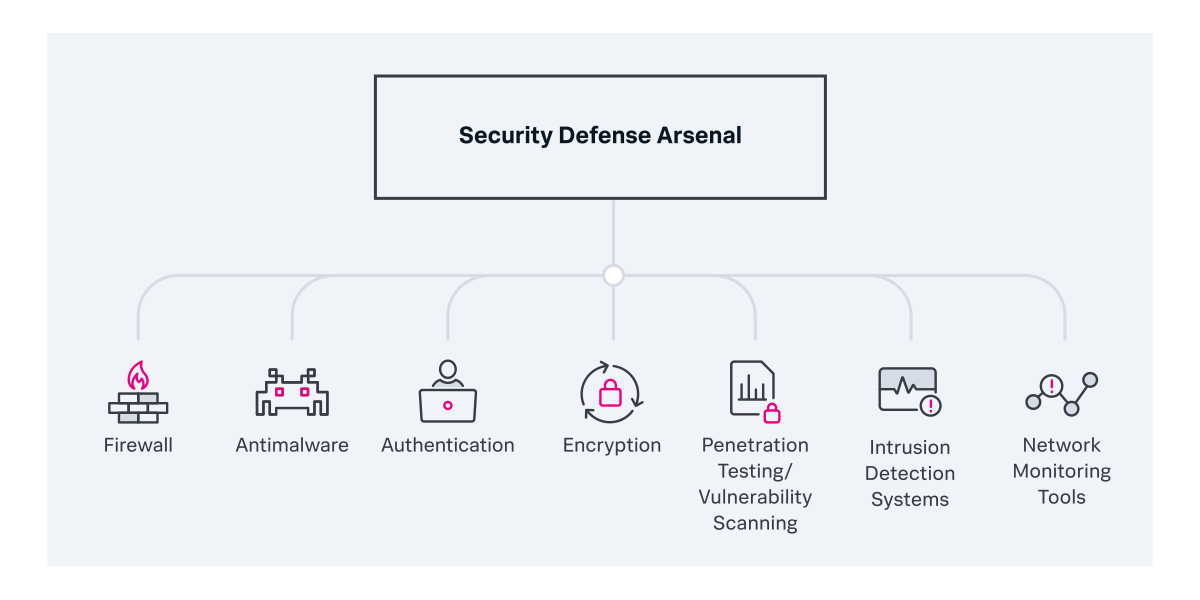
As defenders against attackers, the blue team is a team of incident response members who mitigate and prevent cyber threats. They work with experts to implement measures and patch vulnerabilities in the security systems.
They also detect suspicious activities by monitoring the organization's network, systems, and applications. The team also analyzes logs and network traffic to identify any anomalies that may indicate an attempted breach. Once detected, the team quickly moves to contain and remediate the threat.
Blue team members
Following are some of the most important blue team members:
- Cybersecurity analysts analyze systems and identify potential vulnerabilities in them. They evaluate the effectiveness of the security measures and make recommendations for improvements to help the team implement security measures accordingly.
- Incident responders respond to security incidents and reduce potential threats. They investigate security incidents and work to remediate any damage caused. By being active in the team, they also work to restore the organization's systems to their previous state before the incident occurred.
- Threat intelligence analysts analyze external threats and identify security risks. They collect and analyze data from various sources to identify threats and recommend appropriate security measures to prevent attacks.
- Information security specialists ensure information security policies and procedures are up-to-date and effective. They work to implement security measures and protect against cyberattacks.
- Security engineers design, implement and maintain the system’s infrastructure. They work as a part of the blue team to implement required security measures and ensure the organization's systems are secure against potential threats.
- Security architects develop and implement a complete security strategy. They also ensure the systems are secure against cyber threats and develop appropriate security policies and procedures.
Blue team responsibilities and activities
The Blue Team has several critical responsibilities and activities essential to maintaining an organization's data security. Here’s what they do on a daily basis:
Performing risk assessments
The team conducts risk assessments to identify the organizational assets that are most vulnerable to exploitation. This assessment helps them prioritize security measures accordingly to protect the system.
Here’s how they perform risk assessments:
- Determine the scope of the assessment.
- Identify the assets that need to be protected, whether physical or digital assets.
- Identify the potential threats that could exploit the vulnerabilities of these assets.
- Assess the assets' vulnerabilities to determine the likelihood of an attack and the impact of a successful attack.
- Implement security controls like firewalls, intrusion detection systems, and access controls to detect and respond to attacks.
Performing routine vulnerability scans
The Blue team performs regular vulnerability scans to identify system and application vulnerabilities. By doing this, they know which areas to prioritize and give immediate attention to.
(Learn more about vulnerability management.)
Securing systems using antivirus or anti-malware software
Blue team deploys antivirus and anti-malware software to protect against malicious threats. These software solutions help detect and prevent malware from infecting the organization's systems. Here’s how they deploy antivirus:
- Select the antivirus software that fits the organization's needs and budget.
- Install the software on all systems and devices on the network.
- Update the antivirus software to ensure it detects and prevents the latest threats.
- Configure antivirus to suit the organization's security needs.
- Monitor the antivirus software regularly to make sure it works correctly.
Planning ahead of the red team
Blue teams stay ahead of attackers to plan appropriate defenses and understand what threats exist. And they perform research to stay up-to-date with the latest threats and attack vectors. This helps them implement appropriate defense mechanisms at the right time.
Analyzing logs and memory
The team analyzes logs and memory to identify unusual activity that may indicate an attempted attack. They use this information to quickly respond to and contain any potential threats.
They do this in the following sequence:
- Collects logs and memory dumps from various sources, including firewalls, intrusion detection systems, web servers and endpoints.
- Uses log analysis tools to identify patterns and anomalies in the logs and memory dumps.
- Correlates events across different logs and memory dumps to identify potential attack vectors.
- Investigates potential threats identified through log and memory analysis.
- Isolates affected systems, blocking malicious traffic and removing malware.
(Read more about log aggregation & log management.)
Recognizing weaknesses in the organization's security
The blue team recognizes weaknesses in its security posture and implements appropriate measures to fix them. They continuously evaluate and update their security measures to ensure they remain effective against evolving threats.
Monitoring security systems
The blue team monitors and analyzes the organization's systems and applications to detect and respond to potential threats. They use advanced detection tools and techniques to identify and mitigate potential threats, ensuring the organization's systems remain secure.
Deploying IDS and IPS software
The Blue Team deploys Intrusion Detection Systems (IDS) and Intrusion Prevention Systems (IPS) to detect and prevent attacks. They act as detectives and preventive security control to spot threats, and as soon as the threat is found, team blue gets alerts.
What does (generative) AI mean for red teams & blue teams?
With that understanding of what red and blue teams do, we also wanted to understand what the bustling field of generative AI. Certainly, we're in the midst of a hype cycle around generative AI, so it’s impossible say anything with certainty. Still, we wanted to get an expert's take, so we talked with Ryan Fetterman, Security Strategist with SURGe by Splunk.
Fetterman thinks that, at this moment, large language models (LLMs) seem best positioned to help red teams in the near team — and that's for a few reasons:
So what about the Blue Teams? Fetterman thinks they're disadvantaged, at least for now, because they have to "worry about organizationally-specific content that isn’t yet coded into an LLM — things like organizational structure, user roles and permissions, vulnerability management, and keeping up with on-going infrastructure projects and changes."
Indeed, incorporating an organizational perspective an LLM — like knowledge of the assets and software versions, open tickets and resolutions --- is possible, but that still requires software development progress and custom-model training. Fetterman continues:
(Learn more about what generative AI means for cybersecurity.)
Working together for security: How red team & blue team team up
The red team vs. blue team game is its strongest when it comes to collaboration. They work in a logical sequence, and here’s their 4-stage process:
Stage 1. Attacking and Exploration
In the first stage, the Red Team will try to breach the organization's defenses using various techniques and methods. They identify vulnerabilities in the systems and exploit them to gain access to systems.
At the same time, the blue team conducts network analyses to identify cyber threats and sources of attacks. They also detect the attacks by analyzing network traffic, logs, and other data sources and responding accordingly.
When the red team attempts to breach the organization's defenses, the blue team is ready to respond! They monitor the red team's activities to keep track of their exploitation acts. This way, the blue team knows which security measures to implement first to strengthen the organization's defenses.
Stage 2. Command and Control
The red team then sends signals to its attack systems to prepare for an attack. They use various methods to communicate with their attack tools and establish command and control over compromised systems. The red team also tries to evade detection using encryption and other stealthy measures.
Now, the blue team alerts security team members to get access to a bigger picture of the attacks and work on understanding the actual point of attack. They monitor the networks and systems for unusual activity and keep an eye on suspicious behavior.
By collaborating during the command and control stage, the blue team uses its knowledge of the red team's signals and attack tools to:
- Proactively identify potential attacks and take appropriate actions to prevent them from causing harm.
- Strengthen the defenses by using the information gained from the red team's attack simulations.
Stage 3. Attacking and Preventing
The red team tries to get more power by finding weaknesses in the security defenses and start exploiting them to gain access to more system areas. They also attempt to steal sensitive data from the organization.
But the blue team finds the points of attack, identifies the threats and takes action. They also assess the organizational risks and try to predict future activity that attacks may cause to stay a step ahead of potential attackers.
By working together, the red and blue teams can strengthen the organization's security posture and prevent future attacks.
Stage 4. Reviewing and Reporting
In the reviewing and reporting stage, the red and blue teams work together to analyze the results of the previous stages.
The blue team analyzes the information gathered during the previous stages and generates a report that details:
- The security incident(s)
- The timeline of events
- The actions taken to address the attack
The red team explains the tools and techniques used during the attack and recommendations for improving the organization's security posture.
The blue team continues to work on identifying the vulnerabilities and weaknesses in the system that were exploited by the red team during the attack. And red teams share lessons learned from the attack with the blue team and other security team members to prevent similar attacks in the future.
(Learn about incident reviews and postmortems & use these incident response metrics.)
Summing up the red team vs. blue team collaboration
Red teams and blue teams are essential to an organization's cybersecurity strategy. The red team exploits the security system by making cyberattacks, while the blue team prevents the attacks made by the red team. Together, these teams work to create a robust security posture that can withstand attacks from real-world cyber criminals.
Related Articles

How to Use LLMs for Log File Analysis: Examples, Workflows, and Best Practices

Beyond Deepfakes: Why Digital Provenance is Critical Now

The Best IT/Tech Conferences & Events of 2026

The Best Artificial Intelligence Conferences & Events of 2026

The Best Blockchain & Crypto Conferences in 2026

Log Analytics: How To Turn Log Data into Actionable Insights

The Best Security Conferences & Events 2026

Top Ransomware Attack Types in 2026 and How to Defend