Real-Time Data: An Overview and Introduction
Key Takeaways
- Real-time data enables organizations to act instantly, powering personalization, fast response, and better decisions.
- Success with real-time data depends on strong architecture and tackling challenges like data quality, cost, and scalability.
- Leveraging real-time data gives businesses a clear competitive advantage and improved customer experiences.
Once a startup mailing DVDs to customers’ doors, Netflix offered to sell to Blockbuster for $50 million — and was laughed off. But when Netflix began streaming, it wasn’t just the technology that set them apart.
It was their use of real-time data.
Every click, pause, and scroll fed Netflix’s algorithms, sharpening recommendations and boosting engagement. Instead of just providing movies, they anticipated what viewers wanted next — building a content empire in milliseconds, while Blockbuster clung to late fees.
Netflix isn’t unique. Today, industry leaders like Amazon, Instagram, and TikTok have redefined expectations with data-driven, real-time experiences. But it’s not just about having data. It’s about using now data.
How can your team harness this transformative power? Let’s break down what real-time data means — and how you can move beyond the buzzwords to build innovative products, respond instantly, and stay ahead of the competition.
What does “real-time” mean?
Real-time data is fast-moving information that is delivered while it still matters.
In other words, real-time data is available as soon as it’s created and acquired. Rather than being stored and processed later, data is forwarded to users as soon as it's collected and is immediately available — without any lag — which is critical for supporting live, in-the-moment decision making.
For some use cases, “real-time” means milliseconds, like in high-frequency trading. For others, it’s seconds or minutes — such as app personalization or operational dashboards. The critical factor isn’t just speed, but relevance. Real-time data enables decisions before opportunities slip away.
Technically, real-time isn’t a fixed threshold but a spectrum:
- True real-time: Under a second responses for critical cases like fraud detection or system alerts.
- Near real-time: Seconds or minutes, suitable for analytics dashboards or recommendation engines.
- Streaming: Continuous data flow from sources like apps, sensors, or APIs, processed as it arrives.
Real-time systems usually involve three core components:
- Ingestion: Rapidly acquiring data.
- Processing: Transforming, enriching, or analyzing data.
- Action: Using it, whether to trigger an alert, update a model, or serve new content.
This capture–compute–respond loop distinguishes real-time analytics from traditional batch processing. Batch tells you what happened; real-time reveals what’s happening now and lets you act immediately.
Batch vs. real-time data processing
To understand the advantages of real-time data, it’s important to contrast it with batch data processing — a commonly used alternative.
Batch data processing is ideal for handling large volumes of data where immediacy isn’t required. Data is gathered over a period of time, then processed in bulk, with results delivered after a delay. This method is cost-effective for tasks like payroll or billing, but not suitable when immediate insight is essential.
Real-time processing, on the other hand, handles data as soon as it’s ingested, delivering output with very low latency — measured in seconds or milliseconds. This is the foundation for experiences like ATM transactions, e-commerce order processing, and live monitoring.
While real-time processing enables users to act on data quickly and ensures information is always current, it also requires significant computing power, which can increase cost and complexity.
How real-time data processing works
Real-time data processing, also called data streaming, refers to systems that process data as it arrives and produce near-instantaneous output.
The typical cycle for turning raw data into actionable insights involves six steps:
- Collection: Gathering data from warehouses, data lakes, connected devices, or other sources.
- Preparation: Cleansing and organizing data into a suitable format for analysis.
- Input: Converting raw data into a machine-readable form and feeding it into the processing system.
- Processing: Manipulating data with AI or machine learning algorithms to generate insights.
- Output: Presenting the processed data in a readable form — such as dashboards, documents, audio, video, or visualizations.
- Storage: Retaining data for future use or further analysis.
(Read about managing the data lifecycle.)
Core real-time data use cases
Now that we’ve defined real-time data, let’s look at how it drives value. For today’s tech teams, it’s not just a luxury — it’s essential for everything from personalization to incident response.
Here are the most powerful and practical ways to put real-time data to work, along with examples from leading companies.
Product analytics
Real-time product analytics offer instant insight into how users interact with your product. Teams can spot onboarding drop-offs, test new features with live feedback, and make UX adjustments before problems escalate.
It’s the difference between reacting next sprint and responding today. For example, Twitter (now called X) uses its native analytics dashboard to track engagement on new features — such as tweet view count — in real-time. It allows product teams to quickly assess whether users are engaging as expected and roll back or iterate within the same launch window if necessary.
Incident detection
When systems go sideways, every second counts. Real-time data empowers engineering and SRE teams to detect anomalies, trigger alerts, and resolve issues as they arise, ideally before users even become aware of them. It’s like having a smoke detector, rather than just a fire alarm.
Shopify relies on real-time monitoring across metrics, logs, and traces to guard against regressions, especially during high-stakes events like Black Friday.
Recommendation engines
Real-time data is the secret sauce that creates the ultra-personalized experiences users now expect. From suggesting the next video to surfacing the perfect product, recommendation systems rely on live signals — clicks, scrolls, watch time, cart behavior —to adapt instantly.
Social media platforms like TikTok excel at this: their “For You” feed dynamically adapts to user behavior, curating content that feels almost telepathic. Every swipe or rewatch is factored in, making the experience highly relevant and engaging — minute by minute.
The result? Hyper-relevant content that keeps users glued to their screens — and companies deeply invested in data pipelines that can keep up.
Fraud detection
Speed is no longer an edge; it’s become non-negotiable as the world relies on cybersecurity and digital transactions. Real-time data is crucial for detecting fraud, abuse, or security threats the moment they start, not minutes or hours after the breach.
Real-time dashboards
Raw data alone has limited value. Real-time dashboards transform raw data into live insights, fueling faster decisions across operations, engineering, sales, and customer service. When done right, they become mission control for organizations, surfacing issues and opportunities as they emerge.
Architectural considerations
Real-time data is powerful but delivering it at scale requires thoughtful architecture. Let’s break down the core components of a real-time data architecture:
Ingestion layer
The ingestion layer is the first stop, where raw data enters the system. This layer must support high throughput, low latency, and the unpredictability of real-world traffic, often across multiple sources.
Technologies like Apache Kafka, Amazon Kinesis, and Google Pub/Sub act as distributed messaging systems or event logs. They buffer massive volumes of streaming data while ensuring reliable delivery and fault tolerance.
Stream processing
After ingestion, data needs to be transformed, enriched, and analyzed immediately. That’s the job of the steam processing layer.
Stream processing tools — such as Apache Flink, Apache Spark Structured Streaming, and Apache Beam — filter noise, join streams, compute aggregates, detect anomalies, and apply machine learning models on the fly.
The goal: turn data into useful signals while it’s still relevant, handling late-arriving data, stateful operations, and fault tolerance, all without slowing down.
Storage
Even in real-time systems, not everything happens in-memory. You still need storage, but it must be fast enough to keep up and flexible enough to serve multiple downstream needs.
Depending on the use case, teams often rely on:
- Time-series databases, like InfluxDB or TimescaleDB, for metrics and telemetry.
- Distributed databases, like Cassandra or DynamoDB, for high-speed lookups.
- Real-time data warehouses, like Snowflake or BigQuery, with streaming inserts, for blending historical and live data.
- Cold storage, like S3 or Google Cloud Storage, for durable, long-term logs.
The key is balancing speed for immediate needs with depth for long-term analysis.
Serving layer
The serving layer is where real-time data meets the real world. This is how insights reach dashboards, APIs, alerts, or even machine learning models — fast enough to make a difference.
Depending on the product or use case, the serving layer might:
- Power a live dashboard used by operations or SRE teams.
- Feed APIs that deliver recommendations in milliseconds.
- Trigger system alerts or notifications.
- Dynamically update user interfaces, like product feeds or personalization models.
To keep performance high, many teams use caching, real-time APIs, or stream-to-UI frameworks (e.g., Apache Druid, Materialize). This final mile turns data into action.
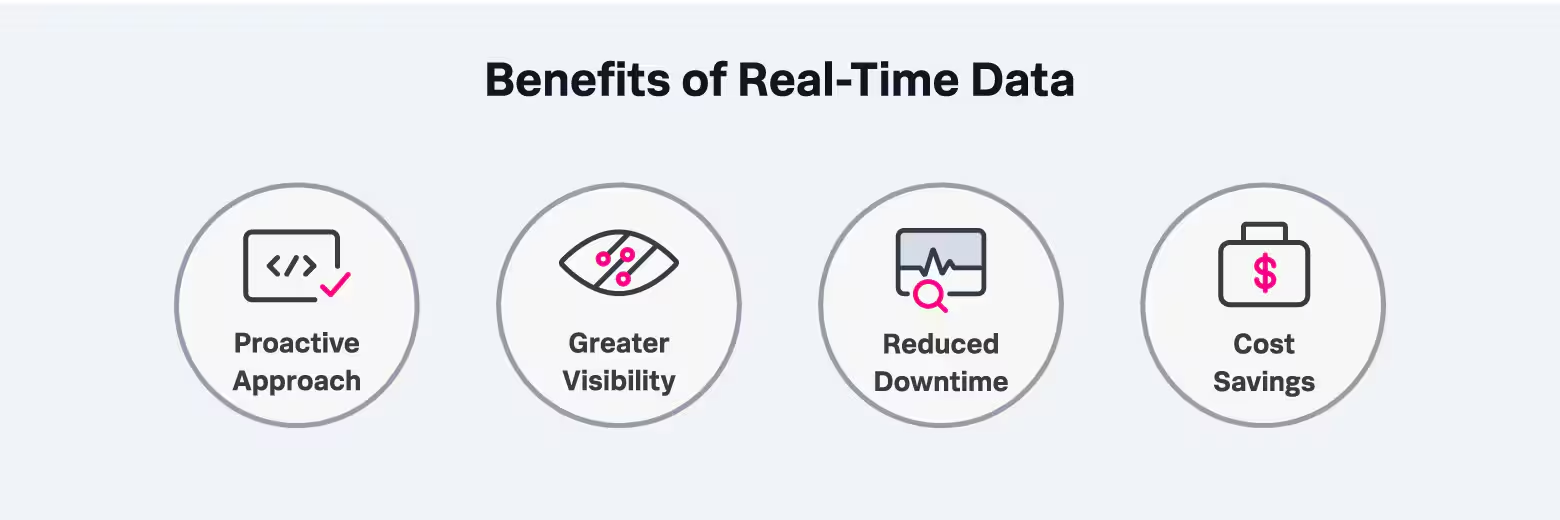
Benefits of real-time data
Real-time data offers a range of benefits for organizations of any size:
- A more proactive approach: Modern analytics enable proactive strategies — using data mining and machine learning to identify patterns and predict problems before they occur.
- Greater visibility: Real-time data provides a comprehensive, unified view across complex IT environments, making it easier to correlate information and generate actionable insights.
- Reduced downtime: With real-time data, teams can predict, prevent, and quickly resolve issues, minimizing service disruptions and impacts to customers.
- Cost savings: By providing insight into resource allocation, system health, and security, real-time analytics helps optimize infrastructure and reduce operating costs.
Challenges and how to solve them
Building real-time data systems isn’t just about speed — it’s about accuracy, scalability, and maintainability under pressure. Here are a few common hurdles teams face, and how to overcome them:
Data quality
A major challenge in real-time systems is maintaining data quality. When data arrives out of order, incomplete, or duplicated, it can throw off metrics, alerts, and machine learning models. Unlike batch pipelines, you can’t easily reprocess bad data later — mistakes have immediate impact.
To address this, enforce strong schemas at ingestion and use clear versioning practices so producers and consumers stay in sync. Stream processors like Apache Flink or Kafka Streams help deduplicate, reorder, and fill in missing data. Always route problematic data to a dead-letter queue for later inspection, avoiding disruption in your main pipeline.
Latency vs. cost
Real-time infrastructure can be expensive. Every millisecond you save often means higher compute and infrastructure costs. Not all use cases require true real-time speed, so focus on those that do — like fraud detection or instant user personalization. For everything else, near real-time or hybrid solutions can be more cost-effective.
Architectures like Lambda or Kappa can help balance speed and cost, letting stream processors handle immediate needs while batch systems process historical data more efficiently.
Scalability
Traffic spikes — such as big launches or viral moments — can easily overwhelm a real-time pipeline. To stay resilient, design for horizontal scalability from the outset. Use tools like Kafka or Kinesis for partitioning and autoscaling, and decouple services so one failure doesn’t cascade.
Incorporate buffers, retries, and dead-letter queues to manage disruptions. Regular load testing is essential, so bottlenecks are found before they impact production.
Tooling fragmentation
Real-time stacks often become a patchwork of tools and services, making integration, onboarding, and debugging more complex. Whenever possible, streamline with end-to-end platforms to reduce operational overhead and integration pain.
If building in-house, prioritize observability and documentation. Standardize interfaces, use structured logging, and implement tracing (like OpenTelemetry) to track data across your stack. These steps pay off during troubleshooting and scaling.
Real-time data, real-world impact
Real-time data isn’t a technical flex; it’s a competitive edge. From Netflix’s recommendations to TikTok’s “For You” feed, the companies shaping the future are the ones acting in the moment.
But true success requires more than speed. It takes thoughtful design, careful trade-offs, and a clear vision of where immediacy matters most. Done right, you’re not just keeping up with your users — you’re anticipating their needs.
FAQs about Real-Time Data
Related Articles

How to Use LLMs for Log File Analysis: Examples, Workflows, and Best Practices

Beyond Deepfakes: Why Digital Provenance is Critical Now

The Best IT/Tech Conferences & Events of 2026

The Best Artificial Intelligence Conferences & Events of 2026

The Best Blockchain & Crypto Conferences in 2026

Log Analytics: How To Turn Log Data into Actionable Insights

The Best Security Conferences & Events 2026

Top Ransomware Attack Types in 2026 and How to Defend