LLM Observability Explained: Prevent Hallucinations, Manage Drift, Control Costs
Key Takeaways
- Observability is essential for production-grade LLMs. It goes beyond monitoring by connecting inputs, outputs, and model behavior to explain why responses succeed or fail, helping teams build trust, control costs, and accelerate iteration.
- Track the right signals to prevent silent failures. Monitoring prompts, retrieval accuracy, groundedness, latency, and costs ensures responses remain accurate, reliable, and efficient while reducing risks like hallucinations, bias, and drift.
- Operationalizing observability creates a competitive advantage. By aligning KPIs (trust, cost, latency) with business outcomes and integrating observability early, organizations can deliver trustworthy, scalable, and cost-efficient LLM-powered applications.
Large Language Models (LLMs) are transforming how businesses interact with users, automate workflows, and deliver insights in real time. But as powerful as these models are, running them at scale comes with unique challenges, from hallucinations and latency spikes to cost overruns and user trust issues.
That’s where LLM observability comes in. Do not think of observability as “just monitoring”. Observability is the practice of understanding why your systems behave the way they do — and we can apply observability to LLMs and AI systems. By tracking everything from prompt quality and retrieval accuracy to model versions and user feedback, observability gives teams:
- A holistic view of system performance
- The insights needed to keep LLM-powered applications reliable, efficient, and trustworthy
Implementing robust observability ensures that answers stay accurate, performance stays smooth, and teams can act quickly when issues arise.
What is LLM observability?
LLM observability is the practice of tracking, measuring, and understanding how large language models perform in production. Unlike traditional monitoring, LLM observability connects model inputs, outputs, and internal behaviors to uncover why a system succeeds or fails.
In this emerging tech, other terms you may hear around LLM observability include:
- AI observability: Broader visibility into AI systems across multiple models
- GenAI observability: Monitoring next-generation generative AI pipelines
- Monitoring large language models: Focusing on performance, errors, and output quality at scale
(Related reading: top LLMs to use today.)
Why observability matters for language models
Even the most advanced LLMs are prone to errors without proper observability. Consider these real-world scenarios:
- Customer service chatbots: A bot may start giving inaccurate refund details. Observability would detect “hallucinations” and trace them back to problematic prompts or outdated knowledge sources.
- RAG-based knowledge assistants: Without tracking document relevance and retrieval accuracy, responses may drift from verified sources, reducing trust. Observability can highlight where these errors occurred and sometimes even suggest next steps to address.
- AI copilots in finance or healthcare: Latency spikes or ungrounded recommendations can lead to costly mistakes or regulatory violations. Observability ensures these systems operate reliably and safely.
By tracking metrics such as prompt quality, retrieval accuracy, model versions, and user feedback, observability provides a holistic view of system performance, enabling teams to optimize for trust, cost, and user experience.
LLM observability vs. traditional monitoring
Traditional application monitoring tells you whether a service is up or down. While traditional monitoring for LLMs can detect crashes, latency spikes, or resource usage, but it cannot explain why a specific model output succeeded or failed.
LLM observability goes deeper, providing teams the ability to:
- Connect inputs, outputs, and internal processing to reveal root causes of errors.
- Track hallucinations, bias, and drift over time.
- Correlate system performance with business outcomes such as cost, engagement, and user trust.
In short, standard monitoring answers “Is it up, is it working?” LLM observability answers “Why did this specific conversation succeed or fail?” For LLMs, you need context-rich traces that tie together all sorts of data, including prompts, retrieved context, model versions, scores, latency, cost, and user feedback.
(Related reading: observability vs. monitoring vs. telemetry.)
Challenges and risks of skipping observability
Failing to implement LLM observability can have serious consequences (and some of these may surprise you):
- Hallucinations and inaccuracies can erode user trust and brand reputation
- Operational inefficiencies increase costs, e.g., untracked token usage or redundant computations
- Compliance gaps can arise if you cannot trace inputs and outputs for audit purposes
- Project abandonment: studies show AI/ML projects increasingly fail before production due to lack of visibility and controls
Observability is not optional for production-grade LLMs. It is a competitive advantage, allowing teams to act before small errors cascade into major failures.
Observability helps handle standard problems with LLMs
Let’s put the business outcomes to the side for a moment. Yes, LLMs unlock new digital capabilities — and they also introduce risks that demand visibility and control. Here are many common and known issues with building and managing LLMs, and how observability helps manage these:
- Hallucinations and factuality: Detect when answers drift from verified sources, so responses stay grounded.
- Bias, fairness, and toxicity: Escalate unintended behaviors and route sensitive or risky content for human review.
- Prompt injection and security: Find jailbreak attempts, context poisoning, and other adversarial inputs before they impact users.
- Latency and performance bottlenecks: Correlate output quality with p95 latency to preserve smooth user experiences.
- Token and cost visibility: Track tokens in/out and per-request costs to avoid budget overruns.
- Model and context drift: Monitor when relevance degrades over time as data, usage, or content changes.
- Black box debugging: Enable root cause analysis across chains, tools, and retrieval steps, shedding light on black box model behavior inherent to AI systems.
- Compliance and reproducibility: Maintain full audit trails of inputs, outputs, and model versions to align with AI governance requirements.
Effective observability ensures systems remain accurate, reliable, and cost-efficient at scale.
Now that we understand why we need observability, let’s see where we can apply it.
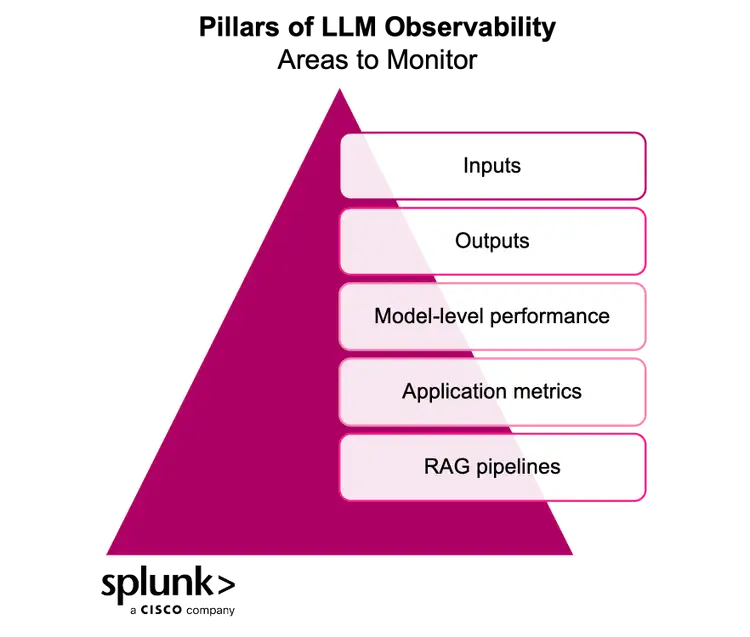
What to monitor: Key pillars of LLM Observability
With LLM observability, it’s not enough to know why models fail — you need to track the right signals across inputs, outputs, models, and applications to detect issues, optimize performance, and control costs.
Let’s look at the essential areas to monitor for true LLM observability.
Input monitoring
Monitoring inputs ensures your LLM receives clean, structured, and meaningful data, which is critical for preventing hallucinations and drift. Key areas to track include:
- Prompt quality and structure: Evaluate template integrity, guardrails, system prompt design, prompt length, and variable usage to ensure consistent, high-quality instructions.
- Context window utilization: Track truncation rates, overflow events, and reranker performance to make sure all relevant context is processed effectively.
- User intent trends and clustering: Identify semantic clusters to anticipate user needs, prioritize content updates, and optimize caching strategies.
Output monitoring
By monitoring outputs, you ensure that your LLM delivers accurate, relevant, and safe responses. The goal, of course, is to prevent errors from reaching users. Key areas to track include:
- Factuality, relevance, and coherence: Measure groundedness scores, retrieval match rates, and content consistency to ensure responses (outputs) are accurate and trustworthy.
- Sentiment and tone analysis: Detect user confusion, frustration, or satisfaction signals to identify areas for UX improvement.
- Moderation for toxic or harmful content: Track flagged categories, override decisions, and escalation paths to maintain transparency and auditability.
Model-level performance
Monitoring model-level metrics helps teams understand how the LLM behaves under different loads. It also supports performance and cost efficiency. Key areas to track include:
- Latency, throughput, and error rates: Measure p50/p95/p99 by route, region, or endpoint to detect bottlenecks and performance anomalies.
- Token usage and compute: Track prompt versus completion tokens, cache hit ratios, and compute utilization to optimize efficiency.
- Cost-per-request: Monitor aggregated costs by feature, segment, or workflow to control spending and prevent budget overruns.
Application metrics
Application-level monitoring connects LLM performance to real-world user outcomes, helping prioritize improvements and ensure adoption. Key areas to track include:
- Feedback loops and satisfaction: Track thumbs up/down, free-text feedback, and document click-throughs to understand user experience.
- API/tooling success: Monitor chain step success and failure rates, tool errors, and integration performance.
- Engagement trends: Measure sessions, retention, and deflection to live support to assess adoption and usage patterns.
RAG pipeline monitoring
For Retrieval-Augmented Generation (RAG) systems, observability requires tracking both the retrieval process and the generated outputs to ensure responses stay grounded and relevant. Key areas to monitor include:
- Retrieval relevance and coverage: Measure recall@k, MRR, and nDCG for knowledge bases to ensure the right documents are selected.
- Source freshness: Track last-updated timestamps and staleness alerts to maintain up-to-date answers.
- Model versioning: Compare base versus fine-tuned models side by side to identify drift or regressions.
(See this in practice! Check out this case study on how a Splunk dev team built end-to-end observability with Splunk and RAG.)
By monitoring inputs, outputs, model performance, application metrics, and RAG pipelines, teams gain a complete, actionable view of their LLM deployments.
Next steps: Use these pillars as the foundation for implementing robust LLM observability, building dashboards, setting alerts, and aligning metrics to business outcomes.
Best practices for effective LLM observability
Implementing observability may seem overwhelming, but it doesn’t have to be. Start small, focus on critical user journeys, and explore observability best practices like these:
- Define KPIs that tie to business outcomes: Trust (groundedness), cost (cost-per-answer), and UX via p95 latency. The table below highlights some sample KPIs to get started.
- Integrate observability early: Instrument prompts, retrieval, and generation before launch.
- Automate data pipelines: Ingestion, embedding, indexing, and eval loops should emit consistent logs.
- Govern privacy and compliance: Minimize data in logs and document retention and disposal policies.
- Enable collaboration: Share dashboards across AI/ML, DevOps, product, and content owners. (This is easy with Splunk.)
- Close the loop: Combine user feedback with automated signals to prioritize fixes and content refresh
LLM Performance KPIs to align with business outcomes
- Groundedness Score: Alignment with trusted documents.
- Factuality Check Rate: Frequency of checks.
- Moderation Flags: Number of flagged responses.
- Cost-per-Answer: Average cost per response.
- Token Utilization Rate: Token input and output analysis.
- Budget Adherence: Spending vs. budget.
- p95 Latency: Measure 95th percentile response times.
- Error Rate: Frequency of errors or failures.
- User Feedback Scores: Satisfaction ratings and feedback analysis.
Make observability your competitive advantage
LLM observability transforms AI from experimental to essential. It's the difference between hoping your AI works and knowing exactly why it succeeds or fails.
For LLMs affecting any user experience, and specifically RAG systems, always track the entire journey from user question to final answer — prompt processing, document retrieval, context assembly, generation, and quality validation.
Frequently asked questions (FAQs) about Observability for LLMs
Related Articles

How to Use LLMs for Log File Analysis: Examples, Workflows, and Best Practices

Beyond Deepfakes: Why Digital Provenance is Critical Now

The Best IT/Tech Conferences & Events of 2026

The Best Artificial Intelligence Conferences & Events of 2026

The Best Blockchain & Crypto Conferences in 2026

Log Analytics: How To Turn Log Data into Actionable Insights

The Best Security Conferences & Events 2026

Top Ransomware Attack Types in 2026 and How to Defend