Human in the Loop (HITL) in Practice: A Guide to Core HITL Concepts, Benefits, and Effective AI Collaboration
Ever wondered how AI systems learn to distinguish between a cat and a dog with such accuracy, or how inappropriate content gets filtered online? Often, the secret ingredient is a "Human in the Loop" (HITL).
What is human in the loop?
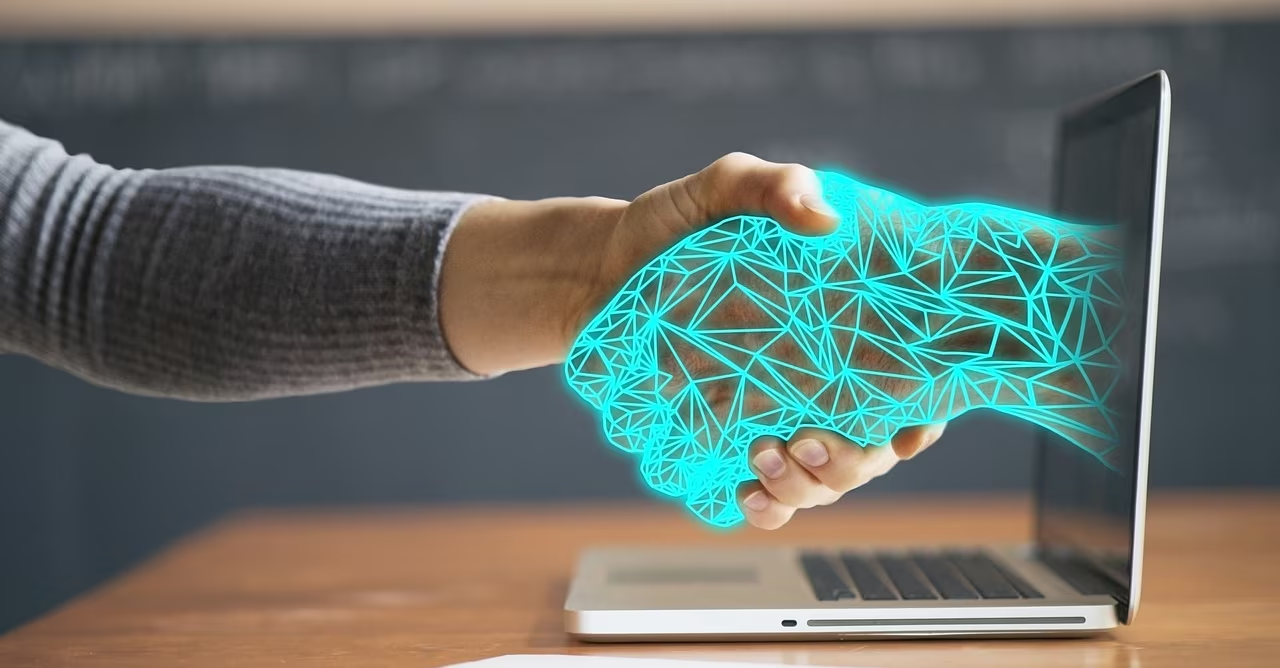
Simply put, Human in the Loop refers to the crucial role of human intervention in an automated or AI-driven process. This involvement is designed to:
- Control and improve the outcome.
- Ensure accuracy.
- Manage complex situations.
- Provide essential oversight.
While the long-term vision of Artificial General Intelligence (AGI) — where machine intelligence might surpass human capabilities — is a topic of discussion, today's most advanced AI products, especially those facing consumers, are heavily developed with HITL pipelines. From data engineers managing information quality to machine learning (ML) scientists designing new algorithms, human feedback is integral to augmenting machine intelligence and achieving high-quality, reliable results.
Why is human in the loop necessary?
The need for HITL in AI stems from several fundamental challenges related to data and model behavior:
- Data quality and structure: Data is abundant, but not all of it is useful for AI training. It's often collected in an unstructured form, whereas AI models typically require data to be structured and standardized. Humans play a key role in cleaning, structuring, and preparing this data.
- Data sufficiency and diversity: For an AI model to generalize well — meaning it performs accurately on new, unseen data — its training data must be both large enough (quantity) and varied enough to represent a wide spectrum of scenarios. In practice, accessing or generating such comprehensive data can be difficult due to access limitations, privacy regulations, or other practical constraints. HITL can help identify and fill these data gaps.
- Safety, ethics, and compliance: Even with perfect data, AI models need to be safe, secure, and aligned with societal norms and regulations for general use. Human oversight is essential to guide model behavior, mitigate biases, prevent harmful outputs, and ensure the end-user experience is appropriate.
Essentially, the processes of data engineering, model training, and AI application deployment are all carefully managed with human judgment and interaction to control how data is processed, how models learn, and how AI applications ultimately behave.
Key approaches to human in the loop AI
Several prevalent approaches describe how humans are integrated into AI systems:
Approach 1. Active learning
In active learning, humans are primarily involved in data processing tasks, typically labeling and annotating data. Machines control most of the learning process, and they strategically select the most informative or ambiguous data points that require human intervention for clarification.
The machine trains the model and can ask human agents to identify features relevant (or irrelevant) to the model's learning. Manually annotating an entire massive dataset is often time-consuming, expensive, and impractical in real-time. Active learning simplifies this by having the learning algorithm pinpoint specific data points or features that are most critical for improving the model. This enhances training data quality and diversity, helping the model generalize better.
Active learning with human intervention is a form of semi-supervised learning, where not all data labels are available initially but are acquired during the learning process itself. This contrasts with supervised learning (all data labeled) or unsupervised learning (all data unlabeled).
Example of active learning
An AI used in medical imaging might flag ambiguous areas on a scan that it cannot confidently classify. A radiologist (the human in the loop) then reviews these specific areas, provides the correct label (e.g., "benign" or "malignant"), and this feedback helps the AI learn and improve its accuracy on similar future scans.
Approach 2. Interactive machine learning (IML)
Interactive machine learning (IML) involves humans directly and iteratively training, improving, and teaching AI models to enhance their performance. Early IML implementations focused on improving the classification performance of classical AI methods like Decision Trees. Later, the focus shifted to guiding the classification boundaries of AI models.
For instance, a human agent might examine a confusion matrix (a table that visualizes a model's prediction accuracy by showing correct vs. incorrect classifications) from multiple AI classifiers and devise a strategy to combine them effectively. In this scenario, the combined model — an "ensemble" of classifiers, where multiple models work together — is optimized through retraining based on human insights.
In modern IML, humans and machines can take on various roles. Humans might validate model predictions during training, guide the model's learning path, or focus solely on data labeling. Essentially, IML is any process where human interaction generates useful artifacts to improve model training and performance. This requires an interface for human-machine interaction and an iterative learning methodology.
Example of interactive machine learning
A content recommendation system on a streaming service uses IML. When you "like" or "dislike" a movie suggestion, or choose to ignore it, your interactions provide direct feedback. The AI uses this feedback to interactively refine its understanding of your preferences and make better recommendations in the future.
Approach 3. Machine teaching (MT)
Machine teaching is an AI paradigm where a human "teacher" — often a domain expert who may or may not have deep machine learning knowledge — controls and guides the learning process of an AI model. The core idea is transfer learning, where the human expert imparts their knowledge to the machine. This is particularly useful when labeled data is scarce or unavailable.
In practice, it looks like this:
- The expert analyzes the dataset and performs necessary data preprocessing, which can include annotating, structuring, normalizing data, or engineering specific features based on their domain expertise.
- The machine then learns from this curated data and produces an outcome.
- The human teacher iteratively refines this process by updating the "curriculum" (the training data and tasks) for the model.
Reinforcement learning from human feedback
A significant category within this is Reinforcement Learning from Human Feedback (RLHF). RLHF differs from some standard Machine Teaching approaches in how humans influence the model. In RLHF, humans typically guide the model's behavior by providing feedback on its actions or by shaping its reward system, which in turn guides its learning process. This is common in agentic AI and Large Language Model (LLM) use cases.
- In standard Machine Teaching, interactions might be more offline (not during the live model learning) and could involve techniques like few-shot learning, where you train a model using very few examples.
- In RLHF, a human expert might interact continuously or iteratively as the model responds to an agent's behavior within an environment, assessing the quality of the agent's actions.
(Related reading: chain of thought prompting explained.)
Example of machine teaching
A cybersecurity expert teaches an AI to identify new types of sophisticated phishing emails. The expert provides the AI with a curated set of recent phishing examples and benign emails, highlighting the subtle linguistic cues, suspicious link structures, or sender impersonation tactics that characterize the new threat. This expert-guided curriculum helps the AI learn to detect these specific attacks more effectively than it might from raw data alone.
Combining HITL approaches
In practice, many modern HITL paradigms combine elements of Machine Teaching (with IML often considered a subset) and RLHF, especially for advanced AI applications.
Benefits and challenges of HITL
Incorporating humans into the AI loop offers significant advantages but also presents challenges:
Benefits:
- Improved Accuracy: Human oversight can correct errors and refine model performance.
- Handling Edge Cases: Humans can manage novel or ambiguous situations that an AI might not be trained for.
- Enhanced Safety and Bias Mitigation: Human judgment can help prevent harmful outputs and identify/correct biases in data or model behavior.
- Better Data Quality: Humans can effectively label, annotate, and curate data.
Challenges:
- Scalability: Human involvement can be a bottleneck for very large datasets or high-volume processes.
- Cost: Employing human experts or annotators can be expensive.
- Consistency and Subjectivity: Human judgments can vary, introducing potential inconsistencies.
- Time: Human review and intervention can slow down otherwise automated processes.
The enduring role of humans in AI
Human in the Loop is not just a temporary measure but a fundamental aspect of developing robust, reliable, and responsible AI systems. While AI technology continues to advance, the need for human insight, judgment, and oversight remains critical for:
- Navigating the complexities of real-world data.
- Ensuring ethical considerations are met.
- Ultimately building AI that effectively serves human goals.
The collaboration between human intelligence and machine capabilities is key to unlocking the full potential of AI safely and effectively.
Related Articles

How to Use LLMs for Log File Analysis: Examples, Workflows, and Best Practices

Beyond Deepfakes: Why Digital Provenance is Critical Now

The Best IT/Tech Conferences & Events of 2026
The Best Artificial Intelligence Conferences & Events of 2026

The Best Blockchain & Crypto Conferences in 2026

Log Analytics: How To Turn Log Data into Actionable Insights

The Best Security Conferences & Events 2026

Top Ransomware Attack Types in 2026 and How to Defend