Common DevOps Roles and Responsibilities Today: Who’s on a DevOps Team & How These Roles Work Together
Key Takeaways
- DevOps unifies development and operations into a collaborative, automated lifecycle, emphasizing continuous integration and delivery (CI/CD), shared responsibility, and accelerated, reliable software delivery.
- Key DevOps roles, such as DevOps engineer, developer, product owner, QA/testing engineer, security engineer, and site reliability engineer (SRE), each contribute specialized skills to distinct phases of the pipeline, ensuring seamless integration and high-quality releases.
- Successful DevOps adoption relies on clear responsibilities, end-to-end automation, strong communication, and a continuous improvement culture, with proactive security and SRE-driven monitoring ensuring resilient, high-quality outcomes.
All organizations are in a constant state of flux, driven by the demands of a fast paced, competitive technology-enabled environment, where opportunities and risks abound in equal measure. The need to deliver better technology solutions at a faster but cost-effective rate has never been greater, especially where generative AI has become the focus for innovation initiatives.
DevOps has continued to demonstrate its value towards meeting this objective, by enabling a culture of collaboration and communication among IT teams. This collaboration delivers an increasingly faster and smoother flow of work from the development environment to production. This 2024 State of DevOps highlights three themes — efficiency, speed, and security — that drive success in the world of DevOps.
As always, the people aspect is at the heart of any successful DevOps practice. That’s because agile, scalable teams are a necessary ingredient towards staying ahead in the digital transformation race.
So, let’s focus on the people in DevOps. In this article, we’ll look at a two-part team structure for DevOps success, and break that structure down into some of the most important and most common DevOps roles and responsibilities.
More DevOps resources for success
Roles and responsibilities in DevOps
Being part of a DevOps team doesn’t mean you have an entire team made up of “DevOps Engineers”. Instead, a DevOps-oriented company will spread the accountability for application development, testing/QA, and release across the entire engineering and IT organization.
Because DevOps teams are set up independently and autonomously, they are required to:
- Be multi-skilled.
- Have a service mindset that focuses on delivering quality first, by addressing defects early.
Such teams require well defined roles that are aligned in terms of priorities, goals, and time frames. According to DASA, the preferred structure of DevOps done right involves having both:
- A platform team who manage the underlying infrastructure of a platform.
- Business system teams (e.g. CRM, HR, BI) who develop and manage end-user products and services that are hosted on the platform.
The platform services, managed by the platform team, are offered through self-service and automation, which enables autonomy and speed for the business system teams to manage the entire lifecycle of services.
So, let’s now examine the roles that you would find in such a structure.
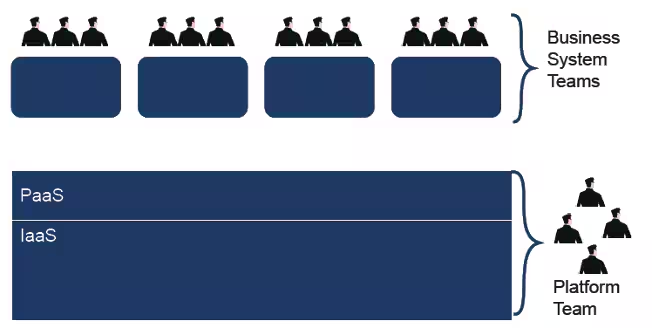
DevOps Team Structure (Source: DASA)
Platform team roles
Platform engineering teams are responsible for deployment and maintenance of internal developer platforms (IDPs) that provide self-service tools for coding, building, testing and releasing software.
As a strategic partner for business systems teams, this team standardizes processes and tools which increase developer productivity in coding and product development. According to DORA research, having a dedicated platform team translates into productivity gains for development teams. The platform engineering team requires a diverse skillset including:
- System integration
- Process automation
- Continuous integration/continuous delivery CI/CD
- Performance testing
- Monitoring
The main roles found withing the platform engineering team include:
Platform manager
Platform managers provide oversight for the platform engineering team, ensuring smooth operations for the platform services, and collaborating with the wider engineering and operations teams in the organization.
More specifically, they help to:
- Guide the team in task prioritization, resolve any team issues and concerns, and facilitate the resources required.
- Outline the technology evolution roadmaps for underlying infrastructure and systems.
As a team lead, platform managers play a leading role in recruiting the right fit for the platform team and driving overall performance to meet organizational goals.
DevOps engineer
The DevOps engineer role carries out the actual infrastructure operations activities that support product development, which SFIA outlines as:
- Provisioning and adapting infrastructure components to meet the evolving needs of users and service providers.
- Managing virtual, cloud, and hybrid/multi-cloud environments.
- Automating tasks through scripting, coding, orchestration tools, and infrastructure-as-code (IaC) practices including the CI/CD pipeline.
- Ensuring infrastructure security through regular updates, patch management, and adherence to cybersecurity policies and established industry practices (i.e. DevSecOps).
- Monitoring infrastructure performance and its impact on efficiency, performance, security posture, and sustainability.
- Collaborating with development teams to onboard their platform requirements.
- Using containerization technologies to enhance application deployment and scalability.
(Related reading: what is a platform engineer?)
Product manager
The product manager role provides unique cross-functional value by translating the needs and pain points of business systems teams into actionable tasks for the engineers.
The responsibilities of product managers are to:
- Ensure that the platform team understands their contribution to achieving overall business goals
- Help prioritize tasks for automation.
- Drive alignment and focus, while significantly enabling effective collaboration and communication with the business teams.
The product manager role can be a standalone role or combined with the platform manager role.
Now let’s turn to the other side of the DevOps people structure.
Business system team roles
The business systems team own the entire product lifecycle. Therefore, they’re responsible for managing the end-users and associated services.
In a DevOps environment, business system teams develop and deploy their application and infrastructure code on the platforms (that are maintained by the platform team) which they access through self-service and automation facilities via APIs. This enables the business systems teams to reuse the infrastructure, without impeding their speed and autonomy.
These autonomous teams constantly interact with the platform team to provide strategic direction and improvement ideas on enhancing the platform services that are then tracked on a backlog for implementation.
The roles within the business team usually borrow from scrum accountabilities, such as:
- Scrum master: Helping everyone understand Scrum theory and practice.
- Product owner: Maximizing the value of the product resulting from the work of the scrum team.
- Developers: Creating any aspect of a usable Increment each sprint.
Additional DevOps roles
Other roles that are key towards driving DevOps excellence within an organization include:
DevOps architect
The DevOps architect role defines, designs, and oversees implementation of the strategies, frameworks, tools, and processes that other DevOps team members abide by.
As a DevOps ambassador, the architect defines the DevOps way of working at enterprise level, with particular focus on:
- Solving complex business problems.
- Driving maturity improvement that leads to achievement of organizational objectives.
This role is senior in nature and requires expertise in business, development, and operational domains.
DevOps governance
The DevOps governance role promotes awareness of business risks and compliance requirements, and guides DevOps team members to understand the intent behind putting appropriate controls in place such as secure development practices and proper change management approval workflows.
They communicate and support the implementation of appropriate checks and balances and best practices to address any risks to automated deployments within the enterprise.
(Related reading: GRC governance, risk, compliance explained.)
Release manager
This role coordinates the planning, scheduling, and control of software releases at both product and platform level across multiple teams.
This role is more active in an environment with legacy infrastructure where continuous delivery is not possible, hence a manual coordination of releases across multiple teams is required.
(Related reading: release management in DevOps.)
DevOps roles should support DevOps goals
While this summarizes the most common DevOps roles, remember that the title of the role is only a title. Other titles may cover the areas of responsibilities that I described.
Similarly, there’s no single way to “do” DevOps. There isn’t a tool or a process that works for every team, and teams have to discover what skills they need for their unique environments. Keeping in mind the goal of a successful DevOps practice—building faster and building better via high visibility and smart collaboration.
Regularly assess your levels of collaboration by asking questions like:
- What’s the best way to communicate during product development and throughout the software delivery lifecycle?
- How can your IT professionals and developers collaborate in real-time and surface issues faster?
FAQs about Common DevOps Roles and Responsibilities
Related Articles

Security Books & Articles: Must-Read List From InfoSec Experts

Incident Severity Levels 1-5 Explained

Cloud Network Monitoring: An Introduction

The Democratization of Data: The Pros & Cons of All That Data

Trunk-Based Development vs. GitFlow: Which Source Code Control is Right for You?

What Is TBD? Trunk-Based Development & Its Role in CI/CD

Status Pages: The Ultimate Guide

When and Why To Adopt Feature Flags