DevOps Release Management Concepts & Best Practices
Key Takeaways
- DevOps release management streamlines and automates software deployments, enabling organizations to deliver updates faster and with greater reliability through practices like continuous integration, continuous delivery (CI/CD), and robust monitoring.
- Success depends on cross-functional collaboration, clear roles and responsibilities, and the use of standardized tools and templates to ensure consistency, traceability, and compliance across every environment.
- Embedding continuous monitoring and feedback into post-release processes helps teams detect and remediate issues early, continuously refine release pipelines, and ensure ongoing stability and efficiency.
In a DevOps environment, release management refers to the process of planning, coordinating and deploying software releases to production environments. The goal of release management is to ensure that new features, bug fixes, and enhancements are delivered to end-users in a reliable, efficient, and timely manner.
Release management is a critical component of DevOps, as it helps to ensure that software is delivered to end-users in a timely and reliable manner, while minimizing the risk of errors and downtime. So, in this article we'll cover:
- The basics of release management
- The differences between DevOps and other environments
- Phases in release management
- Best practices
- More DevOps resources
What is release management?
Release management in software development and IT operations is a system for managing the entire software delivery lifecycle — from planning to building to testing to deployment. For both ITIL and DevOps, this is the general process. However, DevOps encourages more collaboration and visibility throughout the entire delivery process, shortening feedback loops and encouraging simpler, faster release management.
While the general concept of release management doesn’t really change across ITIL® and DevOps, the approaches different in two key ways:
- ITIL is a framework specific to IT service management while DevOps looks at the collaboration across software development and IT operations.
- These isn’t a single way to implement DevOps whereas ITIL is a more prescriptive set of instructions.
Let’s look at how release management manifests itself for ITIL and DevOps teams:
ITIL release management
The process for release management in ITIL 4 is to schedule and maintain the integrity of new deployments, all the way from planning to release. In ITIL, the IT operations team will receive code from the software developers and decide when and how to deliver the service while maintaining uptime for existing services.
DevOps release management
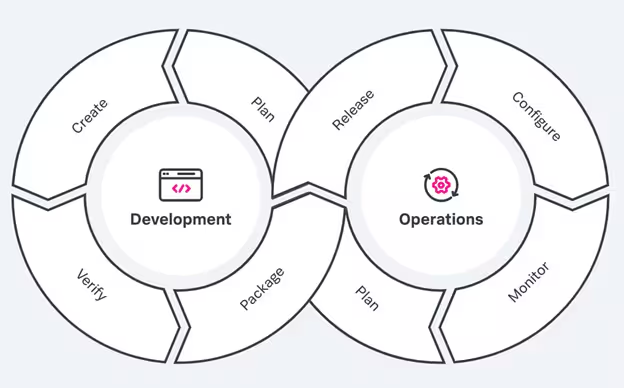
In DevOps, release management is also about planning, scheduling and controlling the software development and delivery process. But, in DevOps, both developers and IT operations collaborate from the beginning of the process to the end — allowing for fewer, shorter feedback loops and faster releases.
DevOps teams share accountability for the services they deliver, own their code and take on-call responsibilities. With software developers and IT professionals involved in the entire delivery lifecycle and on-call, incidents are detected and resolved faster – both during the release process and after.
Stages in DevOps release management
Release management involves several stages, including planning, testing, deployment and monitoring. The processes are typically broken into three phases:
- The development team creates new code or features.
- Next, they test the new code/features in a staging environment.
- Following thorough testing and approval, that code/new feature is then released to production.
Note that depending on your business model, this new piece of software may or may not go directly to the customers. In some scenarios, you might release something to production from a developer standpoint, but from a sales standpoint or aligning with a particular timeline, you might choose to wait on releasing that code to the overall user base. Or, perhaps you take a middle step, like only releasing a beta to a smaller pool of users.
DevOps release management best practices
With definitions clarified, let’s go over a few key DevOps philosophies and how they apply to release management best practices.
Define criteria for success
How do you know when software is ready to ship? Clear acceptance requirements in both releases and testing will to more reliable releases. The criteria for a successful release can’t be subjective. If it is, you can’t learn from your mistakes and continue to iterate on the release management process to figure out what works best.
Product owners, quality managers and release managers need to define key release metrics and agree to acceptance criteria before moving forward with any new project.
Constantly strive for minimal user impact
The best release managers will constantly work to reduce two significant events:
- Downtime
- Impact on the customers
Proactive testing, active monitoring and real-time collaborative alerting can help you identify issues during a release – many times before a customer will even notice. Coupled with a collaborative incident response plan, the team can quickly resolve incidents and continue along toward a successful release.
(Understand continuous monitoring.)
Maximize your staging environment
Constant upkeep of the staging environment and keeping it as close as possible to your production environment can ensure for more successful releases. Everyone from product owners to QA should be combing through staging and running tests to identify any issues with a new deployment.
As long as your staging environment is nearly identical to production, you can easily find issues in staging before deploying the code to production. A well-designed staging environment will:
- Reduce customer impact
- Help DevOps teams ensure that releases meet acceptance criteria faster
Streamline CI/CD and QA
The shift-left idea is common in DevOps. By moving QA, automation and testing earlier in the development lifecycle, the DevOps team can identify potential issues faster. This reduces the amount of time spent in feedback loops and allows the delivery pipeline to continue moving forward.
The more you can integrate testing with development workflows, the easier it will be to maintain a consistent CI/CD pipeline.
(Learn about DevSecOps, which formally brings security into the DevOps paradigm.)
Use automation to your advantage
The #1 rule in DevOps? Automate anything that can improve the efficiency of your people, processes and technology.
Whether it’s on the software development, QA or IT operations side of the fence, automation should be used to reduce human error and make day-to-day operations easier for your people. Allowing your team to spend more time on strategic thinking and less time on day-to-day tasks, you’ll be able to consistently deliver reliable services to your customers.
Make things immutable when you can
In programming, an immutable object’s state can’t be modified once it has been created. Immutable programming causes teams to deploy entirely new configurations instead of modifying existing ones, you’ll reduce errors and bugs that could appear from changing current configurations. This causes releases to be inherently more reliable – leading to happier customers and employees.
DevOps release management is people-centric
DevOps processes naturally lead to a better release management structure — creating best practices for collaboration and testing throughout the entire delivery lifecycle. While people tend to focus on automation as the key value in DevOps, the automation should always be geared toward improving the efficiency of your people. As people reduce human error and create operational efficiency, they naturally begin to release reliable services quickly.
These DevOps release management best practices are just the starting point. As technology evolves and people continue to learn, our release management processes need to change too. The continuous improvement of people, processes and technology is essential to any successful DevOps release management structure.
FAQs about DevOps Release Management
Related Articles

IT Benchmarking: A Tool for Measuring IT Performance

What is AI Engineering? Skills, Tools, and Process

What Is Spyware? Definition, Types, and Prevention

What Is Hybrid Cloud? Trends, Benefits, and Best Practices

Proxy Servers: How Proxies Work, Common Types, Uses & More

Data Lakes: What Are They & Why Does Your Business Need One?

What Is Synthetic Data? A Tech-Savvy Guide to Using Synthetic Data

Threat Actors: Common Types & Best Defenses Against Them
