AI Use Cases for the SOC: How Generative AI Transforms Security Operations
Key Takeaways
- AI augments, not replaces, SOC analysts. Generative AI reduces manual effort and accelerates workflows, but human oversight remains essential for judgment and decision-making.
- Real SOC use cases show measurable value. From onboarding junior analysts to automating triage, AI is already reducing alert fatigue and shortening investigation timelines.
- Implementing AI requires clarity and care. While the benefits are real, organizations must address issues like trust, data governance, and false-positive noise before deploying AI in the SOC.
Today’s security operations centers (SOCs) are under more pressure than ever. The number of alerts is growing. Threats are more complex. And security teams are expected to detect, investigate, and respond to incidents faster, all while grappling with talent shortages and limited resources.
Generative AI is emerging as a critical enabler in this environment. Not because it replaces human analysts, but because it empowers them to work more efficiently, respond more quickly, and maintain control even under mounting pressure.
This article explores how generative AI is already transforming key SOC workflows, from threat detection to triage to response, and how AI can become an essential part of the modern cybersecurity toolkit.
Why SOC teams need AI-powered support
Security teams are operating in increasingly complex environments. The volume of telemetry and incident data has rocketed. Adversaries are using automation and AI to increase the speed and scale of their attacks. Compliance requirements are more demanding. Meanwhile, many organizations still face staffing shortages and skills gaps, especially among junior analysts.
This creates an overwhelming situation for SOCs. A single investigation might involve hours of log correlation, manual root cause analysis, and false-positive triage. And because senior analysts are in short supply, teams often rely heavily on a handful of experts (and that model is not sustainable).
Generative AI offers a way forward. When embedded thoughtfully into SOC workflows, AI can act as an always-available assistant that helps analysts interpret data, identify patterns, and act faster — without compromising the human judgment at the core of good security operations.
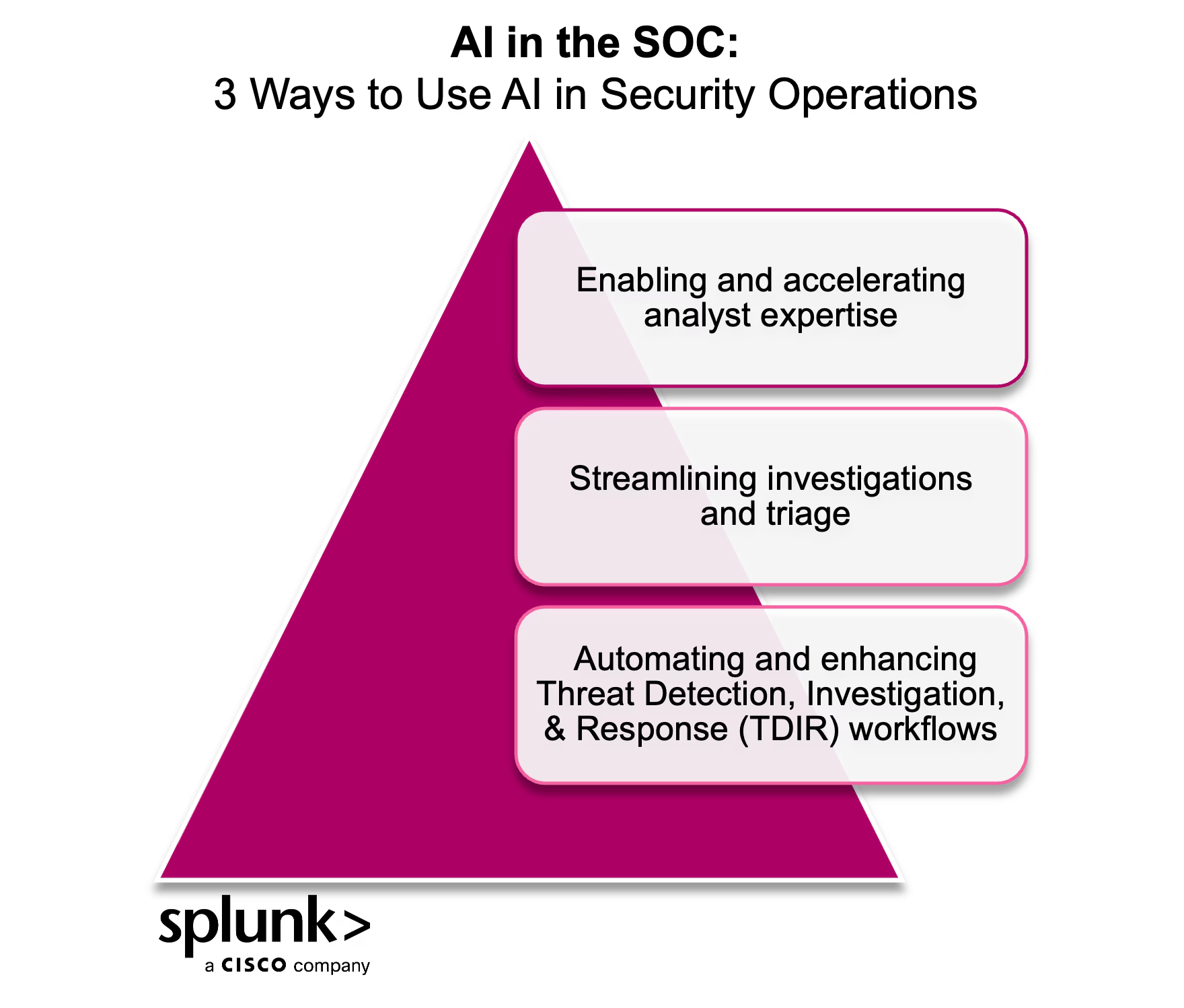
Three ways generative AI supports the SOC: enhancing analyst expertise, accelerating investigations, and improving TDIR workflows.
Use case 1: Enabling and accelerating analyst expertise
One of the most promising applications of generative AI in the SOC is its ability to help analysts level up quickly.
Supporting junior analysts
New SOC hires often face a steep learning curve. They're expected to understand complex attack vectors, decipher logs from unfamiliar tools, and piece together incident timelines under pressure. Generative AI can accelerate onboarding by:
- Summarizing threat intelligence and incident reports.
- Explaining log patterns and security alerts in plain language.
- Suggesting queries or next steps during an investigation.
- Providing contextual learning opportunities in real time.
Rather than shadowing a senior security analyst or struggling through documentation, junior staff can ramp up with on-demand support that meets them where they are.
Empowering senior analysts
For experienced team members, AI becomes a strategic assistant. It can:
- Surface emerging tactics and novel indicators of compromise (IoCs).
- Highlight relationships between datasets that might otherwise be missed.
- Automate tedious, time-consuming investigation steps.
- Free up time for threat hunting, detection engineering, or mentoring.
Instead of replacing analysts, AI helps every team member operate at a higher level — contributing more, with less manual effort.
Use case 2: Streamlining investigations and triage
Even in a well-run SOC, threat investigations are often slow, reactive, and fragmented. Analysts must correlate data from disparate sources, validate threat intel manually, and build timelines from scratch.
Generative AI changes that equation.
Reducing investigation time
By integrating with SIEMs, XDR platforms, and other tools, AI can ingest data across multiple sources and generate instant summaries that include:
- Key events in the timeline
- Likely root causes
- Affected assets or users
- Suggested mitigation actions
Instead of spending hours manually building a picture of an incident, analysts can start from an AI-assisted summary and go deeper from there.
Improving triage accuracy
False positives remain a major pain point in the SOC. AI can help by analyzing alert patterns, user behavior, and historical data to identify which signals matter most. This allows analysts to:
- Prioritize high-risk alerts.
- Dismiss benign events faster.
- Focus their time on real threats.
As a result, mean time to detect (MTTD) and mean time to respond (MTTR) can be significantly reduced.
Use case 3: Automating and enhancing TDIR workflows
Threat detection, investigation, and response (TDIR) is the core of SOC activity and also one of its most resource-intensive areas.
Generative AI strengthens TDIR by automating routine processes and delivering insights that would be difficult or time-consuming to produce manually across disparate tools.
Real-time detection and correlation
AI models trained on historical attack data can identify anomalous behavior in real time and correlate signals across systems. This enables earlier detection of complex threats before they escalate.
Automated incident response support
Once an incident is identified, generative AI can recommend or initiate appropriate response actions, such as:
- Isolating compromised systems.
- Blocking malicious domains.
- Notifying relevant stakeholders.
By reducing manual handoffs and decision-making delays, AI enables faster and more confident action during critical moments.
Key considerations and limitations
While the benefits of AI in the SOC are compelling, there are important caveats to consider.
- Trust and accuracy: Analysts must validate AI-generated insights before acting on them. Transparency in how conclusions are reached is essential.
- Sensitive data handling: AI models must be configured to respect data boundaries and prevent leakage of confidential or regulated information.
- Alert noise amplification: Poorly tuned AI can generate even more false positives. It's important to start with high-quality data and clear detection objectives.
Ultimately, AI is a tool, not a decision-maker. Human oversight remains critical, especially when the stakes are high.
Looking ahead: the AI-powered SOC
The role of AI in cybersecurity will only grow in the coming years. We’re already seeing the emergence of new job functions (like prompt engineering), increased investment in AI-powered platforms, and a shift in how teams approach threat detection and response.
For SOC leaders, the imperative is clear: adopt AI not as a trend, but as an enabler. Teams that use AI to augment, not replace, their analysts will be best positioned to handle today’s complexity and tomorrow’s threats.
Learn more: how real-world SOCs are using AI
Generative AI isn’t theoretical anymore. SOC teams are already using it to save time, reduce burnout, and detect threats faster.
Want to see how? Explore specific workflows, use case examples, and platform capabilities in our full guide: Uplevel Your Security Analysts with AI. This free guide is packed with analyst-level insights to help your team work smarter, not harder.
FAQs about Using AI in Security Operations
Related Articles

How to Use LLMs for Log File Analysis: Examples, Workflows, and Best Practices

Beyond Deepfakes: Why Digital Provenance is Critical Now

The Best IT/Tech Conferences & Events of 2026
The Best Artificial Intelligence Conferences & Events of 2026

The Best Blockchain & Crypto Conferences in 2026

Log Analytics: How To Turn Log Data into Actionable Insights

The Best Security Conferences & Events 2026

Top Ransomware Attack Types in 2026 and How to Defend