Tokenomics: The Token Is the New Currency of the Agent Era
Artificial Intelligence Romain ValentinKey takeaways
- Tokens are AI's unit of account. Every model interaction is measured and billed in tokens. As agents move from simple prompts to multi-step workflows, usage can grow from a few thousand tokens for a query to more than 100,000 for a complex agentic task.
- Visibility is the path to cost control. The token meter often runs in the background. Vendors need to provide transparency, and enterprises need to ask for it.
- AI cost governance follows a familiar pattern. The agent era echoes the early cloud era: elasticity, surprise bills, and waste. FinOps emerged to manage cloud spend; tokenomics applies those lessons to agentic AI.
- The agent economy is emerging. Autonomous agents are beginning to transact with services and other agents through micropayments and emerging payment protocols. Cost governance is becoming a discipline in its own right.
Generative AI has introduced a new unit of measurement for technology and finance leaders: the token. As AI agents move from demos to production, that small unit is reshaping how organizations plan, govern, and optimize AI budgets. Welcome to the era of tokenomics.
What is a token, and why do agents use so many?
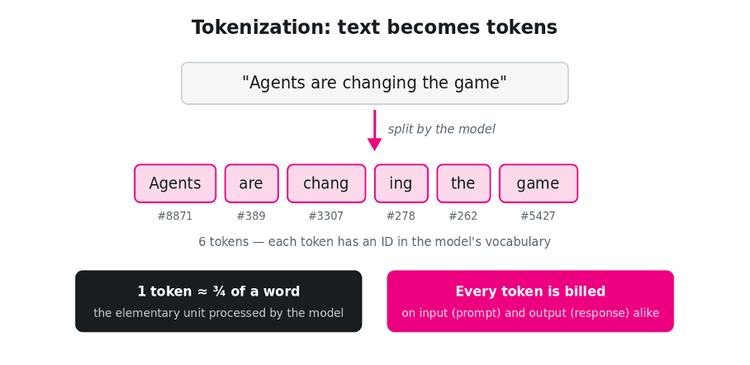
A token is the basic unit of text that a language model processes. It can be a short word, part of a word, or a punctuation mark. In English, one token is roughly three quarters of a word. Before a model processes a request, it splits the text into tokens, then uses those tokens to generate a response. Model providers typically meter and bill both input and output tokens.
When AI use centered on chatbots, the cost equation was relatively straightforward: one question, one answer, and a few thousand tokens. Agents change that equation. An autonomous agent can plan, call tools, query databases, verify results, retry failed steps, and delegate to sub-agents. Each step uses tokens. A simple retrieval-augmented generation (RAG) query can use 2,000 to 10,000 tokens, while a complex agentic task can use 30,000 to more than 100,000 tokens, with no guarantee of a successful outcome.
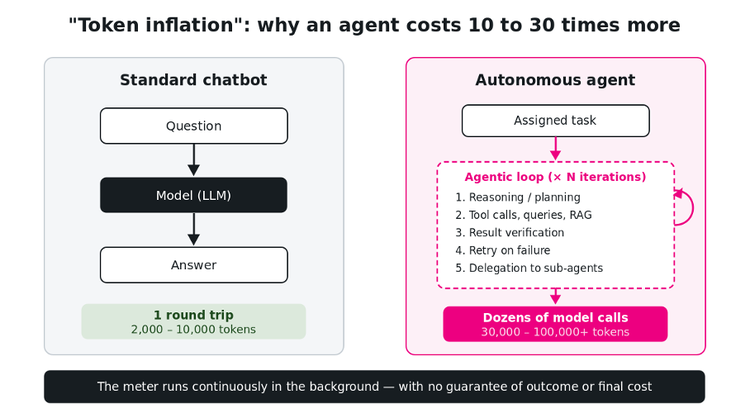
This compounding effect is what Cory Minton calls token inflation. Agentic AI costs often don't scale linearly with use. They compound as agents take more steps.
Optimizing tokens means optimizing costs - if you can see them
The unit price of a token keeps falling, but total bills keep rising. The reason is volume. As more teams deploy agentic workflows, usage increases quickly. A workflow that once required a single model call can now require many calls across planning, retrieval, verification, and retries.
A meaningful share of that consumption can be waste. Common causes include redundant context, repeated retrieval of the same data, poorly designed retry logic, and agents that continue running without a clear exit condition. Some analyses estimate that 40% to 60% of enterprise token budgets can be wasted this way.
FinOps Foundation analysis reinforces the broader point: tokens are only one layer of AI cost. A complete cost model also includes GPUs, vector databases, data pipelines, guardrails, evaluation, and monitoring. As AI spend grows, AI cost management is becoming a critical FinOps capability across organizations of every size.
This creates a clear requirement for software vendors and model providers: visibility. Teams need to know how many tokens each agent, workflow, and task consumes, and how that usage maps to business outcomes. An agent caught in a loop should appear in a dashboard before it appears on an invoice. Without observability, AI becomes both technical debt and financial debt.
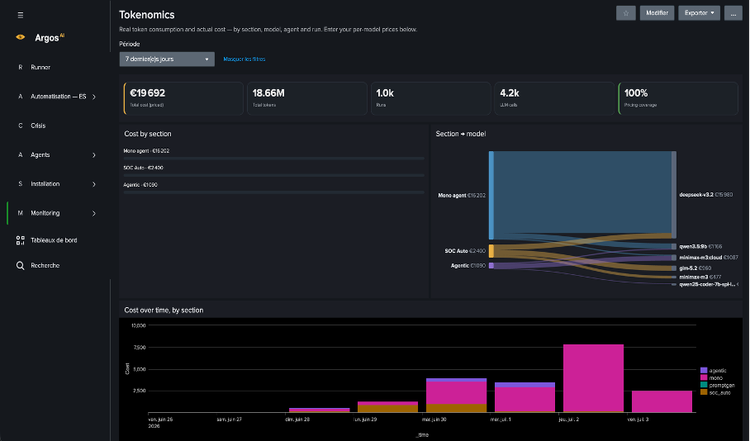
Explore Tokenomics in practice: The Argos AI dashboard, a Splunk application built by the author, shows token consumption and costs by workflow, model, and agent.
The token trap: When cloud history repeats itself
This pattern is familiar. In the early days of cloud, the promise of pay as you go often led to unpredictable bills, forgotten instances, and oversized environments. Years later, studies still estimate that roughly 30% of cloud spend is wasted. That experience helped create the FinOps discipline.
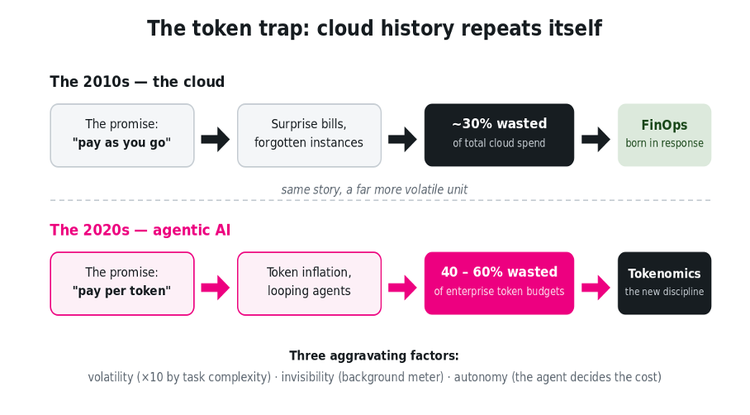
Tokens follow the same pattern and add new complexity. Three factors make agentic AI harder to govern: volatility, because consumption can vary significantly based on task complexity; invisibility, because the meter runs in the background; and autonomy, because an agent workflow can take multiple steps without a fixed path.
The macroeconomic context raises the stakes. Organizations are investing heavily in AI infrastructure, models, and talent, and those investments need to show value. Agentic AI projects that reach production without cost controls can face the same outcomes as unmanaged cloud programs: freezes, migration, or abandonment. Tokenomics is not only a technical topic. It is a credibility test for technology leaders.
Several best practices are already emerging: use circuit breakers to stop an agent when it exceeds a cost or quality threshold, budget by business workflow rather than raw token volume, and route each task to the smallest model that can handle it. Reserve larger models for work that requires more complex reasoning.
Splunk's approach: predictable AI costs and agent visibility
Splunk addresses tokenomics on two fronts.
First, Splunk AI Assistant is available to active Splunk Cloud Platform and Splunk Enterprise customers at no additional fee, aside from standard subscription fees. It helps users generate SPL, explain searches, and investigate data without turning every prompt into a separate assistant charge. That predictability helps teams adopt AI with more confidence.
Second, Splunk Agent Observability gives teams a centralized view of agent performance, quality, cost, and security. Teams can track requests, latency, input and output tokens, cost, quality indicators, and risk signals such as hallucinations, bias, prompt injection, and PII leakage. That visibility helps identify runaway agents, compare model choices, and optimize cost without sacrificing response quality.
Together, Splunk helps teams use AI with predictable platform economics and the observability required to govern their own agents.
What's next: The economy of autonomous agents
Tokenomics is the first chapter of a larger shift: an agent economy in which autonomous agents can purchase services, data, compute, APIs, and even the services of other agents.
Payment infrastructure is beginning to take shape. The x402 protocol revives the HTTP 402 Payment Required status code to support request-based payments for APIs and services. Google's AP2 (Agent Payments Protocol) is designed to provide a secure framework for agent-initiated payments, with more than 60 partners including PayPal, Mastercard, and American Express. Juniper Research projects agentic commerce spend could reach $1.5 trillion by 2030.
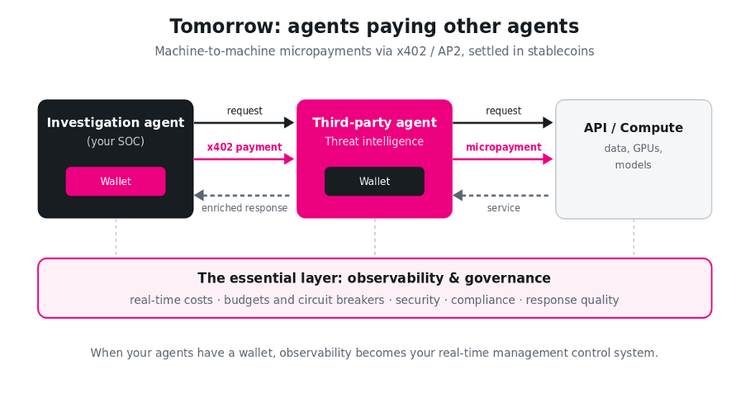
Consider a security investigation workflow: an agent requests threat intelligence enrichment from a third-party service, and that service charges for compute or API access through micropayments. The opportunity is significant, but so are the cost, security, and compliance implications. When agents can initiate payments, observability becomes a real-time governance layer.
Conclusion
Every major technology wave creates a new management discipline. Cloud created FinOps. Agentic AI requires tokenomics. The organizations that lead in the agent era won't be the ones that consume the most tokens. They will be the ones that understand why each token is spent, connect that spend to business value, and choose partners that help them innovate without creating avoidable budget risk.
To go further, explore Splunk Agent Observability and read Cory Minton's article, The New Currency of AI: Why Tokenomics is the Next Big Test for Tech Leaders.
Related Articles

Approaching Kubernetes Security — Detecting Kubernetes Scan with Splunk

Innovations in Splunk Security Expands Unified TDIR Experience to On-Premises and FedRamp Moderate Environments