The New Currency of AI: Why Tokenomics is the Next Big Test for Tech Leaders
Artificial Intelligence Cory MintonKey takeaways
- AI is rewriting technology budgets. Consumption-based pricing isn't new, but the token is — a unit of spend that swings unpredictably with every agent task and stays largely invisible until the bill arrives. The token is the operational currency of the AI software stack.
- Agentic AI triggers "token inflation." Autonomous agents reason, call tools, and retry tasks, burning tens of thousands to over 100,000 tokens per task versus a few thousand for a standard query. The result: unpredictable, often six-figure surprise bills plus adjacent infrastructure costs the model invoice never shows.
- Observability makes AI spend visible. Splunk Agent Observability, powered by our acquisition of Galileo, evaluates 100% of agents cost-effectively, surfaces runaway agents on a centralized dashboard, and correlates token cost with output quality.
- Govern AI like network traffic. Deploy AI circuit breakers, budget by workflow metrics instead of raw token volume, and route each task to the right-sized model.
Artificial intelligence is accelerating the pace of software development, customer support, and business workflows. But as organizations rush to infuse AI into their business processes, tech and business leaders are facing a harsh reality: AI is fundamentally changing operating budgets.
This shift isn't simply from licensing or subscription to consumption—a lot of software already bills that way. What's new is the unit itself. The token—the unit of input and output data processed by AI models—swings wildly with usage and is hard to see in real time. It's the operational currency of the AI software stack.
Welcome to the era of AI tokenomics. If your AI systems aren't observable, they aren't just a technical liability; they’re a financial liability.
The Token Inflation Problem in Agentic AI
Tokenomics extends far beyond simple generative AI chatbots or basic Retrieval-Augmented Generation (RAG) queries. The primary financial challenge for modern enterprises is the rapid adoption of agentic AI.
At Cisco Live 2026 in Las Vegas, tech leaders highlighted the shock of "token inflation."
Unlike traditional software, agentic AI costs don’t scale linearly. Autonomous agents are designed to reason, dispatch sub-agents, search databases, call external tools, verify results, and retry failed tasks. Each of these steps consumes tokens, and a single misdirected agent can compound them quickly—looping, re-querying, and chasing dead ends that burn compute without moving the task forward.
Because the "token meter" runs continuously in the background, organizations face unexpected, high-volume expenditures.
Tokens Consumed by Application Archetype
*A turn is a single user prompt and the AI’s reply.
**A task is the goal being solved, which ranges from single-step prompts (one turn) to complex, multi-step agentic workflows.
While a simple RAG turn might use a few thousand tokens, agentic tasks can run from tens of thousands of tokens into hundreds of thousands. And there’s no guarantee of completion or accuracy. Because the "token meter" is running continuously and invisibly in the background, organizations are suddenly being hit with surprise six-figure bills.
The Hidden Adjacent Costs of Running AI
Tokenomics isn't just about the LLM API bill. Forward-thinking organizations are realizing they must account for "adjacent costs." Running AI requires underlying infrastructure: GPU utilization, memory consumption, vector databases, and proxy services. The monitoring layer counts too—naive approaches to evaluating and observing agents can consume nearly as many tokens as running the agents themselves. If you're only looking at your model provider's invoice, you're missing the full financial picture.
Govern AI cost and performance with Splunk Agent Observability
You can't optimize what you can't see. To build reliable, cost-effective, and trusted AI, teams need unified, deep visibility across the entire AI stack.
Splunk Agent Observability, powered by our acquisition of Galileo, gives organizations full visibility into agent costs and performance. With Galileo's AI evaluation and observability capabilities integrated directly into Splunk Observability, teams can strictly govern token usage and costs, confirm that agents behave as intended, and block inaccurate and harmful outputs.
Here is how Splunk helps you manage token costs in practice:
- Cost-effective evaluations: Monitoring an AI agent shouldn’t cost as much as running the agent itself. Splunk Agent Observability uses Luna-2, Galileo's small language models (SLMs) purpose-built for AI evaluation. This enables low-latency, cost-effective evaluations that eliminate the need for sampling, allowing engineering teams to observe 100% of their agents within budget.
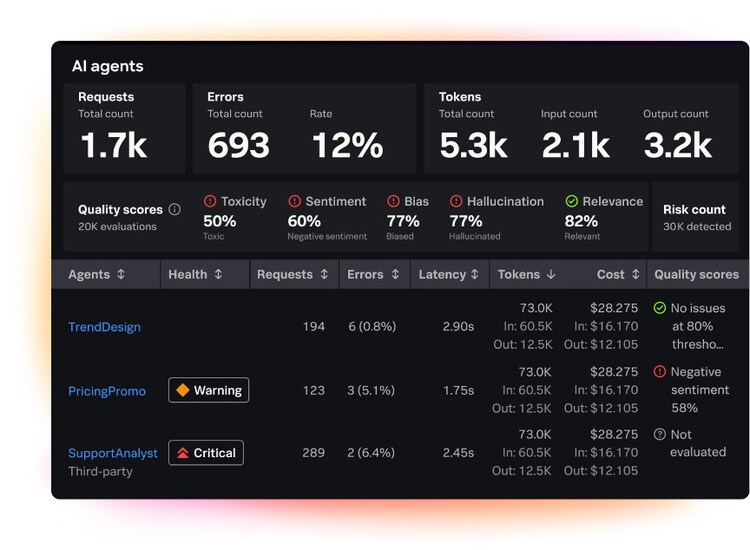
- Centralized AI Agents Dashboard: Gain a comprehensive view of all agents in the environment. Track total requests, latency, and the exact number of input/output tokens alongside their respective costs. This allows teams to instantly identify and terminate "runaway agents" caught in infinite loops before they cause budget overruns.
- Cost and quality correlation: Cost optimization should be balanced with output quality. Splunk allows teams to view token usage alongside quality metrics (hallucinations, bias, toxicity) and performance metrics (latency, errors). If a cost-effective model achieves the same quality score as an expensive frontier model for a specific task, organizations can confidently route traffic to the more efficient option.
Comprehensive AI Infrastructure Monitoring
Visibility into the application layer must be paired with hardware insights. Splunk Infrastructure Monitoring provides data-dense dashboards for the underlying hardware and services powering AI workloads.
Whether your organization uses NVIDIA NIMs, Milvus vector databases, or pre-validated full-stack solutions like Cisco AI PODs, you can track GPU power consumption and memory utilization alongside tokenomics metrics. This end-to-end visibility is critical for identifying infrastructure bottlenecks that impact both system stability and operational cost.
Strategic Best Practices for AI Cost Management
To shift from passive consumption to active, data-driven management of your AI footprint, implement these operational standards:
- Deploy circuit breakers: Treat token usage similarly to network traffic. Set dynamic thresholds and build automated "circuit breakers" into agentic systems to terminate processes that exceed predefined cost limits.
- Transition to workflow metrics: Move away from budgeting based solely on token volume. Measure the cost per process, retry rates, and end-to-end execution time to understand the true ROI of automated tasks.
- Optimize model routing: Abandon a "one-size-fits-all" model strategy. Match the appropriate model size to the specific task, reserving expensive, high-parameter models strictly for complex reasoning and utilizing smaller models for routine operations.
Conclusion
Maximizing AI's value without runaway costs comes down to disciplined tokenomics. By moving from a narrow technical view to unified observability, tech leaders keep AI a productive, high-ROI asset—not an unmanaged liability.
Ready to manage your AI spend and ensure model performance? Learn more about Splunk Agent Observability and get hands-on with the Splunk Observability Cloud Free Edition today.
Frequently Asked Questions
In AI, the term circuit breaking describes a safety mechanism that interrupts a language model the instant it starts generating harmful, illegal, or inaccurate content, cutting off the bad output before it reaches the user. It’s similar to circuit breaking in network architecture, where the term means a resilience pattern that stops a system from repeatedly calling a failing service.
In short, it's a guardrail that keeps AI systems reliable and safe under pressure.
Sign up for our event series on Splunk Agent Observability:
Workshop
Build Better, Spend Less: A Hands-On Workshop on Token Efficiency
August 27th 2026 | 10:00am – 11:30am PT
Office Hours
Agent Observability & Tokenomics: Real World Questions, Use Cases, and Insights
September 24th 2026 | 11:00am – 12:00pm PT
Related Articles
Splunking the LLM Gateways. Search Head Meets Prompt Head
Splunking GenAI Applications for Observability Insights