AI at Splunk: Trustworthy Principles for Digital Resilience
Artificial Intelligence Hao YangThere’s no doubt AI will radically reimagine the way we live, work and interact. It will empower new ways to solve business challenges and deliver customer value, but such a widespread impact requires a holistic approach. Building AI responsibly is one thing, but embedding trust into every aspect of our AI strategy is another entirely – and that’s what Splunk sets out to do.
As an innovator in data and AI, Splunk has had to answer hard questions: How do we keep our customers and employees safe in this era of uncertainty? How can we lean on AI to enhance digital resilience, not erode it? To answer these questions, we needed to take a high-level view and consider how AI would impact our customers, employees, partners and ecosystem.
As a market leader in security and observability, Splunk is primed to help customers reap the benefits of AI while staying protected from any unintended consequences. With a deep commitment to building a safer and more resilient digital world, we can make a real difference by approaching AI responsibly.
Introducing Splunk’s Trustworthy AI Principles
Informed by a rigorous process that engaged Splunk stakeholders and assessed emerging regulations these principles will guide our AI usage and development moving forward. We believe that AI should be guided by the following principles:
Accountability
Shaped by humans. AI systems should embrace human oversight and those responsible for the different phases in the AI system lifecycle should be identifiable and accountable for the outcomes.
Transparency
Glass box approach. AI systems and the use of data should be explainable, transparent, and understandable to our customers and stakeholders.
Privacy
Data trust. AI systems should be designed to respect and protect individual privacy and the confidentiality of personal and organizational data.
Fairness
Institutionally unbiased. AI systems should be inclusive and accessible and avoid discrimination or bias.
Resilience
Built to withstand. AI systems should be developed and deployed to ensure safety, security, and resiliency, even in the presence of unintended failures and malicious attacks.
How We’re Embracing Trustworthy AI Principles
Splunk has developed a framework that provides an organizational path to turn our principles into actions.
Through executing our principles into actions, we deliver on our promise to make good choices, build trust and achieve our desired outcomes. As we make progress with implementation, we expect the need to adapt as AI technology and legislation evolves. We have built in continuous learning and evolution into our framework to stay ahead of evolving technologies and laws.
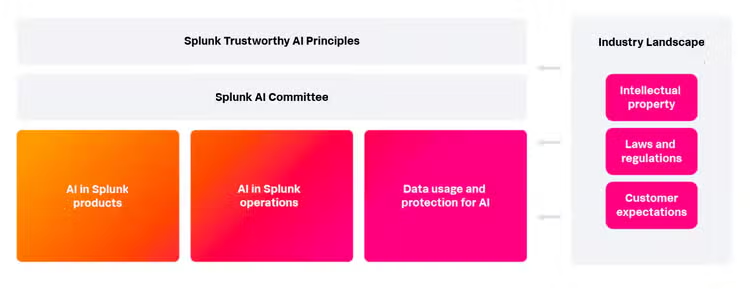
AI in products. We’re taking a thoughtful and deliberate approach to how we incorporate AI into our products. Our AI product philosophy is driven by three key ideas:
- Domain and Splunk-specific: We believe the most effective AI for digital resilience is domain-specific for security and observability use cases and tightly integrated within workflows. This surfaces the right information at the right time, with the right context.
- Human-in-the-loop: AI won’t entirely replace humans, but should work alongside them, acting as copilots to quickly deliver facts, summarize events, and bring priority alerts to the forefront. But humans should always be in the driver’s seat.
- Open and extensible: As we plan to directly integrate more AI into the Splunk platform, we will allow customers and partners to extend our models or bring their own models in line with their policies and risk tolerance. These models can work with data in Splunk as well as data on other data stores, providing flexible solutions.
AI in operations. Trustworthy AI within our operations and culture is just as important as trustworthy AI within our products – and similarly, extends across technology, people and processes. We’re internally embracing the business benefits of AI while recognizing the potential risks.
AI doesn’t understand inclusivity – but we do. Through our AI approach, we acknowledge and communicate problems like bias and inaccuracies so that we can proactively tackle them. We believe the way forward is to provide clear guidance and guardrails that empower employees to work smarter. Our comprehensive approach will foster innovation and transformation – with responsible AI usage at the forefront.
At a high level, our AI policy is grounded in Trustworthy AI Principles and echoes elements of our product philosophy: AI should assist Splunkers, not do their jobs.
Data usage and protection for AI. Data stewardship is sacred – especially in the age of AI. Our commitment to data usage and privacy stretches back years, but to address the specific data privacy challenges that AI will bring, Splunk has a board-level committee, the Cybersecurity & Data Responsibility Committee.
Our dedication to security has paid off. For nine years straight, we’ve been named a leader in SIEM in Gartner’s Magic Quadrant. We’ll continue to build on 20 years of insights and extend our commitment to data privacy for AI use cases, building for the needs of the next 20 years and beyond.
Keeping AI (And Humans) Leading
AI is complex and requires a cross-functional governance approach. To support that approach, Splunk has created a committee that oversees the adoption and integration of Splunk’s AI principles across the three pillars in our Framework.
This committee is a set of leaders across Splunk, spanning product and technology, legal, privacy, security, go-to-market, human resources, global impact, marketing and other key functions to incorporate diverse perspectives. Its role is to review AI use cases across product development and operations, ensuring that our Trustworthy AI Principles are adhered to throughout the lifecycle.
Building AI for the Future
The future of AI is incredibly bright, and we view it as a requirement for building digital resilience — especially as digital environments become increasingly complex.
At the same time, AI is an evolving area, and being at the forefront of this evolution requires agility and flexibility. Regulation and clear governance will likely address some of the concerns currently associated with AI, but it’s on companies pioneering the usage and development of AI — like Splunk — to help organizations navigate AI safely and effectively.

We don’t just talk the talk, but we walk the walk. Learn how Splunk is bringing our AI philosophy to life in our e-book, The AI Philosophy Powering Digital Resilience.
This blog post was co-authored by Kriss Deiglmeier and Hao Yang.
Related Articles

Splunk Cloud Self-Service: Announcing The New Admin Config Service API

Introducing Automatic UI Updates