Self-Service Observability: How To Scale Observability Adoption Through Self-Service
TLDR:
For observability adoption to scale, you must eliminate the bottlenecks. A self-service approach is the only sustainable model, enabling all teams–not just a select few–to access, implement, and scale observability easily. But making the shift requires more than access: you have to design for it.
If you're responsible for the success of observability tools in your organization — whether you're on a platform engineering team, part of the observability CoE, or simply the go-to for making observability usable — this article is for you.
With any luck, you have a solid observability toolset. But usage is inconsistent, requests are piling up. Your team is buried in repetitive tasks instead of advancing the observability practice. Teams aren’t adopting the tools as expected, and the platform’s value isn’t being fully realized.
The path forward? Self-service observability!
In this article, let’s explore why self-service for observability is no longer optional, what happens when you don’t embrace it, and the key considerations to help you scale adoption across the organization — all without burning out the people behind the tools.
What is self-service observability?
Self-service observability is a service delivery model that empowers teams to independently create, manage, and improve observability assets without depending solely on a centralized request-fulfillment process. Observability assets may include:
- Dashboards
- Detectors
- Service level objectives and indicators (SLOs/SLIs)
- Log pipelines
- Telemetry configurations
Self-service o11y is a framework for giving teams hands-on access to observability, so that the people closest to the systems they build and support can take full ownership. These teams are best positioned to:
- Understand service behavior.
- Detect degradation early.
- Continuously evolve visibility as their stack changes.
Self-service doesn’t mean chaos or a free-for-all. It’s about equipping engineers with the access, skills, and patterns they need to build meaningful, sustainable observability.
Benefits of self-service observability
This shift matters because it accelerates adoption and drives real value realization from your observability investments. When more teams can use the tooling effectively, the organization at large sees:
- Better coverage
- Faster incident response
- Higher ROI
It also frees up your observability and platform engineering teams to focus where they’re needed most: enabling lower-tech users, building tighter integrations, improving tagging and telemetry standards, and automating observability through pipelines and APIs.
Self-service isn’t a lack of structure — it’s the framework for how you scale structure through enablement.
Yesterday’s monitoring model doesn’t scale
In my role here at Splunk, I work with organizations of all shapes and sizes. Some are scaling observability practices with strong momentum. Others are still stuck treating observability like a legacy monitoring service — specifically, the full-service delivery model.
Here’s a simple example that illustrates the full-service model. A team submits a request:
- “Can you add logs for this service?”
- “We need dashboards for our new API.”
Then they wait. Sometimes days. Sometimes weeks. Sometimes the request falls through entirely.
When every request, no matter how basic, has to go through a central queue, both sides suffer. Requestors are left waiting. Fulfillment teams are buried in low-value, repetitive tasks. Instead of working on strategic observability initiatives — like platform integration, automation, and pattern development — the fulfillment team becomes the bottleneck.
And the entire org slows down.
As the organization grows, this model simply doesn’t scale. If you want observability to move at the pace of innovation, teams need the autonomy to help themselves — with the backing and assurance of observability standards, patterns, and support.
The impact: missed coverage, missed context, missed value
When observability is offered only as a full-service model, the downstream impacts are operational and organizational. This model slows teams down, creates visibility gaps, and limits the business value of your observability investments. You’ll start to see symptoms like:
- Inconsistent instrumentation: Some services are deeply instrumented, others barely visible. There’s no consistent baseline across environments.
- Missed alerts when it matters most: Critical signals get lost in the noise, or never get configured at all, because the team closest to the system wasn’t empowered to own visibility.
- Delayed onboarding: New services or projects can’t move fast because they’re waiting for dashboards, detectors, or integrations to be set up.
- Low adoption: The tools are there, but usage is minimal. A full-service-only model becomes a barrier to scale.
- Siloed ownership: Observability is treated as someone else’s job, which creates accountability gaps during incidents.
- Observability becomes a tax: Instead of accelerating detection, diagnosis, and resolution, it adds friction and process overhead.
The result? Visibility gaps. Slower MTTR. Underutilized tooling. And engineering teams that don’t have the insight they need to protect the customer experience.
When full-service observability is appropriate
Now, to be clear, full-service observability isn’t inherently bad. In fact, it’s essential in many orgs. Less technical teams, business units without direct engineering support, or advanced use cases (like executive dashboards or cross-domain event correlation) often require a centralized team to lead the charge.
But that model shouldn't be the default for everyone.
Self-service: observability as a shared responsibility
As organizations adopt the SRE-inspired mindset of “you build it, you own it”, observability ownership becomes a shared responsibility, through a self-service framework, that includes ensuring…
- Critical telemetry is in place.
- Alerts are actionable.
- Visibility evolves alongside the service.
Critical consideration: Is your observability platform self-service capable?
Before you can enable self-service observability, you need to ask:
Is your observability platform capable of supporting self-service?
Many teams attempt to scale observability using legacy tools built for centralized control, not team ownership. Just to operate, these platforms often require niche expertise, rigid UI paths, and deep tribal knowledge. These tools certainly weren’t built for the speed, scale, or team-based delivery model that modern organizations demand.
A self-service-capable observability platform is a requirement for scaling adoption, realizing value, and freeing up your observability and platform engineering teams to focus on what matters most.
Features of self-service observability platforms
A self-service capable observability platform must be able to support things like:
-
Programmatic setup and automation APIs, SDKs, and Terraform providers to create and manage detectors, dashboards, access policies, and alert rules as code (this is “observability as code”).
-
Multi-tenancy and scoped visibility: The ability to logically separate observability data by team, service, or business unit, so groups can focus on what matters to them.
-
Reusable templates and out-of-the-box content: Including curated dashboards, analytics workspaces, deep-dive navigators, and golden configurations to help teams ramp quickly.
-
Embedded documentation and AI-assisted workflows: In-product guidance that helps teams get started, validate coverage, and troubleshoot without external dependency.
-
OpenTelemetry and OTLP support: Native support for vendor-agnostic, standardized telemetry collection, making it easier to get data in and focus on using it effectively.
-
A clean, discoverable user experience that surfaces related content automatically contextually linking metrics, traces, logs, and alerts across capabilities so teams don’t have to hunt for signal correlation.
-
Enterprise observability-as-a-service capabilities that include built-in support for:
- Observability pipeline management: aggregate, filter, enrich, and route telemetry across multiple backends.
- Token management: delegate access and manage ingestion securely at scale.
- Utilization metrics and cost visibility: enable usage-based chargebacks, optimization, and business transparency.
If your platform lacks these fundamentals, you’re not facing friction — you’re facing a blocker.
Splunk offers modern observability solutions
Looking for a platform that delivers these must-have features? Splunk Observability Cloud is a leading modern observability platform that supports end-to-end visibility and enables self-service observability across the enterprise.
- • Learn more about Splunk Observability Cloud
- • Try Observability Cloud for free
- • Explore technical docs for observability and the developer portal
Check out this Splunk Tech Talk that shows these concepts in action:
| Video |
|---|
| https://www.youtube.com/embed/Ewdkp2lYhzA?si=FiCy9_e_NtHKujB1 |
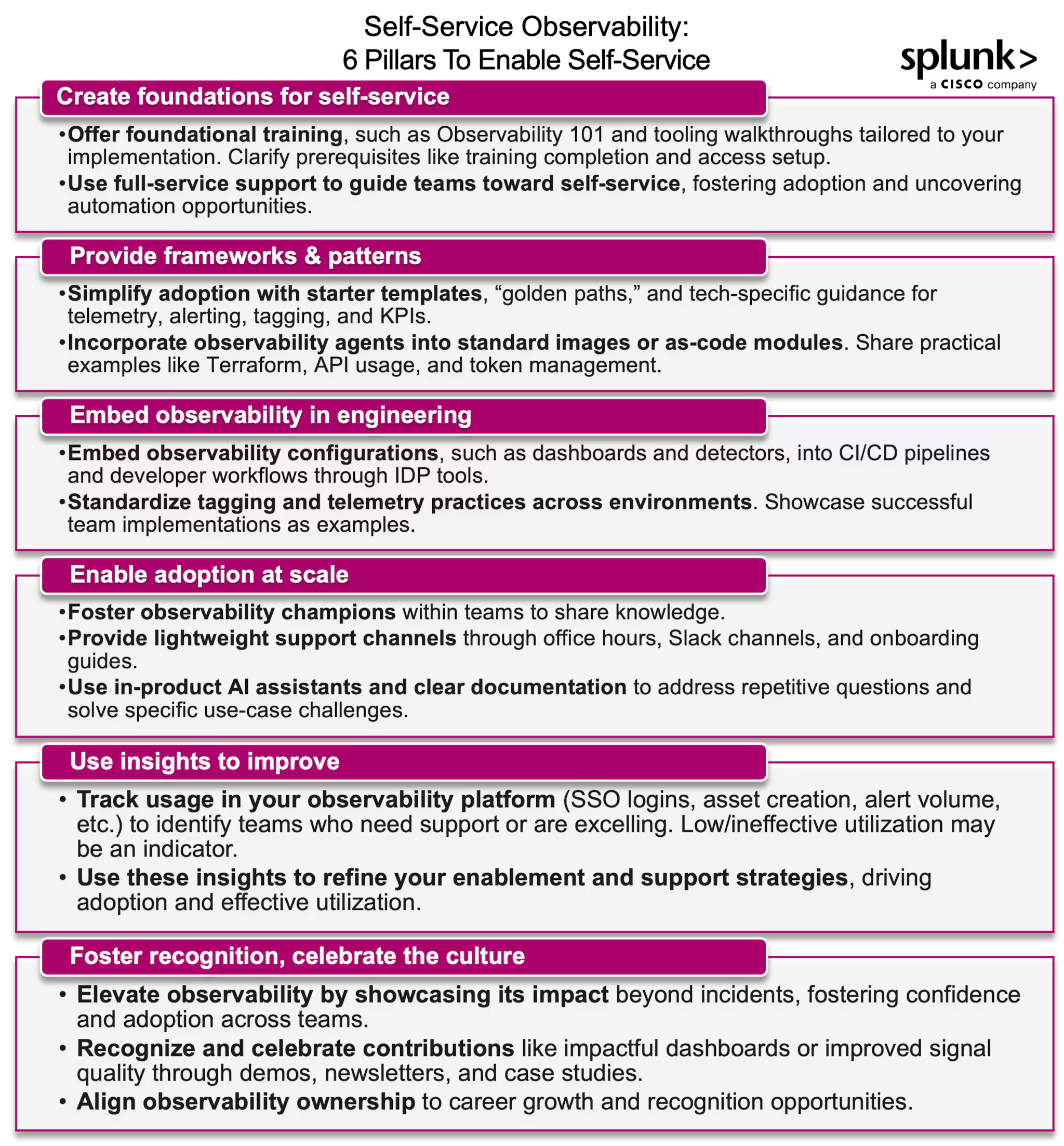
How to enable self-service observability: 6 pillars
Is your observability platform self-service capable? Great! The next challenge is making it real and scaling it.
This section is especially relevant for observability platform owners, administrators, CoE members, or anyone helping scale adoption across teams. It outlines the foundational pieces that enable teams to confidently use observability tools, without bottlenecking progress or overwhelming central support.
Self-service doesn’t just happen when you open up access. It takes structure, patterns, and support systems to drive usage, maturity, and real business value.
Foundations for self-service
A solid foundation sets everyone up for success. Start with readiness, not assumptions, and provide users with knowledge:
-
Provide foundational training that’s easily available, for example with Observability 101, tooling walkthroughs specific to your implementation, etc. Cover items such as:
- How to instrument code
- How to log in to the observability platform
- When and why to utilize the tool
-
Make clear what’s required before jumping in, like completing the training and obtaining access tokens, logins, etc.
-
Use full-service observability support as an opportunity to guide teams toward self-service in the future. This “teach to fish” approach accelerates self-service adoption and identifies automation opportunities.
Frameworks, patterns, and the easy button
Make the right path the easiest one to follow.
- Provide starter templates or “golden paths” for common services and use cases.
- Share tech-specific guidance for telemetry setup, alerting, tagging, and KPIs. Consider including observability agents as part of standard images and/or as-code modules or configurations.
- Highlight real examples of Terraform, API usage (with things like real-world cURL examples), and token management.
Embed observability in engineering
Observability works best when it’s part of the build, not an afterthought.
- Include observability configurations directly in CI/CD pipelines. Observability configurations like dashboards and detectors are then part of any deployments from your CI/CD pipelines.
- Integrate observability into internal developer platform (IDP) tools and developer workflows.
- Standardize tagging and telemetry practices across environments.
- Highlight and showcase examples of teams that have embraced these concepts.
Enable adoption at scale
Support more teams without overwhelming your experts.
- Encourage champions for observability in each domain or team to share knowledge
- Provide lightweight, easy to use support channels. Examples include office hours, dedicated Slack channels, and onboarding guides.
- Leverage in-product AI assistants and documentation to reduce repetitive questions and solve use case driven problems.
(Related reading: see what AI can do in Splunk Observability Cloud.)
Insight-driven improvement
Use your observability platform to guide adoption.
- Track observability tool usage: SSO logins, asset creation, alert volume, and team activity.
- Identify teams who need help (indicator: low/ineffective utilization) and those who are leading the way.
- Feed usage data into your enablement and support model.
Culture, growth, and recognition
Make observability matter, beyond incidents. This makes it easier for teams to see how it works and feel confident they can do it, too.
- Celebrate teams who build high-impact dashboards or improve signal quality.
- Share great examples across orgs through demos, newsletters, and showcases.
- Align observability ownership with career growth and recognition.
Self-service is the way to scale observability
You cannot scale observability by adding more tickets, more admins, more process. You scale it by removing friction and enabling teams to help themselves.
Self-service observability isn’t just a service delivery model, it’s how you turn your observability tools into a force multiplier. With the right platform, structure, and enablement, teams can harness observability as the key driver of resilience, velocity, and insight.
Mature your observability practice: how-to's for the real world
Love O11Y content like this? Check out the other blogs in this series
- Introducing the Observability Center of Excellence (CoE)
- How To Form an Observability CoE
- Measuring and Improving Observability-as-a-Service
- Simplifying & Rationalizing Tools for Observability Success
- Tiered Observability: How To Prioritize and Mature Observability Investments
Want to see this in action? Try it yourself with this free Observability Cloud trial and explore how the solution supports self-service observability.
Related Articles
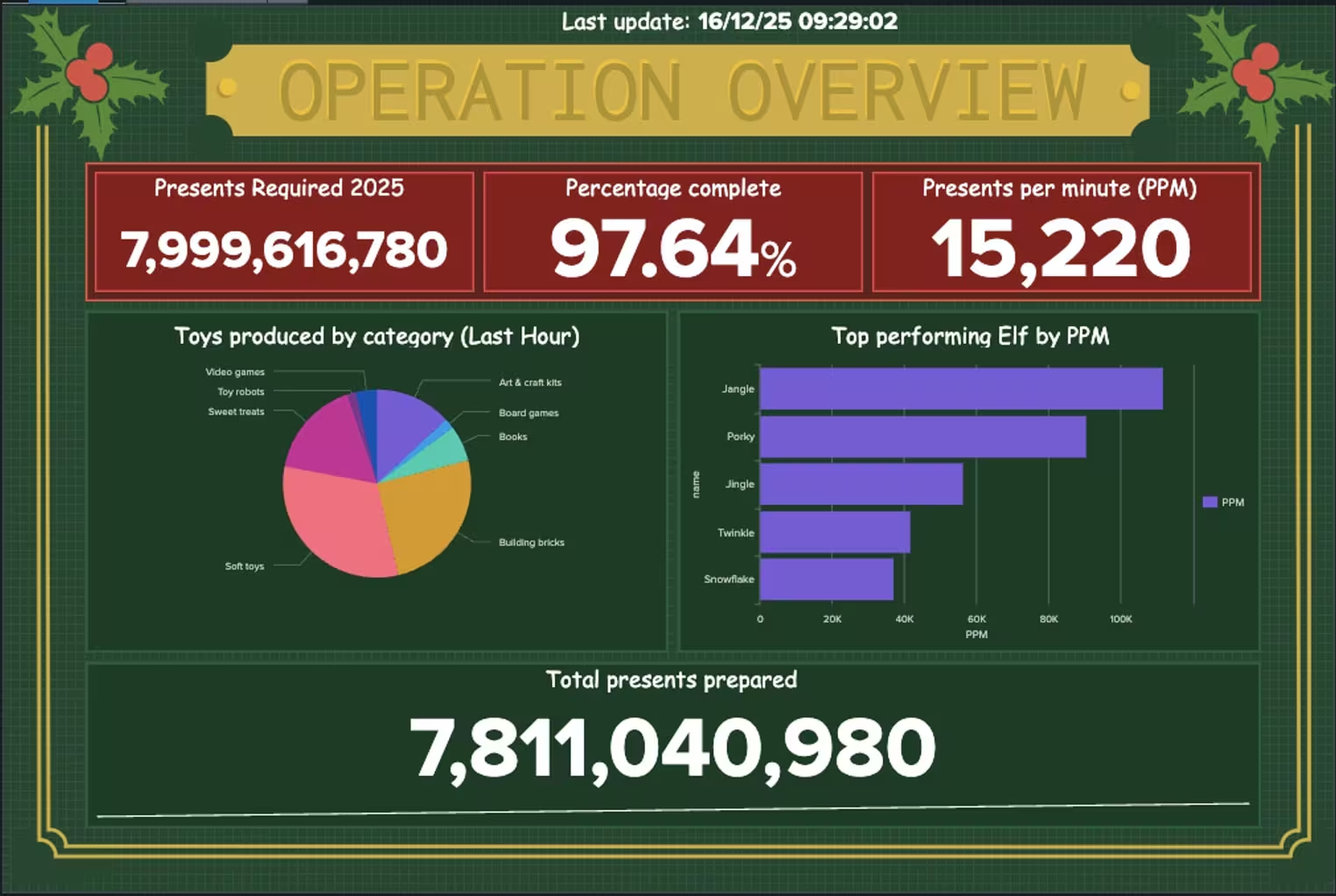
What the North Pole Can Teach Us About Digital Resilience

The Next Step in your Metric Data Optimization Starts Now

How to Manage Planned Downtime the Right Way, with Synthetics

Smart Alerting for Reliable Synthetics: Tune for Signal, Not Noise

How To Choose the Best Synthetic Test Locations
Advanced Network Traffic Analysis with Splunk and Isovalent

Conquer Complexity, Accelerate Resolution with the AI Troubleshooting Agent in Splunk Observability Cloud

Instrument OpenTelemetry for Non-Kubernetes Environments in One Simple Step