From Downtime to Uptime: Monitoring Tools and Techniques for Systems, Websites, APIs, and More
Learn Joseph NduhiuRecently, while visiting a friend in a local hospital, I found myself facing a frustrating distraction: trying to pay parking fees using USSD (a mobile text-based system for quick transactions). The service was either painfully slow or not working at all.
I wasn’t alone. Other visitors were just as exasperated, and parking attendants stood idle, their handheld devices frozen in endless loading loops. It made me wonder if the county’s IT team knew what we were all enduring — or how much revenue was slipping away because the system simply didn’t work.
Monitoring the uptime of IT systems and components is a critical activity that ensure IT service availability and that its performance remains within agreed thresholds and targets. Here’s what we can say about uptime, without any doubts:
- It is integral to both the success of the business and a positive customer experience.
- Uptime is closely linked to other performance indicators, like capacity, security, and continuity. In fact, 44% of downtime incidents stem from application and infrastructure issues.
So, let’s understand this critical business activity: we will review activities and roles involved in uptime monitoring, then look at what the future holds for this critical element.
Understanding uptime monitoring to avoid downtime
With a focus on the reliability and availability of IT services and their components, the purpose of uptime monitoring is to:
- Detect conditions of potential significance.
- Track and report the uptime status.
- Share the information with relevant stakeholders, like internal teams and external customers who may be affected.
Failure to monitor uptime effectively can result in serious negative effects. A delayed response to recovery efforts can result in financial losses, lower customer perception, and even potential regulatory penalties. In fact, today in 2025, data center outages are becoming less frequent and less severe relative to the rapid growth of digital infrastructure — yet major failures still occur and will continue to occur. That’s because of growing complexity across data centers, networks, and systems.
Uptime monitoring activities
Let’s look at monitoring activities through two lenses: strategy and then tactics — how to actually monitor for uptime.
From a strategic standpoint, uptime monitoring starts with understanding the needs of those who use IT services or the business units that request them on their behalf. These needs might be:
- Outlined during the business analysis phase, where IT service requirements are gathered.
- Shaped by the organization’s broader goals, which set specific quality standards for IT services.
Where possible, these uptime requirements are negotiated with the IT provider to balance system capabilities and costs. Then, service level agreements (SLAs) document and formalize these uptime targets.
Once agreed upon, IT teams set to work, configuring monitoring systems to track and report on performance, ensuring these targets are met. So how do they do that? Let’s take a look at the main activities that inform uptime monitoring:
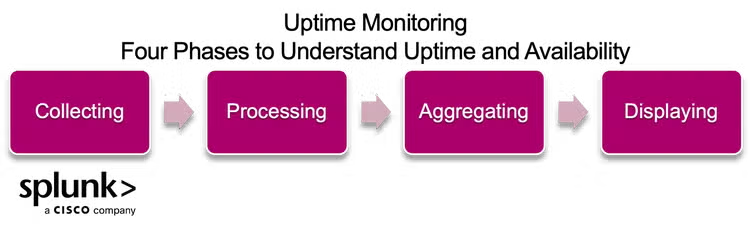
Phase 1: Collecting data
Monitoring technology components usually employs two approaches:
- Leveraging native monitoring features of the components being observed such as CPU, memory and disk.
- Employing designed-for-purpose systems that poll components and collect data on uptime status.
Metrics provide the raw data needed for monitoring, spanning multiple layers like infrastructure, databases, applications, services, and end-user experiences.
Monitoring based on system internals like logs or HTTP endpoints— referred to as "white-box monitoring" by Google — is often preferred over "black-box monitoring," which tests only the external behavior visible to users.
(Related reading: MELT metrics, events, logs, and traces.)
Phase 2: Processing data
Once collected, uptime metrics are processed into information that makes sense to those monitoring it in order to adequately respond to it. Key focus areas for processing monitoring data for IT system uptime are:
Once collected, uptime metrics are transformed into meaningful information to help the right people respond as quickly as possible. The key areas of focus when processing this data for IT system uptime are:
- Latency: The time delay for a data packet across IT systems. The longer the delay beyond expectation, the more the system is perceived as being down.
- Errors: The rate of system requests that fail over a time period. The greater the error rate, the more the perception of uptime being impaired.
- Saturation: A measure of resource constraints. If a system is unable to handle load, it may be unable to process new or existing requests resulting in downtime.
Processing metrics ensures the right balance between measurement frequency, detail, and cost. It also categorizes uptime monitoring data into three event groups based on their impact, with each group linked to a specific response:
- Informational events: These events do not require action to be taken as they reflect normal operational status.
- Warning events: These events signify an unusual state, notifying the team that uptime levels are dropping towards a threshold that could warrant action to be taken to forestall impairment.
- Exception events: These events indicate a critical uptime threshold has been surpassed which may result in negative impact on IT service availability.
Phase 3: Aggregating data
Processed uptime metrics are next grouped by time intervals and data points, to the appropriate level of granularity. Aggregation organizes large volumes of data into a cohesive set that highlights trends and outliers, helping pinpoint the symptoms and causes of downtime. It ensures that those monitoring uptime receive summarized alerts that:
- Simplify disruption analysis.
- Improve decisions on remedial actions.
Aggregated data also enables the calculation of key availability metrics like MTBF (mean time between failures) and MTRS (mean time to restore service).
Phase 4: Displaying data
Once aggregated, uptime monitoring data — like alerts and trends — are presented in dashboards that summarize core uptime metrics for IT services or components. These dashboards include filters and selectors, making it easy to drill down into the data most relevant for investigating and troubleshooting downtime.
These dashboards can also be shared with service consumers to keep them informed about uptime status.
People, roles, and technologies involved in uptime monitoring
Uptime monitoring typically involves sysadmins and, especially in enterprise environments, the NOC.
IT sysadmins
IT system administrators are the frontline responders for uptime monitoring. Once IT systems go live, these teams are responsible for receiving and addressing alerts generated by monitoring tools.
While their primary focus is operational, they also play a crucial role during the design phase of IT systems, ensuring monitoring requirements are built into new or updated solutions. Additionally, they configure and test uptime monitoring during the transition phase, as newly developed or acquired services move into production.
The NOC
In larger IT environments, particularly within mid-to-large-sized service providers, uptime monitoring is often centralized in a network operations center (NOC). A NOC is staffed by a dedicated team that monitors service uptime and performance around the clock. This team provides first-line support to resolve issues or escalates them to specialized teams or external vendors as needed.
The NOC’s primary goal is to detect and triage downtime issues as quickly as possible, typically within the response times defined in SLAs.
A NOC is easily recognized by its digital display screens, which show critical information such as alerts, logs, trends, and other signals that reflect the current state of IT services. These services may be hosted locally or subscribed from third-party providers. Equipped with robust communication and collaboration tools, the NOC facilitates the sharing of expertise and information across teams to support the investigation and resolution of downtime.
Complexity of modern IT makes uptime monitoring a challenge
The complexity of modern IT environments makes uptime monitoring an increasingly challenging task. Mid-to-large-sized organizations often manage thousands of interdependent components, automated changes and deployments via microservices, containers, and CI/CD pipelines, and integrations across multiple service providers.
This sprawling ecosystem often leads to "alert storms," where system administrators and NOC analysts are overwhelmed with excessive alerts, resulting in analysis paralysis.
To address these challenges, AIOps (Artificial Intelligence for IT Operations) solutions have become invaluable. By ingesting and correlating monitoring data from distributed IT systems, AIOps tools leverage machine learning to:
- Perform real-time analysis.
- Detect issues impacting service uptime.
- Initiate automated actions to resolve downtime.
These solutions continuously learn and improve, offering IT teams better visibility, faster decision-making, and more efficient operations.
Effective uptime monitoring for the enterprise: tips and best practices
Effective uptime monitoring relies on carefully managing the scope and meaningfulness of monitoring data. Organizations require a well curated approach to monitoring that identifies and prioritizes:
- Which components to be monitored
- The appropriate alerting thresholds to be set
Understanding dependencies from underlying components and services ensures that the appropriate resources and efforts are focused on monitoring what matters most to the organization and its customers.
IT teams should strive to design their uptime monitoring systems with rules that are simple, predictable, and reliable. To maintain efficiency, system administrators and NOC stakeholders should regularly review the monitoring scope to remove rarely referenced data, ensuring that only actionable alerts reach the monitoring teams. This reduces noise and allows teams to concentrate on critical issues.
Additionally, investing in modern monitoring solutions that integrate AI can significantly enhance the speed and effectiveness of detecting and resolving issues that impact uptime. These tools bring advanced capabilities to streamline operations, improve visibility, and ensure IT services remain reliable for users and customers alike.
Splunk helps businesses ensure continuous uptime
Splunk’s market-leading observability tools deliver real-time visibility into every transaction and infrastructure component. That means businesses can reduce MTTR (mean time to repair) from 30 minutes to just 5 minutes while maintaining 100% uptime — even during unexpected traffic surges.
Try Splunk Observability Cloud for free to see how it can transform your uptime monitoring.
Related Articles

Data Stewardship Guide for Modern Enterprises

The Digital Resilience Guide: 7 Steps To Building Digital Resilience