The Theory of Constraints: The Complete Guide to Constraint Theory
Learn Muhammad RazaTheory of Constraints is a management concept that tries to leverage any bottlenecks in a system in order to improve overall system performance. This theory is based on two core ideas:
- Every system is limited by constraints.
- Constraints represent opportunities.
Let’s take a look the concept of constraint theory in detail.
What is the theory of constraints?
A management philosophy introduced by Dr. Eliyahu M. Goldratt in his 1984 book The Goal, the Theory of Constraints (TOC) focuses on identifying and managing the bottlenecks that hinder an organization's ability to achieve its goals.
Goldratt's approach is centered on the idea that every system or process has at least one constraint that limits its performance, and improving this constraint can lead to significant enhancements in overall productivity and efficiency.
Origin story for TOC
The Theory of Constraints originated from Goldratt's background in physics and his understanding of systems thinking. His work was initially applied in the manufacturing sector, where he observed how production processes were often limited by specific bottlenecks. Goldratt's insights were revolutionary because they shifted the focus from optimizing individual processes to improving the entire system by addressing its constraints.
Surprisingly, his book The Goal was a best-selling novel – rare for business and management theories. It became a bestseller in the 1980s and has influenced countless businesses worldwide.
Today, the constraints theory applies in all sorts of manufacturing and development areas, including lean, agile, and more. You’ll also hear about related concepts like total quality management (TQM), Six Sigma, and SCADA process control.
Now let’s dive into the theory itself.
Every system is limited by constraints
First things first: every system has certain constraints that limit the system in some way. The most effective way to improve overall system performance — any system — is to resolve the constraints.
Constraints can include resources (or lack of), policy/governance, process, or other issues.
For example, a core constraint of an ecommerce store is the limited warehouse space for inventory. If it was not the case, the ecommerce store would never run out of stock for items when demand exceeds supply — that means you’ll continue generating revenue on that item, especially while it’s popular. No delays for making or restocking the items means money keeps rolling in.
Constraints represent opportunities
Next, the Theory of Constraints holds that these constraints, which may limit your system, also present opportunities.
The idea here is that a system behaves in a given state toward achieving a goal. Considering that constraints exist in this state, a system can elevate its state if the applicable constraints are removed.
For example, if the ecommerce store serves as a marketplace and a direct shipping platform that connects buyers and sellers, it is no longer limited on revenue generation by its own warehouse space constraints.
Five focusing steps (core concepts for TOC)
How can you execute on the core ideas behind the Theory of Constraints? With this continuous cycle that’s known as the "Five Focusing Steps":
- Identify
- Exploit
- Subordinate
- Elevate
- Repeat
This cycle is crucial for ongoing improvement. Let’s review how these working principles are relevant today:
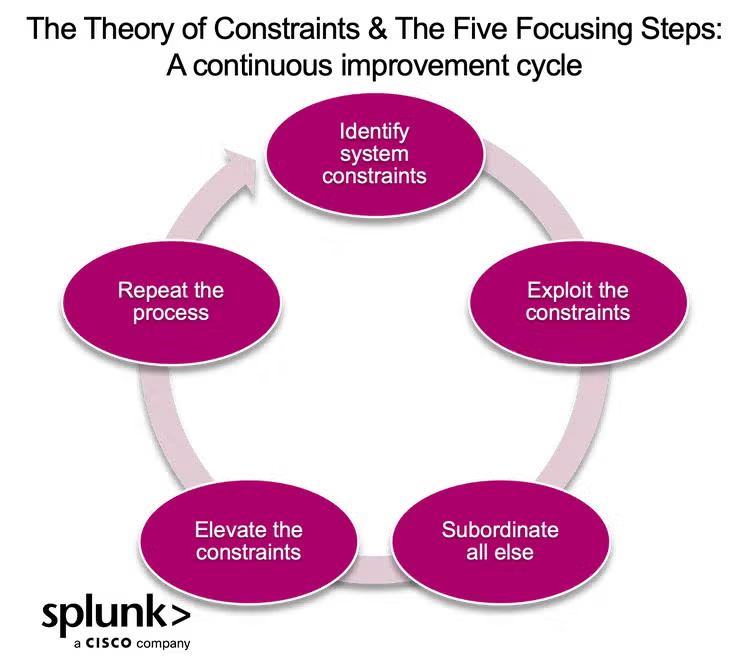
Identify system constraint(s)
A system can have several constraints. A first step is to discover these constraints in a timely and actionable manner and then prioritize and rank them.
In a complex enterprise IT network, certain functions are relevant for this first working principle of the Theory of Constraints, including:
Remember that constraints are not limited to IT and technology systems. Constraints are just as likely to result from organizational, cultural, and managerial areas. The bottlenecks in your organizational workflow, for example, may be due to a variety of factors:
- Internal governance policies
- Your style of management
- Hiring and HR decisions
A key idea here is to map these constraints with business impact: which bottlenecks impact business processes in which way, when and how.
Determine how to exploit the constraints
It may be possible to entirely eliminate certain constraints, particularly physical constrains.
Other constraints are harder. For example, a cultural or policy constraint may require your organization to change the way it operates. The policy changes may apply to many areas:
- Hiring practices
- Project management
- Software development frameworks such as Agile and DevOps
- Technology investments
- And more
Subordinate everything else
The decision on exploiting these constraints may not be easy: a policy change can roll out at any moment, but putting the policy into place or policing it may be limited by the organizational culture or external factors such as market dynamics.
The Theory of Constraints also acknowledges that every subsystem or system component (constraint or non-constraint) could be dependent on each other: changing one component can affect the overall system behavior, positively as well as negatively. Therefore, you’ll over time aim optimize the resolution for every constraint: the end goal should be to maximize the performance of a system.
Elevate the system’s constraints
The state of a system will change when a constraint is eliminated or resolved. These changes may emerge from internal co-dependencies or external factors.
The goal of a system may also evolve, changing your view on the system constraints. This means that a system will enter a new state where it will experience new constraints.
No system is free from constraints. It is not possible for a system to operate entirely free of constraints — but it is possible to manage them. Here are some what-if scenarios that illustrate this:
- Business organizations could generate virtually unlimited profits if there existed an operational state with no applicable constraints.
- Compute power could be virtually unlimited if the number of transistors on the same processing chip could be increased without limitations. (This is exactly what Moore’s Law is all about.)
The Theory of Constraints prepares both the system and the entire organization for the new constraints and how non-constraints can be better utilized to deliver the intended results.
Repeat the process
Essentially, you can think of these working principles as a framework for continuous improvement.
This “final” step — repeating the process — makes constraint discovery a continuous process. The next action plan is to resolve the new constraints. It also suggests that your constraint resolution action or policy may not be static but evolve in response to your new system state and the applicable constraints.
A great example is when you transition from a Waterfall to an Agile methodology, IT and business decision makes will measure new decision metrics. The new information will be instrumental in guiding your Agile workflows toward continuous improvement.
For example, Agile teams may need to better align QA and Dev responsibilities. Upon further assessment, your teams may need to adopt a more collaborative framework — such as DevOps that is better focused toward the collective goals of both QA and Dev functions. Importantly, this view was only available after the organization transitioned from Waterfall to Agile, evaluated new performance metrics, and identified silos between Dev and QA as another opportunity for improvement.
Thinking Processes in constraints theory
TOC includes a set of logical thinking processes to solve complex problems and implement change effectively. These processes help in identifying root causes and designing solutions that address constraints systematically.
- Current Reality Tree (CRT): The CRT is used to map out and analyze the current state of the system. It helps identify the root causes of problems by tracing symptoms back to their origins. This process involves constructing a visual representation of the issues and their interconnections.
- Evaporating cloud (EC): Also known as the Conflict Resolution Diagram, the EC helps to address and resolve conflicts or dilemmas within the system. It identifies assumptions underlying the conflict and explores ways to "evaporate" these assumptions, leading to viable solutions.
- Future reality tree (FRT): The FRT is used to visualize the potential outcomes of proposed solutions. It helps ensure that the changes will lead to desired results without creating new problems. This process involves developing a model of the future state that includes the implementation of solutions.
- Prerequisite Tree (PRT): The PRT identifies obstacles that must be overcome to achieve the desired future state. It helps in planning by outlining steps necessary to remove these obstacles, ensuring smooth implementation of solutions.
- Transition Tree (TT): The TT is a detailed action plan that outlines the steps needed to move from the current reality to the future reality. It provides a structured approach to change management, ensuring that actions are aligned with objectives and constraints are effectively managed.
These Thinking Processes provide a systematic approach to problem-solving and decision-making, enabling your teams to address constraints effectively and drive continuous improvement.
Use cases for Theory of Constraints in the enterprise
In the realm of enterprise IT, the Theory of Constraints is highly applicable, especially in areas such as software development, IT operations, and project management. Here’s how TOC can be utilized:
Software development
TOC is particularly well-known in agile and DevOps environments, where constraints often appear in the form of:
- Slow development cycles
- Inadequate testing processes
- Delayed or rolled back deployments
By identifying these bottlenecks, teams can streamline workflows, enhance collaboration, and improve the speed and quality of releases.
IT operations
Constraints in IT operations might include limited server capacity, network bandwidth issues, or outdated infrastructure.
By applying TOC, organizations can prioritize upgrades, optimize resource allocation, and ensure robust performance and reliability of their IT systems.
IT service management
In IT service management (ITSM), TOC can be used to identify constraints in service delivery processes, such as:
- Incident response times
- Customer support operations.
This enables organizations to enhance service efficiency and customer satisfaction.
(Related reading: IT operations vs. ITSM, differences explained.)
Project management
TOC helps in managing IT projects by focusing on critical tasks that determine project timelines. By identifying and addressing constraints, project managers can better allocate resources, manage risks, and ensure timely delivery.
Strategic planning
By incorporating TOC into strategic planning, IT leaders can better align technology initiatives with business goals, ensuring that investments and efforts are directed toward overcoming key constraints that impact organizational performance.
(Related reading: how to build your IT strategic plan.)
Concepts and practices related to TOC
For a more comprehensive understanding on the theory of constraints, let’s look at these related concepts.
Throughput Accounting: TOC often involves a unique approach to accounting called throughput accounting, which focuses on three key metrics:
- Throughput (the rate at which the system generates money through sales)
- Inventory
- Operating expenses (OpEx)
This differs from traditional accounting methods and emphasizes the financial impact of constraints.
Drum-Buffer-Rope (DBR): This TOC scheduling mechanism is designed to manage workflow and ensure that the constraint is always working efficiently.
- The 'drum' sets the pace.
- The 'buffer' protects the drum from disruption.
- The 'rope' is the communication link that ties the processes together.
Cultural change: The theory of constraints emphasizes the importance of cultural change within an organization to successfully implement its principles. This involves shifting the mindset from local optimization to system-wide improvement.
TOC summary
Think of the Theory of Constraints provides a powerful framework for improving organizational performance by systematically identifying and addressing the bottlenecks that limit success. Its application in enterprise IT offers a structured approach to enhancing efficiency, productivity, and strategic alignment, ultimately driving business growth and innovation.
Related Articles

Data Orchestration Explained

Incident Response Plans: The Complete Guide To Creating & Maintaining IRPs