How Supply Chain Attacks Work: Definition, Types, Security and Prevention
Learn Kayly LangeEvery day, thousands of companies download updates to the software they rely on, making sure they're using the latest, greatest software with the least amount of issues.
Certainly a staple of digital life, this action is no longer completely harmless. It is now one of many avenues of attack that bad actors use to access systems and execute supply chain attacks. The past few years have witnessed some of the most significant — and scary — breaches: SolarWinds, Log4J, and CircleCI are just a few supply chain attacks in the past few years.
And this concerning trend shows no signs of stopping. Because of cybersecurity issues, 62% organizations reported disruption in their supply chain. Why? These attacks are very lucrative for bad actors: the hits they can get from a single weapon aren’t proportional to anything else in the industry.
Organizations need to evolve their approach to security to meet these sophisticated attacks. Here is what you need to know about supply chain attacks and how to advance your security to face them.
Quick summary: Supply chain attacks
- Supply chain attacks exploit trusted third parties and vendors to gain access to compromise the supply chain. The technique of "island hopping" is often part of a supply chain attack.
- Attackers use multiple methods to infiltrate networks, including malware injection, third-party software, counterfeit components, and physical tampering.
- Organizations can protect against these attacks using regular assessments, vetting vendors, creating a response plan, and educating stakeholders on the risk.
Keep reading to get more detail about supply chain attacks, how they work and — critically — the most effective ways you can protect your organization from an attack.
Splunk supports supply chain operations
Ensuring reliable Electrionic Data Interchange (EDI) communication is critical for smooth supply chain operations.
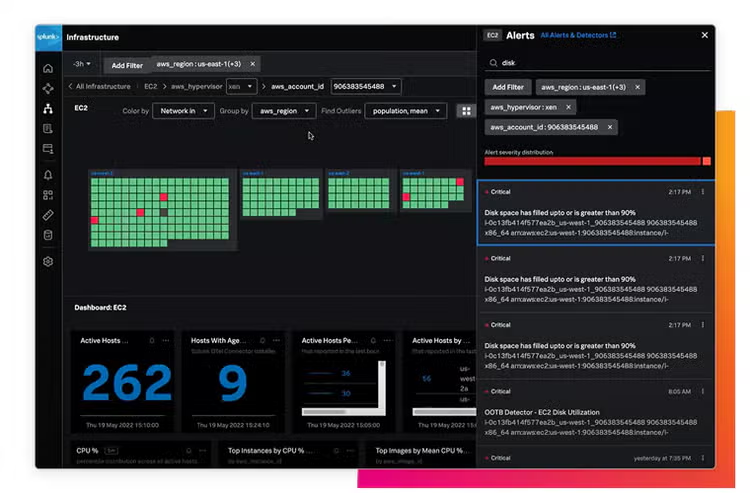
Manage and monitor EDI transactions with Splunk Enterprise or Splunk Cloud Platform, innovative and powerful solutions for modern supply chain operations. See how Splunk powers proactive supply chain management.
Already use Splunk? Explore these resources:
What is a supply chain attack?
A supply chain attack is a specific type of cyber breach that targets your organization's supply chain. It exploits trusted parties to access systems and compromise the supply chain. Supply chain attacks can seriously impact organizations, including the theft of sensitive data, reputational damage, disruption of operations, and financial losses.
The supply chain refers to all of the networks involved in creating and delivering your product or service to customers. This includes your organization as well as anything that directly impacts delivery:
- People
- Activities
- Information
- Resources
In the digital era, few organizations work alone. Companies rely on third parties and outside vendors to perform essential duties and help maintain their digital systems. Supply chain attacks leverage this multi-pronged system to access sensitive data across multiple organizations without trying to hack into each individual one directly.
As cybersecurity threat experts Ryan Kovar and Marcus LaFerrera put it:
How supply chain attacks work
A supply chain attack exploits outside providers and partners that can access your systems to penetrate your digital infrastructure. Once in the system, they can…
- Hide malware.
- Change source code.
- Otherwise cause problems.
Because the software comes from trusted third-party sources, the updates and apps are automatically signed and certified. Vendors are unaware that they have malicious code when they release them to the public, and the code can then run with the same permissions as the app. To completely understand how supply chain attacks work, we should explore some specific methods attackers use to infiltrate networks, island hopping being one of them.
An important angle to understand in supply chain attacks is the "chain" part: how attackers take advantage of the vulnerabilities within a single, often smaller or less known software in order to get access to more opportunities.
What is an island hopping attack?
The term "island hopping" is frequently referenced in the context of supply chain attacks. Here, island hopping is no tropical vacation. Island hopping refers to the technique where an attacker targets less secure, often smaller organizations within the supply chain so that they can infiltrate a large organization.
The small vendor here acts as a stepping stone for the attacker to gain access to a larger company's network. For instance, attackers might first target a small IT vendor's system. After that, they can use their admin access to exploit the vendor's client organization. The attack is highly effective because small organizations often lack sufficient security protocols, making them susceptible to attacks.
Attacks like island hopping can cause a great deal of damage, amplifying the attack's impact across the entire supply chain.
Why is software that lacks a large user base particularly vulnerable?
Software with a small user base is often vulnerable to supply chain attacks for a few reasons:
- Less resources = less scrutiny. A small software project has very limited crew and funding. Thus, the project lacks the necessary resources to carry out frequent audits, implement advanced security protocols or release timely updates to address new threats. Also, extensive testing and analysis are less likely to happen consistently.
- Slow detection. With few users interacting with the software, finding unusual behaviors or issues may take a longer time. Delayed discovery of a security issue gives attackers more time for software exploitation without detection.
- Insufficient peer review. When software has a large user base, especially in open source software, a major benefit is that there are many contributors regularly reviewing and refining its code. Here, there's likely more security procedures in place to pick up on vulnerabilities that may be exploited, for example.
Software with a small user base is a potential target for attackers. Once compromised, the software acts as a backdoor into larger companies that are using it, increasing the potential damage across the entire supply chain. We will discuss more on that in the upcoming sections.
Understanding these types of attacks help companies to prepare and defend against sophisticated threats. But before exploring the means to defend against supply chain attacks, let's discuss some other common supply chain attacks.
Types of supply chain attacks
There are multitudes of methods and supply chain vulnerabilities that bad actors exploit to infiltrate a target organization’s network. Some of the most common types of supply chain attacks include:
- Malware injection. Attackers insert malicious code or malware into a software application or hardware component distributed through the supply chain.
- Third-party software. Bad actors use third-party software to gain access to the target’s network.
- Counterfeit components. Attackers introduce counterfeit hardware components into the supply chain to gain access to the network.
- Man-in-the-middle (MITM) attacks. Attackers intercept and modify data transmitted between the target organization and suppliers, enabling them to insert malware and other malicious code.
- Physical tampering. Bad actors physically tamper with devices and equipment during the manufacturing or shipping process, allowing them to access the network once the target installs it.
- Mismanagement of secrets. Like passwords, API keys, and tokens, secrets enable systems to communicate securely. However, if not properly managed, they become a vulnerability. Attackers take advantage of mismanaged access tokens, hardcoded secrets or compromised build pipelines to manipulate code, infiltrate systems and escalate privileges.
- Insider threats. Insiders, such as employees of suppliers or shipping companies, carry out attacks on the organization’s supply chain.
4 ways to defend against supply chain attacks
Any company that provides software or hardware to other organizations is a target for attackers. Even top security vendors, such as FireEye, Microsoft, and Malwarebytes, are not immune to supply chain attacks. However, there are ways to reduce the likelihood of an attack and reduce the damage to your company and reputation.
1. Vet suppliers & vendors
While no vendor is entirely immune to an attack, proper due diligence will go a long way. Ask the difficult questions upfront to protect your supply chain.
First, evaluate your supplier’s security posture. It should involve reviewing their security policies, conducting security audits, and assessing their compliance with relevant industry standards and regulations.
In addition, check on their security practices. Evaluate their physical security, network security, data protection and incident response capabilities. Checking on their security is not a one-and-done practice. Instead, continue monitoring their ongoing security practices to ensure they have adequate security controls.
The contractual agreement you hold with your vendors is also crucial to maintaining your security. Your agreement needs to include specific security requirements and outline their responsibility for protecting your data. Also, be sure that your contract stipulates that they provide you with regular security reviews.
(Related reading: TPRM third-party risk management.)
2. Conduct regular audits
One of the issues that many organizations run into is that detecting supply chain attacks is difficult. Here at Splunk, our security teams have researched ways to detect attacks and explored potential cyber defense methods.
We found that focusing on JA3 and JA3s hashes using multiple Splunk queries and commands is a simple — yet clever — way to fingerprint TLS negotiations between a server and client. While there are no silver bullets to detecting malicious activity, especially supply chain attacks, abnormal JA3/s hashes have a high probability of detecting anomalous activity.
In many environments, JA3/s helps detect anomalous malicious activity that might not be picked up otherwise. Although not a perfect method, it provides an additional layer of protection crucial in an increasingly threatening environment.
Get more details on this method in Detecting Supply Chain Attacks, a free whitepaper (PDF) from SURGe by Splunk.
(Related reading: the role of security compliance auditing.)
3. Create an incident response plan
Malware attacks (stealing sensitive data and credentials) have increased by 58% in 2024. And that will continue increasing...so what to do? Creating an incident response plan (IRP) is important to reduce the impact of an attack and quickly recover from any damage.
Build a response team to help you create an incident response plan, often called a CSIRT: computer security incident response team. The team should include representatives from each department, including IT, security, legal and communications. Appoint an incident commander, too. They should each be trained on the steps to take in the event of a supply chain attack.
Once formed and educated, this team should establish incident response procedures that outline the steps to take should an attack occur. The procedures should include:
- Identification
- Containment
- Investigation
- Eradication
- Recovery
- Reporting
Communication is vital in the case of an attack, but it is too often the first thing to break down. Your team needs to establish communication protocols that outline how information about the event should be shared with employees, vendors, and other stakeholders, including customers and law enforcement.
Your plan needs to be updated regularly to account for new or former employees, systems, vendors, and threats. Regular updates will help you ensure it remains relevant and effective.
4. Educate employees & stakeholders
Your employees, vendors, and key stakeholders represent the frontline of defense for your organization. Helping them understand the risks and how to respond is essential to reduce the risk of a successful attack. The more education IT and leadership can provide workers, the more effective your defenses will be.
Develop training materials that explain supply chain attacks, how they work, and their potential impact on business. Written materials, videos, and webinars are all great ways to get information across your organization.
In your training, provide real-life examples of supply chain attacks so that everyone understands the risks and recognizes specific warning signs better. Although supply chain attacks are subtle and often hard to spot, the more that employees are aware, the more eyes you can have looking out for anything suspicious or off.
Your training also needs to include preventative measures to prevent attacks. This may include tips like verifying the identity of suppliers, monitoring network activity for suspicious behavior, and reporting suspicious activity to your IT or security team. Regularly reinforce the information in your training through internal communications, meetings, and other channels.
Evolving security defenses to face supply chain attacks
Supply chain attacks are the latest challenge in the cyber security world. They’re hard to spot and can have a larger ripple effect than most other attacks. Organizations need to take proactive steps and evolve their approach to security to protect their business and minimize the potential for damage.
With the right plans and safeguards in place, you can stay ahead of emerging threats and ensure the security of your entire supply chain.
FAQs about supply chain attack
Related Articles

Configuration Management & Configuration Items (CI) Explained

IT Operations Management (ITOM): A Detailed Introduction