SSL/TLS Web Security Certificates & Protocols
Have you ever wondered about the tiny padlock icon in your browser and why it's there?
This little padlock icon, along with the "https" in the URL, signifies that your connection to the website you're on is secure and encrypted using SSL/TLS protocols. It's a symbol that represents the security of all types of information transferred to and from your website — not just for ecommerce transactions.
These SSL/TLS protocols have revolutionized web security and transformed how we transmit sensitive information online. From protecting private data to strengthening customer confidence and supporting regulatory compliance, SSL/TLS has become a crucial component of web security.
But how did we get to this point? Let's take a look at the evolution of web security protocols from Secure Sockets Layer (SSL) to Transport Layer Security (TLS).
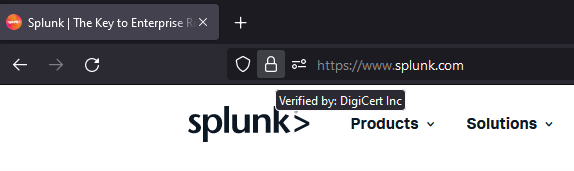
When you hover on the padlock in your browser, you’ll likely see the verified certification.
The beginning: Secure Sockets Layer (SSL)
In the early days of the Internet, website owners wanted a way to secure their online transactions and protect sensitive information from being intercepted by hackers.
Before SSL, data on the Internet was transmitted in plaintext that could be read by anyone who intercepted the message. For example: if you made a purchase on a website using your credit card details, those details could be intercepted.
The first usable version of SSL (v2.0) was released in 1995 by Netscape to correct this problem and protect user privacy. Interestingly, Version 1.0 was never officially released due to security flaws.
In 1996, with the release of SSL 3.0, users online started seeing more of a widespread adoption across the websites that they visited. This version introduced stronger encryption algorithms and improved security features.
SSL 3.0 was still widely used until fall 2014 when a major security vulnerability was discovered named POODLE. At this point, it was suggested to switch over to TLS. Here, SSL 3.0 was no longer recommended — and it was eventually abandoned.
The transition: From SSL to TLS
As technology continued to advance, the Internet Engineering Task Force (IETF) proposed an update to SSL in 1999. With the technology no longer being developed by Netscape, IETF decided to change the name to Transport Layer Security (TLS).
While the differences between SSL 3.0 and TLS 1.0 were very minimal at the time of release, the name change was done to highlight the change in ownership.
Despite the name change, the term SSL stuck. Many people to this day use the term SSL when referring to TLS, whereas others use the term SSL/TLS when talking about the technology.
The evolution: Transport Layer Security (TLS)
While there are many similarities between SSL and TLS, there are also some key differences. One major difference is that TLS has stronger security protocols, making it more secure than its predecessor.
Additionally, unlike SSL which only had two versions (2.0 and 3.0) before the name change, TLS continues to be updated and improved upon. These versions include 1.0 (1999), 1.1 (2006), 1.2 (2008), and the latest release, 1.3 (2015).
Since its release, TLS has become the standard for web security protocols and is used by all major browsers and websites today. It is able to:
- Provide stronger encryption algorithms.
- Authenticate servers and clients with digital certificates.
- Protect against a wider range of attacks.
The role of certificates: Enabling trust & authentication with SSL/TLS
For a website or application to use SSL/TLS, a certificate needs to be installed on the origin server. This certificate acts as a digital "passport" — verifying the identity of the website and securing the communication between the server and client.
Certificate Authorities (CAs) are used to verify the authenticity of the website before issuing a SSL/TLS Certificate. This helps establish trust between the user and the website, ensuring that sensitive information is only shared with legitimate websites.
SSL/TLS certificate types
Here are the three types of SSL/TLS certificates:
- Extended Validation Certificates offer the highest level of identity assurance. The certificate shows information about the company or parent company that owns the website when a user clicks on the lock icon. This type of certificate is used by banks and trusted retailers online.
- Organization Validation Certificates is the mid-level option that requires applicants to prove three things: they own the domain name, their organization is registered, and that they're legally accountable.
- Domain Validation Certificates is the most basic option that should only be used on non-commercial websites such as brochure sites and personal blogs.
(Tutorial: learn to threat hunt in TLS/SSL certs.)
The role in search
In addition to providing trust and authentication, SSL/TLS certificates also play a crucial role in search and search engine optimization (SEO).
Back in 2014, Google began ranking websites higher when secured with SSL/TLS. This was an early warning. Eventually, in 2018, Google began calling out websites that lacked an SSL/TLS certificate by flagging them as "Not Secure" when viewed in Google’s Chrome web browser.
How it works: SSL/TLS handshakes & record layers
The process begins with an SSL/TLS handshake, where the client and server do two things:
- Exchange information.
- Agree on which encryption algorithms or protocol to use.
After the handshake is completed, data is transmitted using record layers that include both encrypted data and authentication codes to ensure its integrity. SSL/TLS uses a combination of private and public keys when securing communication between clients and servers.
This complex system of encryption and authentication is what makes SSL/TLS so effective in securing web communications and protecting sensitive information.
The future: The ongoing development of SSL/TLS
From its humble beginnings as a way to secure online transactions, SSL has evolved into the highly advanced TLS protocol that protects all kinds of information transmitted over the web. As technology continues to advance and security threats evolve, TLS will continue to be updated and improved upon to provide even stronger protection for web communications.
With data breaches becoming more common and cyberattacks on the rise, the importance of SSL/TLS encryption cannot be overstated. It has become a fundamental part of web security and will continue to play a critical role in protecting sensitive information for years to come.
So next time you see that little padlock icon in your browser, remember the history and evolution of SSL/TLS protocols and how they keep your information safe online.
FAQs about SSL/TLS certificate
Related Articles

How to Use LLMs for Log File Analysis: Examples, Workflows, and Best Practices

Beyond Deepfakes: Why Digital Provenance is Critical Now

The Best IT/Tech Conferences & Events of 2026

The Best Artificial Intelligence Conferences & Events of 2026

The Best Blockchain & Crypto Conferences in 2026

Log Analytics: How To Turn Log Data into Actionable Insights

The Best Security Conferences & Events 2026

Top Ransomware Attack Types in 2026 and How to Defend