Software Supply Chain Security: Proven Frameworks & Tactics to Stay Ahead of Threats
Learn Shanika WickramasingheKey Takeaways
- The software supply chain is a growing target for attackers: Modern software relies heavily on third-party components, tools, and dependencies, making the entire development and delivery ecosystem vulnerable. A single weak link can compromise your entire system.
- Real-world breaches highlight the risks: High-profile attacks like SolarWinds, Log4Shell, and Codecov show how attackers exploit vulnerabilities in trusted tools and libraries, causing widespread fallout across industries.
- Securing the supply chain requires a proactive approach: Strategies like maintaining a Software Bill of Materials (SBOM), shifting security left in development, and adopting frameworks like SLSA can help organizations protect their code, tools, and teams.
Most modern software isn’t built from scratch.
It’s assembled from dozens, sometimes hundreds, of external components like open-source libraries, third-party APIs, CI/CD tools, build scripts, and deployment pipelines.
This entire ecosystem is what we call the software supply chain. Similar to a physical supply chain, if one weak link breaks, the whole system is at risk.
What is software supply chain security?
Software supply chain security is the practice of protecting every layer of the software development and delivery process. It’s not only the final product, but everything that touches it along the way.
The first step to securing the software supply chain is understanding what actually needs to be secured. It’s not only your application code — it’s the entire system around how your software is built, tested, and shipped. Key components include:
- Your source code, both what you write and maintain internally
- Third-party dependencies
- Build tools like Jenkins, GitHub Actions, or CircleCI
- Deployment tools such as Docker, Kubernetes, or Helm
- People such as developers, testers, DevOps engineers, and their access credentials
In short, if anything is part of building or releasing your software, it’s part of the supply chain, and it needs to be secured.
Why this matters more than you might think
Modern development moves fast. Organizations rely on open-source packages, external APIs, and automation software to release code quickly and often. That’s a good thing for speed, but not always for security.
The truth is, your app isn’t entirely your own.
A big chunk of it comes from libraries written by strangers. It’s stitched together with tools and scripts maintained by third parties. And it’s deployed using platforms you don’t fully control.
Hackers are well aware of this. They don’t need to attack your code directly. They simply need to compromise one component of your supply chain, and they could gain access to everything.
This is why it’s no longer optional to take your software supply chain seriously. This isn’t difficult to imagine:
- A vulnerable open-source package could expose sensitive user data.
- A compromised build tool might inject malware during deployment.
- Leaked developer credentials could give attackers access to your entire codebase.
- An outdated dependency might help attackers exploit known bugs.
- Misconfigured CI/CD pipelines could be hijacked to push malicious updates.
- Exposed credentials in QA environments, often hardcoded in manual or automated test scripts, can lead to unauthorized access.
To see how serious this can be, let’s look at the real world.
Biggest software supply chain attacks and what went wrong
When software tools become attack vectors, the damage doesn’t stop at one company; it spreads across all that depend on them. Let’s look at major software supply chain attacks that are famous in the industry, what exactly went wrong, and why we’re still talking about these major incidents.
1. SolarWinds, the wake-up call for enterprise security
The SolarWinds Orion breach in 2020 remains one of the most devastating supply chain attacks to date.
Hackers inserted malicious code (later called Sunburst) into Orion’s updates, which were delivered to around 18,000 customers, including U.S. federal agencies and tech giants like Microsoft. Because the software had admin-level access, the attackers silently moved across high-security networks for months before being discovered.
Fallout and long-term consequences
- Massive espionage campaign: The breach allowed attackers to steal sensitive data from government agencies, including the U.S. Treasury and Homeland Security.
- Global impact: The attack targeted not just U.S. organizations but also private companies and government agencies worldwide, creating a ripple effect of security breaches.
- Erosion of trust: The attack exposed how third-party tools could be weaponized, leading organizations to question the security of even trusted enterprise software.
2. Log4Shell: a tiny library, a massive impact
In late 2021, a remote code execution (RCE) flaw was discovered in Apache Log4j, a logging tool used across the Java ecosystem.
This vulnerability, dubbed Log4Shell, was used by attackers to remotely take control of servers with no login or authentication needed.
Widespread fallout
- Global panic: Ssince Log4j was embedded in countless applications and systems, Organizations scrambled to patch their systems — many of which were difficult to identify, let alone address.
- Long-term exposure: Even months after disclosure, unpatched systems remained vulnerable, leaving organizations at risk of ransomware attacks and data breaches.
- Supply chain implications: The attack highlighted how a single vulnerability in a widely-used open-source library could put entire ecosystems at risk, from small businesses to critical infrastructure.
3. Codecov, when CI/CD becomes the backdoor
In 2021, Codecov’s CI/CD tool was compromised after attackers accessed credentials used during Docker image creation.
This helped threat actors to modify a Bash uploader script that developers used in their pipelines. Since those scripts had access to secrets and tokens, the attackers siphoned credentials from hundreds of environments.
Worse, the breach went undetected for three months — long enough to quietly infiltrate many internal systems without raising alarms.
Consequences and fallout
- Credential theft at scale: Hundreds of organizations unknowingly leaked sensitive information, including API keys, tokens, and private repositories.
- Undetected compromise: The breach went unnoticed for three months, giving attackers ample time to infiltrate internal systems and exfiltrate data.
- Trust erosion in developer tools: The incident underscored the risks of relying on third-party CI/CD tools, driving greater scrutiny of security practices in developer pipelines.
Where do threats really come from?
Threats to your software supply chain fall into two broad categories based on their origin.
External threats
External threats are attacks that originate outside your organization, often targeting third-party components, public infrastructure, or insecure transmissions. Examples include:
- Malicious code in third-party libraries used during development.
- Interception of updates or packages during transit without encryption.
- Vulnerabilities in public-facing components, like containers or registries.
Internal threats
Internal threats come from within your organization through employee mistakes, compromised accounts, or poor security practices in your development pipeline.
- Leaked or misused developer credentials used in build or deploy pipelines
- Unpatched, outdated components left in production environments
- Exposed or misconfigured APIs allowing unauthorized access or data leaks
But these threats don’t attack randomly — they tend to target specific components of your software lifecycle. Let’s break that down.
- Source code threats target the integrity of your codebase, whether through malicious commits, compromised version control system (VCS), or vulnerable third-party contributions.
- Build environment threats exploit your CI/CD pipeline to inject malicious artifacts without changing the original source code.
- Dependency-related threats insert vulnerabilities via direct or transitive dependencies, often through abandoned or spoofed packages.
- Deployment and runtime threats target the live environment through misconfigurations, leaked credentials, or outdated software.
How to build a secure software supply chain
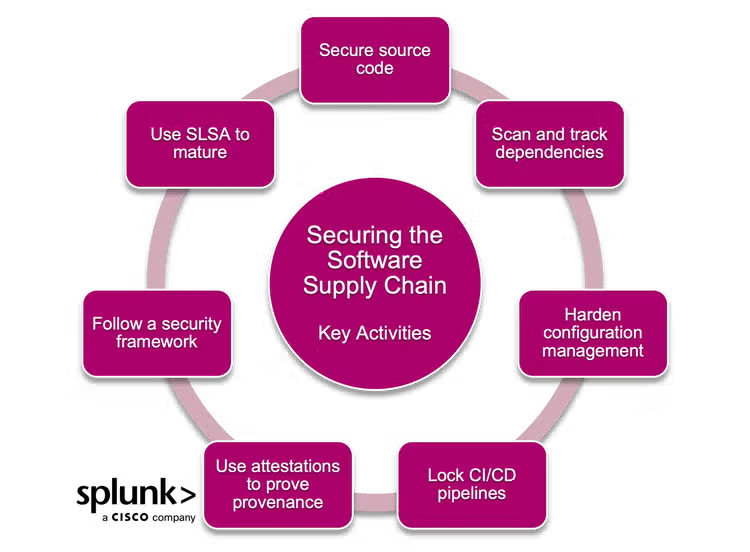
Securing the software supply chain isn’t about just installing one tool. It’s about identifying real risks in the development lifecycle and layering defenses where they matter most. Let’s look at this approach.
Secure your source code
You can tighten control over your codebase by:
- Using signed commits.
- Enforcing branch protection rules
- Enabling mandatory code reviews.
Even simple steps like preventing direct pushes to main or requiring 2FA on Git accounts go a long way. One misconfigured branch can become an attack surface if you're not careful.
Scan and track every dependency you use
You probably use dozens of open-source packages without thinking twice. Start scanning them automatically before building direct and transitive dependencies. Then generate a Software Bill of Materials (SBOM) as part of your build process so you always know what’s in your app and where it came from.
This alone can save days of panic when the next Log4Shell drops — it’s a matter of when, not if.
Harden your configuration management tools
Tools like Ansible, Puppet, or Chef control how your infrastructure is deployed, and if misused, they can deploy malware easily. You can reduce risk by treating your playbooks as critical code:
- Apply version control.
- Restrict access to secrets
- Monitor for unauthorized changes.
Lock down your CI/CD pipelines
An over-permissioned or poorly isolated CI/CD pipeline is a huge risk.
You can isolate runners, rotate credentials automatically, and use signed build jobs. And during the build process, generate attestation metadata to prove what was built, on which system, and by whom.
Use attestations to prove what you built
Every time you release a build, you can attach signed attestations. Tools like Sigstore and Cosign help you do this automatically. These attestations show that your artifacts haven’t been altered and include details about the environment and tools used.
(Related reading: how to perform SCA software composition analysis.)
Follow a security framework (SSDF is a great start)
Platforms like NIST’s Secure Software Development Framework (SSDF) give you a roadmap. You can begin by training your devs, scanning code early, and setting up a process to respond to vulnerabilities before they become incidents.
(Related reading: application security requirements & top cybersecurity frameworks.)
Use SLSA levels to measure your supply chain security
Pronounced “salsa”, SLSA stands for Supply-chain Levels for Software Artifacts, a security framework designed to protect the integrity of software supply chains. Developed by Google, it provides a set of best practices and compliance levels to help organizations secure the software they build, use, and distribute. Think of it as a roadmap to incrementally strengthen the supply chain security.
SLSA aims to ensure that software artifacts — like source code, build scripts, and container images — are created and maintained in a secure, verifiable way. It focuses on preventing unauthorized changes, ensuring traceability, and reducing the risk of tampering.
Think of it as a maturity model for your environment. Start at Level 1, and progress through the four levels of security maturity:
- SLSA Level 1: Basic security requirements, such as source control and build automation.
- SLSA Level 2: Requires tamper-resistant builds and authenticated provenance (evidence of how the software was built).
- SLSA Level 3: Adds stricter controls, such as using isolated, trusted build environments.
- SLSA Level 4: The highest level, requiring end-to-end integrity guarantees and rigorous access control mechanisms.
FAQs about securing the software supply chain
How do I manage risk in the supply chain?
Managing risk in the software supply chain means identifying weak points before attackers do and adding systems in place to monitor, assess, and respond to those risks.
This is where Supply Chain Risk Management (SCRM) comes in.
At its core, SCRM is about understanding the full scope of your supply chain vendors, tools, third-party libraries, cloud platforms, and even your customers and evaluating how each piece could impact your security posture.
It’s not only about your direct suppliers. The tools they use, the platforms they run on, and how securely they manage their environments all factor into your overall risk. SCRM helps organizations to:
- Assess and analyze risks across the full chain.
- Monitor for anomalies or suspicious behavior.
- Maintain compliance with security standards and regulations.
- Prepare for and respond to supply chain security incidents.
There are many platforms that support SCRM practices by providing features like threat intelligence, vendor assessments, and continuous monitoring. But first, the strategy needs to be in place.
Why can’t I trust manual processes anymore?
Relying on humans to track vulnerabilities, apply patches, or verify code integrity is too slow and too error-prone for the pace of modern development. Manual steps simply can't guarantee the same speed, scale, or security — that’s why automation is becoming a must.
Automating security tasks like vulnerability scanning, access control, and patch management helps catch and fix issues before they become threats. It also reduces the risk of something being missed in fast-moving CI/CD pipelines.
One critical innovation is automated attestation. This involves generating metadata about a software artifact, who built it, when, where, and how, as part of the build process. It proves the software hasn’t been altered maliciously and complies with security standards. With tools like Sigstore and Cosign, organizations can automatically sign and verify artifacts as they're built, creating a reliable audit trail throughout the software lifecycle.
For industries with regulatory pressure or high trust requirements, automated attestation isn’t merely useful, it’s becoming essential.
How do SCA and SAST strengthen software supply chain security?
When we talk about securing the software supply chain, two core techniques come up often: SCA and SAST.
- Software Composition Analysis (SCA) checks your codebase for open-source packages. It tells you which ones you’re using, whether they have known vulnerabilities, and if they’re outdated or risky.
- Static Application Security Testing (SAST) scans the proprietary code you and your team write. It looks for issues like insecure logic, input validation problems, and other bugs that attackers love to exploit.
Together, SCA and SAST give you full coverage. SCA protects you from risks in the code you borrow. SAST protects you from mistakes in the code you build. If you want to take supply chain security seriously, you need both.
What is threat modeling? Why does it matter in supply chain security?
For many organizations, securing the software supply chain is a priority, but the biggest challenge is knowing where to start. With so many layers like source code, build tools, CI/CD, and dependencies, it’s easy to get lost.
This is where threat modeling becomes a practical first step. Threat modeling helps you map out your software systems and ask critical questions such as:
- What are the valuable assets?
- Where are the weak spots?
- Which threats matter most right now?
Not every component is equally risky, and not all threats are theoretical. Some, like dependency poisoning or build script modification, are active attack methods seen in the wild. A threat model helps organizations to spend time on what’s real.
Organizations like the OpenSSF End Users Working Group have developed sample threat models for open-source software consumers. These models can detect common risks, tie them back to frameworks like SLSA and SSDF, and help you identify security gaps across the development lifecycle.
Foundational security: securing the software supply chain
Securing your software supply chain is a fundamental need now. As software becomes more interconnected, every library, script, tool, and CI/CD job turns into a potential attack vector.
With threats evolving and regulations tightening, practices like Zero Trust CI/CD and real-time anomaly detection are becoming the new standard.
Start small, secure your repos, isolate your builds, and verify everything. Because in the end, trust in your software begins with trust in how it's built, and that trust must be earned, step by step.
Related Articles

What is GitOps: The Beginner's Guide

What is Real User Monitoring?