IT Service Delivery Explained: Key Processes, Best Practices, and Technologies for Enterprises
Learn Joseph NduhiuKey Takeaways
- IT service delivery ensures users have reliable access to essential IT services by focusing on customer experience, service level agreements (SLAs), and continuous improvement.
- A strong IT service delivery framework relies on well-defined processes, clear roles, automation, and performance monitoring to meet business objectives and user needs.
- Adopting best practices—such as regular KPI tracking, proactive governance, and leveraging modern technologies—enables organizations to drive productivity and digital transformation.
Within the modern enterprise, technology has taken a strategic role, serving as a key enabler of productivity and innovation across all functions and processes. For this reason, staff joining or working for digital-centric organizations require access to the right IT tools and systems to perform their operational tasks and achieve strategic objectives.
In this article, we will consider the elements required for success in IT service delivery, and where the industry is heading to.
What is IT service delivery?
IT service delivery refers to the coordinated set of activities and resources required to provide IT services to users once they have been deployed in the production environment. The right approach to IT service delivery results in satisfied users whose interactions with IT are positive and whose requests for service access are fulfilled quickly and with high quality.
Due to the complex and constantly evolving world of enterprise IT, ensuring that business users are equipped and supported to adopt new offerings is a critical concern. IT teams must invest in the right capabilities, embody a strong service culture, and remain adaptable to their operational context whenever demands for improvement and compliance arise.
IT service delivery is different from IT service management (ITSM) as its customer facing and typically relies on service level agreements (SLAs) to ensure customers are receiving a high level of service.
Foundations of IT service delivery
The service management framework
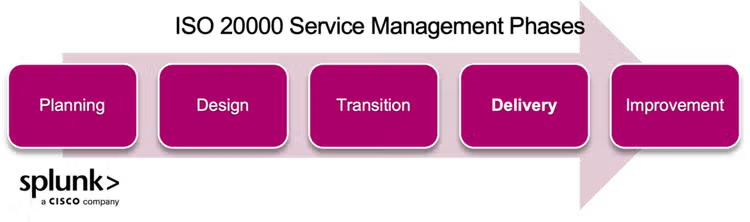
The ISO 20000 standard considers service delivery as one of the five main phases within a service management approach, designed to meet the requirements of service consumers and deliver value for the organization.
It sits in between transition and improvement phases, and involves both:
- The provision of access to deployed services.
- Support whenever there are issues with the IT services that need to be addressed.
Whether IT services is delivered by internal teams or outsourced third parties, IT service delivery focuses on providing the right experience for users and the business as a whole.
Common examples of IT service delivery include provision of accounts for new users, credential resets, hardware requests, repair requests, new software implementations, and additional storage or computing services.
Service agreements and customer relationships
At the heart of IT service delivery is the definition of the relationship between the service provider and the customers, including end users.
According to the CMMI model, this typically takes the form of a service agreement, which describes:
- The services to be provided.
- Service level targets such as response time, resolution time, and availability.
- Responsibilities of the parties involved.
- Communication channels and feedback mechanisms.
- Exceptions, workload limits, and escalation procedures where necessary.
A service agreement can be formal, such as service level agreement signed by provider and customer representatives, or informal, as in a service catalog or terms and conditions accepted before accessing services. This agreement serves as the foundation for managing services to better meet customer expectations.
Core elements of IT service delivery
Other core elements that play a role in IT service delivery include:
Processes
These are the interrelated or interacting activities that use inputs to deliver IT services. The most prominent process in IT service delivery is service request management. As defined by ITIL 4, its purpose is to handle all predefined, user-initiated service requests efficiently and in a user-friendly manner, supporting the agreed-upon quality and experience levels.
The service provider receives requests from users and fulfils them through manual or automated means. Service requests can range from support actions to information or access, some of which require prior approval. For example, a new employee might require a configured computing device ad access to enterprise software systems and information repositories.
Other key processes in IT service delivery include:
- Incident management: Handling IT service disruptions affecting individual users or groups.
- Change management: Managing requests for IT changes raised by users e.g. changes to a CRM workflow following an organizational restructuring.
- Service catalog management: Marketing and presenting the available IT service offerings to users.
- Release management: Making deployed IT services available to users.
Roles
Effective IT service delivery relies on a robust communication interface between the service provider and users. The service desk (or IT helpdesk) serves as the primary IT service delivery role, acting as the entry point and single point of contact for capturing requests and issues from users. Typically, this is a dedicated team that provides first-line support, handling most tasks and escalating others to specialist teams or vendors.
In addition to technical skills, IT service delivery roles require service empathy — recognizing and understanding user frustration, expressing sympathy, and adjusting actions accordingly. Emotional intelligence and strong communication are essential for maintaining good relationships with users and IT service customers. Regular training is crucial for enhancing both technical and interpersonal skills to keep pace with evolving business needs and technological advancements.
Technologies
Automation is heavily leveraged in IT service delivery to fulfill user requests. Ticketing and workflow systems are widely used, allowing users to submit requests through various channels (email, phone, chat, web) into a centralized system where they are categorized, prioritized, routed, escalated, and resolved — ultimately closing the ticket when user satisfaction is confirmed or after a predetermined time.
Other relevant tools include:
- Knowledge bases for quick reference and resolution guidance.
- Monitoring tools for verifying IT service status.
- Communication tools for notifying users and stakeholders.
- AI large language models (LLMs) to assist with analysis, response drafting, and research into novel issues.
(Related reading: LLM monitoring.)
Emerging technologies such as Digital Employee Experience (DEX) tools are increasingly automating the IT service delivery value chain, including resolving issues before they are reported by users.
Best practices for service delivery
There are a range of recommended best practices that improve the modern IT service delivery process, including:
- Defining KPIs relevant to your business: This process should be done in collaboration with IT, business management and IT service continuity management to determine what KPIs matter most (i.e. page load speed, network uptime, help desk ticket resolution time, mean time to repair, etc.).
- Developing systems to collect and monitor these KPIs: These are developed preferably through a centralized dashboard that is visible to both IT and management.
- Developing workflows that emphasize meeting and exceeding KPIs: Hold departments and individuals accountable for achieving the required results.
- Reporting KPIs regularly, during daily scrums: These can be done in formal reports to management, and in broader reports to other enterprise stakeholders, ideally with the most current IT infrastructure data available.
- Leading discussions and focus groups to generate ideas about how to improve KPIs when they’re not being met: Identify ways to improve operations, service support, timeliness, optimization, operational level agreements, as well as simplify workflows, or implement new technologies that will lead to tangible business results and better customer experience. Develop root cause procedures for errors and problems through a blameless investigation process and prevent them from recurring.
- Using mobility whenever possible: KPI information should be available on any type of device at any time, including mobile devices, to promote a culture that values real-time data availability.
(Related reading: key performance indicators.)
IT service delivery governance
IT service delivery activities operate within a framework of parameters that ensure the provider’s goals and objectives are achieved. Governance establishes, monitors, and evaluates these parameters, aligning the service delivery ecosystem with leadership expectations. Governance activities are shaped by legal and regulatory requirements, stakeholder input, and ownership at the highest organizational levels.
Key elements of governance in IT service delivery include:
- Policies: Directives from top management that guide decisions and ensure compliance in areas such as ethical behavior, human resource management, technology acquisition, data privacy, and access rights.
- Performance tracking: Ongoing monitoring to ensure IT service delivery performance meets strategic objectives. This includes establishing metrics and KPIs to measure the effectiveness of responding to and resolving user requests and issues — such as fulfillment against SLA timelines and net promoter score for user and customer experience.
One of the major goals of modern IT service delivery is continual service improvement and making the IT function more proactive and predictive. Thus, well-defined KPIs are critical, and give business the ability to tie throughput, service quality and stability to business results such as profitability, productivity and user satisfaction.
(Related reading: data governance.)
Final thoughts
Today’s enterprise IT environment faces the challenge of keeping up with evolving business models, changing user preferences, and rapid innovation. As a result, IT service delivery has become essential in driving digital transformation by providing and managing services that support modern user requirements and enable organizations to capitalize on the opportunities of the digital age.
Delivering IT services effectively and efficiently requires a holistic approach — anchored by a sound IT strategy, well-resourced budgets, capable staff, and effective contracting with third-party vendors.
Related Articles

Beyond Deepfakes: Why Digital Provenance is Critical Now

Open Source vs. Closed Source Software