Risk Remediation Explained: Remediating Risk for Cybersecurity
Learn Joe HertvikRisk remediation is part of an ongoing risk assessment framework for systematically controlling security vulnerabilities — because these risks can threaten an organization. Risk remediation strategies identify and counter known threats to business processing and security in many different areas, including:
- IT cybersecurity
- Financial threats
- Environmental issues
- Disaster planning
- Other risks
This article discusses risk remediation strategies for IT cybersecurity environments. In this, we’ll explain what risk remediation is, its goals, how it’s different from (and complements) risk mitigation, and the four elements of an effective risk remediation framework for cybersecurity.
(Related reading: vulnerabilities, risks, threats: what’s the difference?)
What is risk remediation?
Risk remediation is the process of identifying, addressing, fixing, and minimizing cybersecurity threats. Used proactively as a continuous improvement process, risk remediation helps do the following:
- Protects sensitive data from theft, corruption, and exposure from malware and ransomware attacks.
- Prevents security breaches by internal and external bad actors
- Stops malicious attempts to disrupt network services through DDoS and other systematic cyberattacks
Risk remediation processes help organizations avoid realized risks by modifying and strengthening security controls and configurations in their IT systems: hardening your enterprise cybersecurity posture and reducing your cyberattack exposure.

Risk remediation vs. risk mitigation: what’s the difference?
Risk remediation is often confused with risk mitigation. These processes are related and can be part of the same risk management framework. But each has different focuses.
Risk remediation is the process of identifying cybersecurity vulnerabilities in an organization’s security posture, prioritizing and eliminating high-impact vulnerabilities.
Risk remediation eliminates potential risk impacts (cyberattacks) before they occur by strengthening enterprise security controls and configurations.
An example of a risk remediation strategy might be to add multi-factor authentication (MFA) to all sign-on processes to prevent a bad actor from accessing systems using just a stolen password.
Risk mitigation deals with controls and processes that are designed to minimize a cyberattack’s impact after it occurs.
Risk mitigation reduces the impact of realized vulnerabilities instead of eliminating them. Risk mitigation processes provide contingency planning to reduce damage when a risk is realized.
An example of a risk mitigation strategy would be to establish a ransomware response plan to mitigate system or data loss after a ransomware attack occurs.
(See more on how to balance these activities below.)
The four elements of risk remediation
Risk remediation is a continuous iterative process that has its own lifecycle. Risk remediation strategies employ these four elements to identify and eliminate vulnerabilities and risks in existing systems.
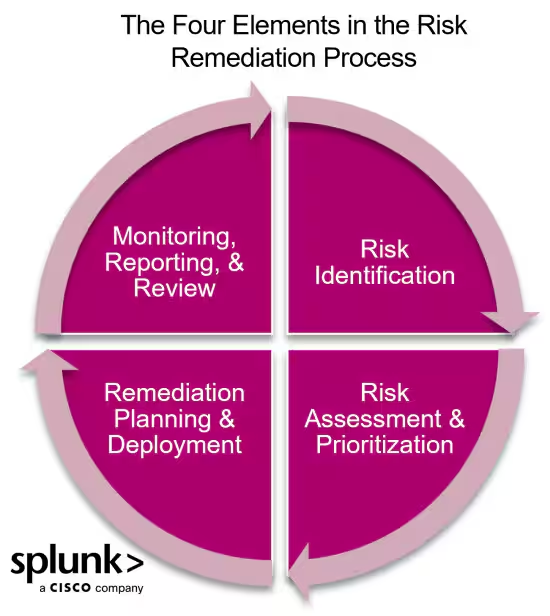
Risk identification
Identifying potential security vulnerabilities. Risk identification can employ a number of methods, including:
- Penetration testing
- Vulnerability management
- Threat modeling
- Vendor recommendations
- Root cause analysis (RCA)
- Brainstorming
- Other risk detection techniques
Risk assessment & prioritization
Potential vulnerabilities are assessed and prioritized based on possible organizational impacts and the likelihood that each risk will occur. Vulnerabilities are prioritized from the most critical to the least critical risks and the urgency with which they need to be addressed.
(Related reading: risk scoring and CVSS: common vulnerability scoring system.)
Remediation planning and deployment
A remediation plan identifies which risks will be addressed, how they will be remediated, timeframes, assignments, reporting, and other project items.
Higher priority vulnerabilities should be quickly addressed to increase cybersecurity. Lower-level vulnerabilities may be scheduled for later deployment or if the risk is small enough, may not be scheduled at all.
Remediation strategies for eliminating risk for individual security vulnerabilities include:
- System and software patching: Implementing security patches and updates to close vulnerabilities across the enterprise.
- Infrastructure settings and configurations: Enabling advanced hardware and software capabilities to protect systems against specific vulnerabilities.
- Security controls: Deploying additional security controls to protect existing systems, including physical and virtual firewalls, anti-malware software, network access controls, subnetting changes, and zero trust architectures.
- Awareness, training, and processes: Training users in best security practices and teaching them how to detect and avoid phishing schemes that exploit vulnerabilities.
Monitoring, reporting, and review
The final element of risk remediation is establishing a process to continually monitor, review, and report on the effectiveness of your risk remediation efforts.
Why? It can be difficult to gauge the effectiveness of a remediation change. For example: If a breach occurs, your change may have failed and needs to go through the risk remediation process again. If no breach occurs, it may mean that your remediation was effective, or it may mean that no one has tried to exploit the specific vulnerability that was remediated.
Risk remediation & risk mitigation: how to balance both
Risk remediation is challenging. While risks can appear at any time, it can take days, weeks, or months to develop and apply a strategy to address a new vulnerability. Worse, several critical but essential items can prevent you from quickly applying an effective remediation technique, including:
- Lack of resources for new hardware, software, or infrastructure
- Availability of qualified staff who can implement the remediation
- Other security or auditing requirements that must be applied immediately
- 24/7/365 processing that prevents risk remediation activities that must be applied during a downtime window
- Misidentification of either the security vulnerability or the fix needed to close a vulnerability
There are many scenarios where risk remediation must be uncomfortably delayed — which is why many risk remediation strategies must be paired with matching risk mitigation strategies.
The risk remediation strategy can prevent a risk from occurring, while the risk mitigation strategy defines what must be done when the system is breached, and the identified risk occurs. The two processes can balance each other out to strengthen your cybersecurity and to create a contingency plan when an attack occurs.
(Related reading: risk appetite vs. risk tolerance.)
An iterative process for development and maintenance
Risk remediation is an iterative process. It should be repeated on a regular basis. With AI, cyber-attackers are creating new attack techniques at an accelerated pace.
Thanks to application development processes like Agile and the chaotic pace of development, new and vulnerable code is also potentially being deployed on a regular basis. Both can cause new cybersecurity vulnerabilities to appear at any time. It benefits any organization to add risk remediation detection, assessment, planning, and monitoring techniques both to its system development process and to its regular hardware and software maintenance routines.
Related Articles

Incident Severity Levels 1-5 Explained

Cyber-Physical Systems (CPS) Explained