What Is Risk Assessment? Steps, Types, and Challenges
Due to complex, distributed networks, most businesses cannot operate as smoothly as they’d like. Complexity holds them back. To avoid this situation, you can ensure that no physical or cyber risks affect your employees and customers. How? Rely on risk assessments to identify and manage risks before they cause severe harm.
Risk assessment identifies what can go wrong and calculates the probability of those risks occurring. This makes it easier to address potential hazards before they become real issues.
In this article, I'll help you understand risk assessment, its key challenges, and some best practices for implementing better assessments.
Defining risk assessment
The idea behind risk assessment is to detect hazards and analyze the damage they can cause. This way, you can take measures to remove the elements causing risk and ensure the safety of people, assets, and the environment.
However, before assessing a risk, know the difference between risk and hazard. Here's what sets them apart:
- Hazard is a harm that occurs due to chemicals, machinery, or an unsafe work environment.
- Risk indicates the chance of someone getting harmed by these hazards.
Examples of risk assessments
Since every industry and organization faces different risks, you must perform risk assessment in a way that suits your environment. Here are a few examples:
- Cybersecurity risk assessment: In this field, risk assessment teams look for outdated software, weak passwords, phishing attacks, and other vulnerabilities to find loopholes in their security systems.
- Health and security risk assessment: Incidents in healthcare companies can risk staff security and patient health. In this situation, teams assess any exposed wires or unsafe machinery to find the root cause of the risks.
- Environmental risk assessment: Working in the manufacturing sector probably involves chemicals — so, it’s important to assess how they can harm the environment and the human body. For that, you can perform various toxicity tests. If the risk hits the maximum permissible level, aim to reduce it to the acceptable level.
How to conduct a risk assessment, step-by-step
No matter if you run a small business or a big organization, you must have a proper risk assessment process in place. (In some industries, this is mandatory.) Here are six key steps of risk assessment that organizations of every size must incorporate:
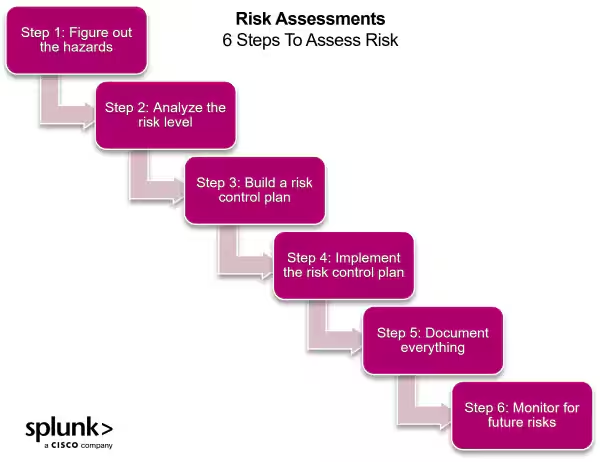
Step 1. Figure out the hazards
First, figure out what can go wrong by investigating all the activities in your organization. This will help you find the risk factors and their exposure to hazards. A couple of hazards include:
- Physical hazards
- Chemical hazards
- Biological hazards
- Psychological hazards
These hazards are caused by several factors, such as daily tasks, equipment usage, and processes operating within your organization.
Step 2. Analyze the risk level
After identifying the hazards, analyze who could be at risk — employees, contractors, or visitors. To understand this, divide people into groups, such as young workers, pregnant women, and workers with special needs.
Next, analyze the severity level of risk because the amount of harm you will experience depends on how severe risk is. This severity level is divided into three parts:
- Severe
- Major
- Minor
If the risk severity level is minor, you will experience a very minimal loss. But in case of major or severe risks, you need to take serious actions to reduce or mitigate them. It will also help you figure out if these risks will lead to physical damage or financial losses.
(Related reading: risk scoring & severity levels for incidents.)
Step 3. Build a risk control plan
Once you know the severity level, your goal is to minimize the risk of these hazards. There are two possible ways to do so: Either eradicate the hazard altogether or find an alternative way to control it. These concepts are formally known as risk remediation and risk mitigation, respectively.
Sometimes you may do both — for example, if a chemical is harmful, you should stop using it and also find a safe alternative.
Let’s consider risk in sensitive data. To eliminate the risks entirely, you can adopt the following control measures:
- Since your priority is to avoid the risk, you can store data on the cloud instead of a personal server.
- If you can't avoid a risk, like where you can store certain data, you should minimize the risk. For example, you can implement data encryption to handle data that poses risks. You can also outsource to a third party to share the stress burden.
(Related reading: risk appetite vs. risk tolerance & risk management frameworks.)
Step 4. Implement the risk control plan
Now that you have the risk control plan, it’s time to implement it. Make sure you have the right resources — necessary experts, tools, and finances — to implement the changes. If these things are unclear, you can meet with stakeholders and risk managers to discuss the plan and assign them roles for implementing it.
Step 5. Document everything
To ensure employees' safety, you're legally bound to record everything from the risks to preventive controls. So, when you’re preparing the risk assessment documentation, include the following:
- Vulnerable points where problems arose
- The hazards and their influence
- The people or departments who could be harmed
- The steps you have taken to eliminate or minimize the risk
- The outcome of your risk control plan
Step 6. Monitor for future risks
Your organization may continually introduce new equipment and staff, which will open doors to new risks. That’s why you must watch out for hazards and regularly review your risk assessment plan to be prepared for future casualties.
Types of risk assessment
Now that you know how to conduct a risk assessment, let's look at different types and ways to assess risk. This will help you choose the right type for your situation.
Generic risk assessment
This type of risk assessment allows you to examine everyday tasks across different locations or teams. In this, teams create and adjust a template to fit specific needs. In this template, you add common risks that your business often faces.
This way, when you work on a new site or project, there's no need to start from scratch — you can use the same template.
Quantitative risk assessment
A quantitative risk assessment relies on numbers and data to predict the chances and outcomes of accidents. It allows you to examine different scenarios and the severity of their impact. For example, the chemical industry can use it to predict the chances of fires and explosions.
Qualitative risk assessment
In contrast, a qualitative approach analyzes risks without using complex calculations and in minimal time with fewer resources. That’s a major reason why small businesses prefer qualitative risk assessment. In addition, it further helps them measure both — the likelihood of the risks including their severity levels and consequences.
Here's how they carry out this assessment:
- Identify the risk.
- Uses a scale of 1 to 5 to rate the impact.
- Rate how likely a risk is to happen.
This table explains the risk severity levels:
(Note: This article, and many others, use an ordinal approach indicating that 1 is the least serious situation. Five, the highest number, represents the highest loss. Other approaches reverse the severity numbers, with 1 indicating the most serious situations. As long as you're consistent within your organization, team, and systems, you'll be on the right track.)
Site-specific risk assessment
You can use it to assess the risk of specific locations or projects. For example, to assess cybersecurity risks, you must use a different approach every time because risks can vary in this field.
Similarly, the tools you'll use to protect email servers will differ from those used for cloud servers. So, you can take a generic template and make it site-specific according to your project needs.
(Related reading: vulnerability, threat & risk explained.)
Benefits of carrying out risk assessments
Risk assessment maximizes profit and saves your employees from physical and mental harm. Let's look at some more benefits that you can avail:
- Reduced vulnerabilities: In 2024, there were 52 thousand new IT security vulnerabilities. But with risk assessment, you can reduce these attacks on your network.
- Maximum productivity: Since there will be fewer hazards, the machinery failure rate will also be reduced, which will improve employees’ productivity. It will also help them feel safe at work and know you value their rights. (That reputation goes a long way.)
- Saves money in the long run: Undetected risks can result in costly mistakes like repairs and lawsuits. But if you spot them earlier, you can mitigate them on time and save money in the long run.
Challenges with risk assessment
Every organization wants to be risk-free and there's no better way to achieve this than performing risk assessments. However, it comes with two major challenges: compliance issues and poor data quality. Let's see how:
Compliance issues: Every state has laws and industry standards for risk assessment. And you've to follow them to gain your stakeholders' trust. But since the laws keep evolving, it’s quite difficult to keep up with them. You'll need advanced tools and skills with a good budget to manage them.
Requires quality data: In 2023, Improving data quality resulted in better customer experience, engagement, and lead generation. That’s why you should not do a risk assessment on inaccurate or duplicated data. But unfortunately, only 3% of businesses have quality data.
Best practices to mitigate the challenges
Yes, there are some challenges, but you can always mitigate them. Here are some of the best practices to abide by if you want to carry out a smooth risk assessment process:
- Stay up to date: Stay on top of changing regulations, by following news and newsletters of your geography, industry, and even local law firms. In addition, you should make it a habit to read blogs and join seminars for one-on-one conversations to learn how to deal with compliance issues.
- Clean your data regularly: Use tools for data entry because they will minimize the chances of duplicate data and reduce human errors. And when you maintain data quality consistently, uncertainties will also be reduced.
- Set clear objectives: Have a clear goal with risk assessment — decide if you want to check the extent of online data breaches or on-site injuries.
- Analyze past risks: Maintain a repository of past risks and success with action plans. This way, you can deal with common risks more effectively and make well-informed decisions.
- Implement error-proofing methods: Have proper methods in place to prevent future risks. For instance, if an issue comes up, the system will stop working. And in case of potential errors, you'll get a warning.
- Create a questionnaire for vendors: When you hire a third party for risk assessment, draft a questionnaire and ask questions like how the vendor ensures your data security and if they ever face data breaches with other clients. This will help you identify security gaps and choose the right vendor.
Risk assessment is more than identifying hazards
If you think risk assessment is about ticking off potential hazards during an audit, that's not the case. Identifying key hazards behind the risk is important — but that's only half the job. In addition, you have to devise a remediation plan to address those risks. It’s the only way to continue smoothly with your regular operations.
Related Articles

How to Use LLMs for Log File Analysis: Examples, Workflows, and Best Practices

Beyond Deepfakes: Why Digital Provenance is Critical Now

The Best IT/Tech Conferences & Events of 2026

The Best Artificial Intelligence Conferences & Events of 2026

The Best Blockchain & Crypto Conferences in 2026

Log Analytics: How To Turn Log Data into Actionable Insights

The Best Security Conferences & Events 2026

Top Ransomware Attack Types in 2026 and How to Defend