What Is Natural Language Processing? A Complete Guide to NLP
Learn Austin ChiaKey Takeaways
- NLP enables computers to understand and interact with human language, driving innovations like chatbots, translation tools, and smart assistants.
- Core techniques such as tokenization, sentiment analysis, and machine translation allow for efficient processing and analysis of large amounts of text data.
- Ongoing challenges for NLP include handling language ambiguity, reducing data bias, and improving support for low-resource languages.
Natural language processing (NLP) is gaining traction in the field of artificial intelligence and machine learning, as it allows computers to understand, interpret, and manipulate human language. With the increasing use of smart devices and virtual assistants, NLP has become even more relevant in our daily lives.
In this blog, we'll dive into the fundamentals of NLP, its history, key techniques, industry-changing applications, and present-day challenges.
What is natural language processing?
NLP is a subfield of artificial intelligence that deals with the interaction between computers and human language. It involves teaching machines to understand, analyze, and generate natural language to perform various tasks.
NLP is a branch of artificial intelligence (AI) focused on enabling computers to understand, interpret, and respond to human language in a valuable way.
At its core, NLP answers a fundamental question: How can computers make sense of natural (human) language data?
Three types of natural language processing
There are three main types of NLP models:
- Symbolic NLP: The norm from the early 1950s through the 1980s, symbolic NLP represented early NLP systems that were hand-coded with a limited number of words programmed into the dictionary. The computer was given a defined set of rules, and its responses were based on those rules.
- Statistical NLP: Launched in the 1990s, statistical NLP introduced NLP algorithms from machine learning. With ML, NLP-based systems were able to use unstructured data—beyond their predefined dictionaries—and analyze and process it in real time, enabling significant advancement in NLP capabilities and applications.
- Neural NLP: In the 2010s, deep neural network-style ML principles began to be applied to NLP. Powered by ML, neural networks are designed to mimic the way the human brain stores and uses information. While neural networks must be trained using ML algorithms, they could learn on their own, once they are trained.
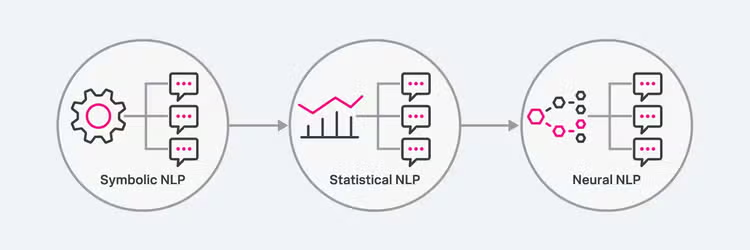
The three main types of NLP models include symbolic NLP, statistical NLP and neural NLP.
Common applications of NLP
NLP has the potential to transform the way we interact with technology, opening a world of possibilities for more intuitive and efficient communication between humans and machines. For example, some common applications of NLP include:
- Text translation: Machines can translate text from one language to another using NLP techniques.
- Sentiment analysis: NLP allows machines to analyze the sentiment or emotion behind a piece of text for market research or customer feedback purposes.
- Speech recognition: With advancements in speech-to-text technology, NLP plays a crucial role in enabling machines to accurately transcribe spoken language.
- Chatbots: NLP is used extensively in developing chatbots that can communicate with users in a natural and human-like manner.
- Topic modeling: NLP techniques such as Latent Dirichlet Allocation (LDA) can automatically identify topics within large collections of text, making it easier for humans to understand and explore the data.
- Named Entity Recognition (NER): This NLP task involves identifying and classifying named entities such as names, places, organizations, etc., from unstructured text.
Key concepts and techniques in NLP
To truly appreciate NLP's impact, it helps to understand its core concepts and methods. Here are some key concepts of NLP.
Tokenization
Tokenization is the process of breaking text into smaller units, like words or sentences. It's the first step in most NLP tasks and forms the basis for further analysis. Tokenization can be as simple as splitting text by spaces or more complex using regular expressions, machine learning models or rule-based systems.
For example, “The cat sat on the mat” becomes six tokens. It’s a basic, but critical, first step for most NLP tasks.
Part-of-speech tagging
Part-of-speech (POS) tagging is the process of assigning a specific part of speech to each word in a sentence, such as noun, verb, adjective, etc. This can help us understand the grammatical structure of a sentence and can be used for tasks like identifying subject-verb agreement errors or extracting keywords from text.
POS tagging is usually done using statistical models or rule-based systems.
For example, in the sentence “The cat sat on the mat”, we can assign the following parts of speech to each word:
- The: determiner
- cat: noun
- sat: verb
- on: preposition
- the: determiner
- mat: noun
POS tagging can also be used for more complex sentences and languages, such as identifying verb tense or detecting different forms of a word (e.g. singular vs plural). It's an important step in many NLP tasks and has applications in fields like machine translation, sentiment analysis, and information extraction.
Named entity recognition
Named entity recognition (NER) is the process of detecting and classifying named entities in text, such as people, places, organizations or dates. It's an important task for information extraction and can be used for tasks like entity disambiguation or question answering systems.
NER identifies and classifies entities such as person names, dates, or locations within text. For instance, in “Apple launched the iPhone in California on January 9, 2007,” NER highlights “Apple” (organization), “California” (location), and “January 9, 2007” (date).
Sentiment analysis
Sentiment analysis is a technique used to identify and extract opinions or emotions from text data. It involves analyzing natural language to determine the overall sentiment or attitude expressed by the writer towards a particular topic, product, or service.
There are various methods for performing sentiment analysis, such as using rule-based systems, machine learning algorithms, and deep learning techniques. These methods use different approaches to analyze text data and classify it into positive, negative, or neutral sentiments.
Sentiment analysis determines whether a text expresses positive, negative, or neutral emotions. Companies use this technique to gauge customer feedback quickly.
For example, a company may use sentiment analysis to analyze customer reviews of their product and identify areas for improvement. This can help them make strategic decisions on how to improve their product and ultimately increase customer satisfaction.
Machine translation
Machine translation is the process of automatically translating text from one language to another using computer algorithms. The goal of machine translation is to produce translations that are as accurate and natural-sounding as possible.
There are several methods for machine translation, including:
- Rule-based machine translation works by using a set of linguistic rules and a dictionary lookup to translate a sentence.
- Statistical machine translation uses large amounts of data to generate translations based on patterns and probabilities.
- Neural machine translation uses artificial neural networks to learn how to translate sentences.
While these methods have improved over the years, they still face challenges with accurately capturing nuances in language, such as idiomatic expressions or cultural references.
(Related reading: machine data & machine customers.)
Text summarization
Text summarization is the process of condensing a text into a shorter, more concise version while still retaining its key information and meaning. It allows us to quickly understand large amounts of text without having to read through every single word.
Text summarization uses abstractive methods that use natural language processing and machine learning to generate a summary that is more similar to human-written text. This approach allows for more concise, coherent summaries but can be more challenging to develop.
As a result, NLP models can scan lengthy documents and produce concise summaries, saving users time and effort in information gathering.
Language modeling
Language modeling is a fundamental task in NLP that involves predicting the next word or words in a sequence of text. This technique is used extensively in various NLP tasks, such as text generation and machine translation.
The most commonly used models for language modeling include recurrent neural networks (RNNs) and transformers. RNNs process sequences of text one word at a time, remembering previously seen words to inform future predictions. On the other hand, transformers use an attention mechanism to process all words in the sequence simultaneously, capturing long-range dependencies more effectively.
Language modeling predicts the probability of a word or sequence of words following a given text. Powerful language models (like ChatGPT 4o) can generate paragraphs, answer questions, or even write poetry using this technique.
(Related reading: small vs. large language models.)
Benefits of NLP
NLP brings a range of benefits:
- Efficiency: Quickly processes and summarizes large amounts of text, enabling rapid information retrieval and web search optimization.
- Accessibility: Powers assistive technologies like speech-to-text and text-to-speech, aiding people with disabilities.
- Removing language barriers: Automated translation supports communication across languages for travel, business, and more.
- Hands-free usability: Enables drivers and users to interact with devices without manual input.
Challenges in NLP
Despite dramatic progress in recent years, NLP remains a difficult field with some persistent challenges. Here are some areas for organizations to consider when implementing NLP.
Ambiguity and context
Human language has some level of ambiguity. For example, sarcasm, idioms, cultural references, and double meanings can be tough for machines, even with advanced models. NLP systems also struggle to understand the context of a conversation or text, which can lead to incorrect interpretations.
Ambiguity in NLP can take several forms:
- Lexical ambiguity: Multiple meanings for the same word. (Ex: “Jane is looking for a match.”)
- Syntactic ambiguity: A word or phrase could mean more than one thing in a sentence. (Ex: I saw a child with a telescope.”)
- Referential ambiguity: A pronoun could refer to more than one person. (Ex: “Maria spoke to Louise. She said, ‘I am hungry.’”)
To address this challenge, organizations must provide large and diverse datasets for training NLP models and ensure that these models are constantly updated with new data.
Bias in language models
AI can inadvertently pick up biases from the data it's trained on, leading to unfair or inappropriate outputs. Ensuring fairness, accountability, and ethical standards is an ongoing concern.
To combat such biases, researchers have proposed techniques such as data augmentation, debiasing algorithms, and creating diverse datasets for training. These methods can help reduce bias and improve the accuracy of NLP models.
Multilingual and low-resource languages
Many modern NLP breakthroughs focus on high-resource languages like English, Chinese, or Spanish. However, there are thousands of languages spoken around the world that do not have the same level of resources and data available.
Multilingual NLP aims to develop techniques that can be applied to multiple languages, including low-resource ones. This area of research is important because it allows for cross-lingual communication and access to information for individuals who may not speak a high-resource language.
Machine learning algorithms used in NLP
In natural language processing (NLP), machine learning algorithms are used to process and analyze large quantities of natural language data to extract useful information or make predictions. These algorithms allow computers to understand, interpret, and generate human language.
Some common machine learning algorithms used in NLP include:
- Support Vector Machines: SVMs are commonly used in text classification tasks, such as sentiment analysis, where they can identify patterns and classify text into different categories.
- Bayesian Networks: These models are used to infer relationships between different words in a text, which can then be used to make predictions about the meaning of the text.
- Recurrent Neural Networks (RNNs): RNNs are useful for tasks such as language translation, where they can process sequential data and learn patterns from large amounts of text.
- Convolutional Neural Networks (CNNs): CNNs are often used in NLP for tasks such as sentence classification or named entity recognition, where they can identify key features in a text and make accurate predictions.
Applications of NLP in various industries
NLP’s impact is felt in almost every sector. Here are some potential applications for NLP across industries:
Healthcare
- Automated patient record analysis: NLP processes doctors’ notes and medical histories to highlight important trends and flag potential issues.
- Clinical decision support: Chatbots and AI assistants guide patients through symptom checks and appointment bookings.
- Medical research: NLP scans research papers for trends and emerging findings much faster than humans can.
Finance
- Sentiment-driven trading: Algorithms analyze financial news, earnings calls, and social media chatter to inform investment strategies.
- Fraud detection: NLP identifies suspicious patterns in customer communications and transactions.
Legal
- Contract review: AI tools automate the reading and annotation of legal documents, calling out critical clauses or risks.
E-commerce
- Chatbots and virtual assistants: Customer service bots answer queries, process orders, and offer personalized recommendations 24/7.
- Review analysis: NLP distills insights and pain points from thousands of customer reviews, aiding product development.
Media and communications
- Content moderation: NLP screens user-generated content for inappropriate or harmful language.
- Automated journalism: AI-generated summaries allow news outlets to cover more stories in less time.
Education
- Personalized learning: NLP enables adaptive learning platforms to assess student writing and deliver feedback instantaneously.
- Language learning tools: Apps employ NLP to correct grammar, suggest vocabulary, and track learner progress.
Who uses NLP?
NLP is used by a wide range of professionals and consumers:
- Healthcare professionals use NLP to create and review patients notes rapidly and accurately.
- Computer security experts use NLP to analyze email messages for indicators of spam or phishing.
- Business professionals utilize NLP tools for grammar checking and speech-to-text dictation.
- Customer service teams employ NLP in telephone trees, chatbots, and sentiment analysis to improve response times and customer satisfaction.
- Social media specialists use NLP for automated sentiment analysis to prioritize engagement.
- Everyday consumers interact with NLP through hands-free applications, grammar checkers, and smart home assistants.
NLP is used by everyone from consumers and business professionals to social media, healthcare security experts.
Final thoughts
Natural language processing is rapidly evolving, with breakthroughs that influence how we work, learn, shop, and connect. Its impact goes beyond convenience, as NLP improves access to information, enables inclusivity, and drives smarter decision-making across disciplines. Challenges remain, but innovation in areas like deep learning and ethical AI continues to move the field forward.
FAQs about NLP (Natural Language Processing)
Related Articles

Data Protection: Best Ways To Protect Your Data Today

Logs vs Metrics: Pros, Cons & When to Use Which