Inside Kubernetes: A Practical Guide to K8s Architecture and Operational Challenges
Learn Muhammad RazaKey Takeaways
- Kubernetes architecture is modular with distinct components such as the Control Plane and Data Plane, allowing scalable orchestration of containerized workloads.
- Operational complexity arises from ephemeral workloads, multi-layered abstractions, and hybrid infrastructure setups that challenge visibility and control.
- Monitoring and observability are critical to maintaining stability, with platforms like Splunk Observability Cloud offering real-time insights and anomaly detection.
Kubernetes (K8s) is an open-source platform that automates the deployment, scaling, and operation of application containers; this is known as container orchestration. Kubernetes groups containers into logical units known as Pods, which run on Nodes with a Cluster.
These clusters are the foundational building blocks of K8s architecture. Each Cluster is composed of Nodes, which can be either virtual machines or physical servers. These Nodes are responsible for running containerized workloads: self-contained software units that package code and all necessary dependencies to operate in any environment.
Another key component of Kubernetes architecture is the Control Plane. This centralized management layer handles orchestration tasks such as scheduling, maintaining cluster state, and deploying applications.
This article will explain the fundamental components of Kubernetes architecture and then delve into the operational challenges it presents, along with strategies to monitor and mitigate them effectively.
New to Kubernetes?
Check out this tutorial for setting up vanilla k8s or explore the Kubernetes certificates worth earning
Key concepts in Kubernetes architecture
Kubernetes relies on a set of standardized components that enable scalable and resilient container orchestration.
Nodes and pods
Nodes serve as the worker machines in a Kubernetes cluster, providing the compute resources necessary to run Pods. Pods are the smallest deployable units in Kubernetes, encapsulating one or more tightly coupled containers. These containers share resources like storage, network namespaces, and execution context, isolating them from the underlying node infrastructure.
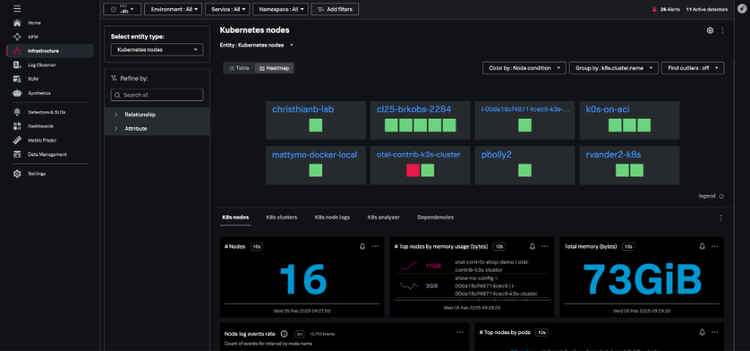
The Kubernetes nodes navigator in Splunk Infrastructure Monitoring provides information about the number of nodes, pods, node events, and aggregated system metrics (CPU, disk, memory, network) across all nodes.
Deployments and services
Deployments manage the lifecycle of applications within the cluster, including instructions for scaling, updating, and rolling back application versions. A Deployment object encapsulates ReplicaSets, which ensure a defined number of Pod replicas are always running.
Services provide stable network endpoints that abstract access to a dynamic set of Pods. Because Kubernetes is inherently distributed, Services play a critical role in load balancing traffic across Pods and ensuring consistent connectivity.
Jobs
Jobs in Kubernetes are used to run tasks to completion. These are especially useful for batch processing and one-off operations. Once the job completes, the associated Pods are terminated.
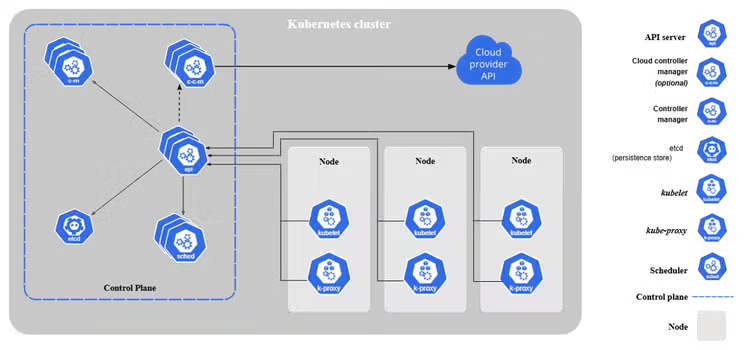
(Source:Kubernetes Docs)
Components of the worker node (Data plane)
The worker node is where actual workloads run and includes several core components:
- Kubelet is the node agent that communicates with the Control Plane. It ensures that the containers described in the PodSpec are running and healthy, and it reports node and Pod status back to the API server.
- Kube-Proxy manages networking rules on each node. It routes traffic to appropriate Pods based on Service definitions, maintaining seamless network communication throughout the cluster.
- Container runtime is the engine that pulls container images, starts containers, and manages their lifecycle. Kubernetes supports multiple runtimes via the Container Runtime Interface (CRI). This design allows flexibility and pluggability in integrating different networking and storage interfaces like CNI and CSI.
Control plane: the management layer
The Control Plane governs the state and behavior of the entire Kubernetes cluster. It consists of several interrelated components:
- API server is the primary entry point for all Kubernetes commands. It processes and validates REST requests, acts as the communication hub, and persists configuration data to the etcd datastore.
- Controller manager runs a set of background controllers that continuously reconcile the current state of the cluster with the desired state. These include node controllers, replication controllers, and endpoint controllers, among others.
- Scheduler is responsible for assigning Pods to Nodes based on resource availability, affinity and anti-affinity rules, taints, and tolerations. It ensures workload distribution aligns with policy and capacity.
- etcd is a highly available key-value store that acts as the single source of truth for the entire cluster. It stores all API objects, including configurations, secrets, and state information.
Challenges in operating Kubernetes
Despite its power and flexibility, Kubernetes introduces significant complexity. Several operational challenges emerge due to its distributed nature and layered abstractions.
Dynamic and ephemeral workloads
The ephemeral and dynamic behavior of key components (such as Pods and workloads) complicates stability and visibility. Resources are frequently created, terminated, or rescheduled, making it difficult to track state in real time.
Multi-layered abstractions
Kubernetes architecture operates across multiple abstraction layers: from Deployments and ReplicaSets down to Pods and individual Containers. Each abstraction layer decouples responsibilities, which, while beneficial for scalability and resilience, introduces complexity in:
- Configuration
- Debugging
Manual configuration requirements
While Kubernetes automates many tasks, it also requires manual configuration of policies such as:
- Affinity rules
- Resource limits
- IAM policies
These settings must be fine-tuned to prevent misconfigurations and ensure workload reliability.
Visibility across hybrid environments
Kubernetes typically runs across hybrid or multi-cloud environments, increasing the difficulty of ensuring end-to-end visibility. Lack of transparency into the performance and health of workloads across environments hinders effective troubleshooting.
Go deeper into these topics with these full guides:
Monitoring and observability in Kubernetes
Addressing these operational challenges requires robust observability. Your monitoring and observability tools, ideally in a unified platform, should give you control of all Kubernetes environments and provide real-time insights into the health and performance of Kubernetes components across all layers.
Effective monitoring solutions for K8s should:
- Continuously track Pod, Node, and Deployment status
- Provide granular visibility into resource consumption
- Correlate logs, metrics, and traces from different system components
- Support speedy detection and automated alerting
Advanced observability platforms often incorporate AI/ML capabilities to identify anomalies, forecast trends, and recommend optimizations. These platforms must also ingest standardized, structured data in real-time for timely analysis.
For example, Splunk Observability Cloud provides comprehensive monitoring for Kubernetes environments. It enables deep visibility into cluster health, workload performance, and resource utilization, facilitating proactive issue resolution and performance tuning.
(Tutorial: See how to monitor Kubernetes using Splunk.)
Robust flexibility, operational complexity
Kubernetes offers a robust and flexible architecture for managing containerized workloads, but its operational complexity should not be underestimated. A strong understanding of its core components (Clusters, Nodes, Pods, and the Control Plane) is essential for any team deploying applications at scale.
With proper observability tooling and operational practices, organizations can navigate the challenges of Kubernetes deployments and maintain stable, scalable, and high-performing infrastructure.
FAQs about Kubernetes Architecture & Core Components
Related Articles

Splunk Product Reviews & Ratings - Enterprise, Cloud & ES

Cloud Cryptomining: How It Works & How To Minimize Risk